
YouTube Demonetized Your AI Channel for 'Shock Value'? The Notice Is Citing a Narrative Rule, Not an AI Rule
- A YPP notice that says "shock value" or "no creative or narrative structure" is quoting the Unsatisfying or Off-putting Content section of YouTube's channel monetization policies. That section explici
- Reused content, inauthentic (generic or repetitive) content, unsatisfying or off-putting content, and the advertiser-friendly "shocking content" rule are four different decisions. The first three judg
- Reviewers do not watch everything. YouTube says they may focus on the main theme, most viewed videos, newest videos, biggest share of watch time, metadata and the About section, so whatever you post r
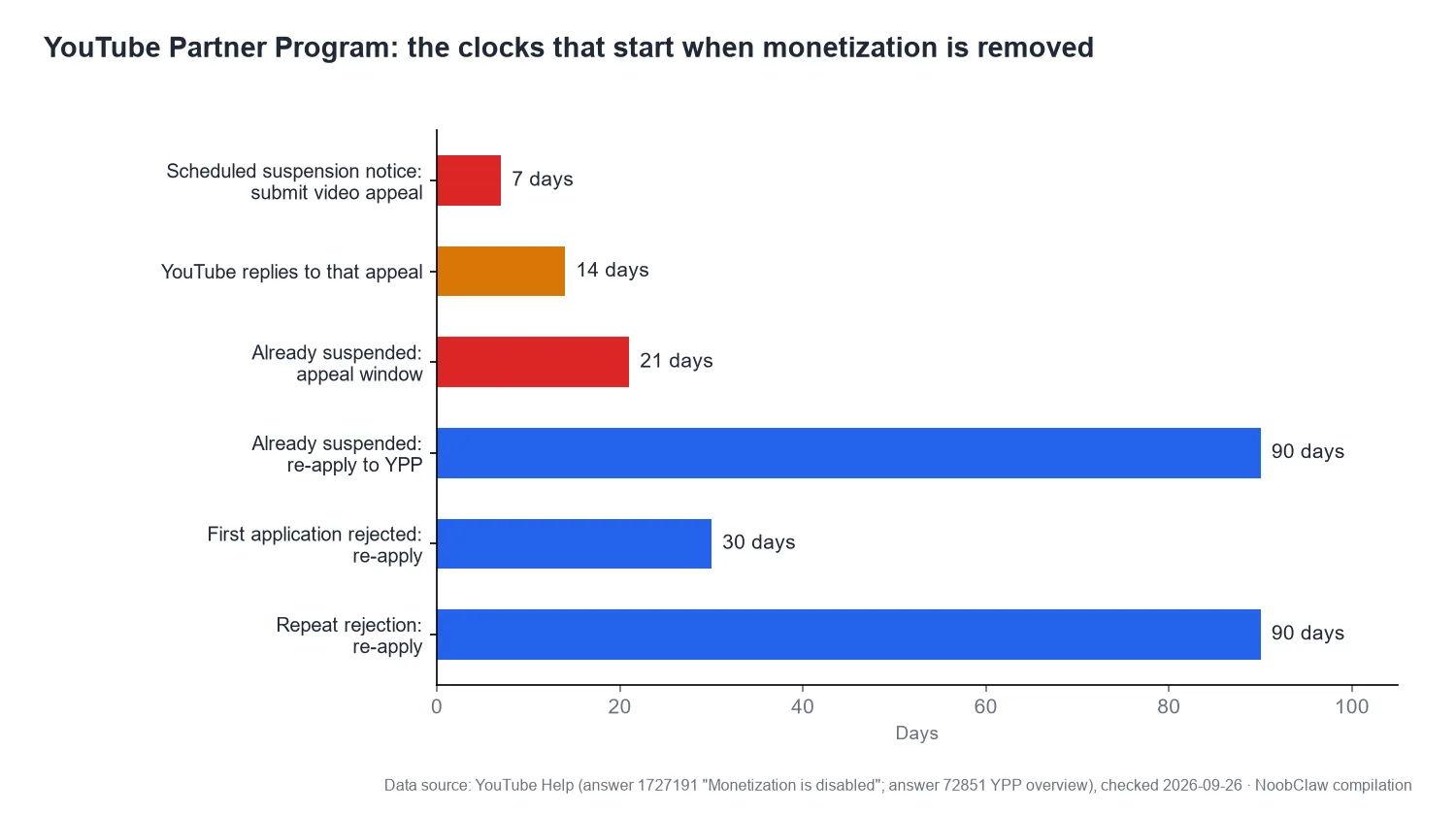
- After a suspension you have 21 days to appeal or can re-apply after 90. A series is explicitly monetizable when each episode has a distinct storyline; the appeal has to make that arc visible to someon
On September 24, 2026, a creator on r/aitubers described a channel that was monetized and demonetized within a week. The channel was an original series made with generative AI: "Recurring characters, story arcs that span multiple episodes." Four months, about six episodes of 8 to 15 minutes, one breakout at roughly 35,000 views, an application, an approval. Then a new episode with political parody characters, and two days later a notice saying the channel was "posting stuff for shock value, grotesque videos with no creative or narrative structure." The appeal video was rejected.
The obvious reading is "YouTube is removing AI channels." The notice does not say that. Its wording maps almost line by line onto one section of YouTube's rules, the only section of the monetization policies that names AI as something you are allowed to do.
Which YouTube policy does a "shock value" notice come from?
YouTube's channel monetization policies have a section called Unsatisfying or Off-putting Content. It describes content that "relies heavily on emotionally manipulative formulas, mimics existing formats or stories to a degree that the videos feel interchangeable, or appears designed to shock or surprise viewers for the sole purpose of getting views."
Its list of what is not allowed to monetize includes:
- "Content that repeatedly uses disturbing themes (such as violence or loss) without building a cohesive narrative"
- "Content that lacks a clear narrative arc or logical progression, such as videos that stitch together unrelated or inconsistent AI clips to surprise or shock viewers"
And its list of what is allowed:
- "Content with a cohesive storyline that doesn't rely solely on shock value to generate views"
- "Content that expresses your unique creative voice, like using AI to visualize a unique character and narrative you invented"
"Shock value" and "no narrative structure" are the section's own terms, and the creator's defence, recurring characters and multi-episode arcs, is its own example of what passes. The dispute is not about whether AI was used. It is about whether a reviewer, looking at a sample of the channel, saw a cohesive story or a string of provocations.
The same section that can remove an AI series from YPP is the one that says AI characters and invented narratives are monetizable. The test is the story, not the tool.
Two caveats from the post itself. We only have the creator's side. And the episode that preceded the notice contained parody characters based on real politicians, which is the kind of content a reviewer might read as provocation first and story second. The creator says they used no real names and that it "Wasn't like a deepfake or anything." If those characters are nonetheless realistic depictions of identifiable people, YouTube's separate altered or synthetic content disclosure rule also applies: creators must disclose content that "Makes a real person appear to say or do something they didn't do."
Reused, inauthentic, off-putting, shocking: four labels, four decisions
The same week, another creator asked whether using characters like Star Trek or Batman counts as "reused content". Four different rules can end up described as "demonetized", and they are decided at different levels.
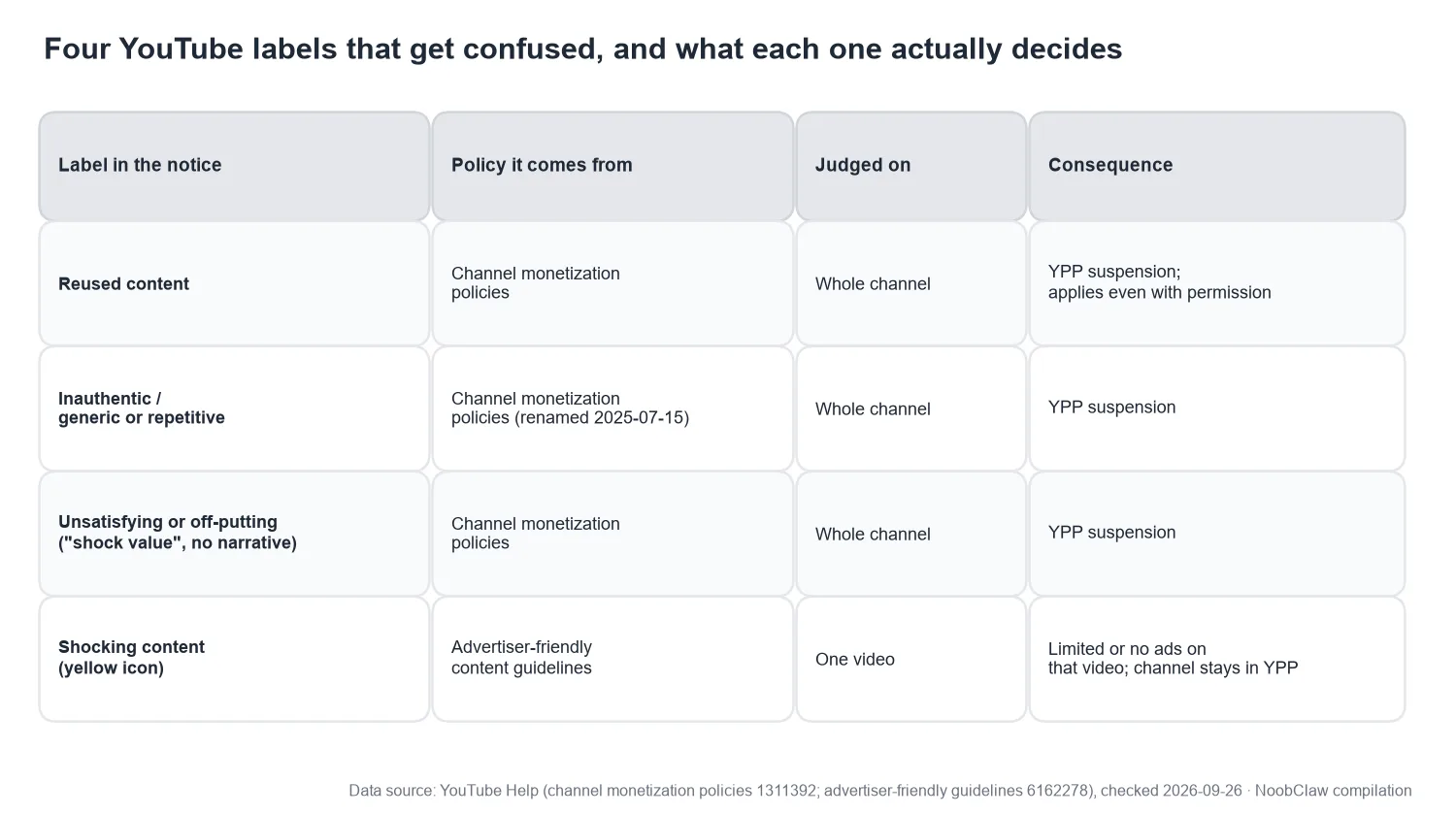
Reused content is about material that already exists: channels "that repurpose content that's already on YouTube or another online source without adding significant original commentary, substantive modifications, or educational or entertainment value." It is separate from copyright. The policy says it "applies even if you have permission from the original creator" and is "not based on copyright, permission, or fair use." Our reading: a Batman character drawn by your own AI pipeline is a copyright question, not a reused-content question; a clip of a Batman film with a voiceover could be both.
Inauthentic content is the name YouTube gave on July 15, 2025 to what used to be called repetitious content, clarifying that it "includes content that is repetitive or mass-produced." On the current page that idea sits mainly under the heading Generic or Repetitive Content, which covers channels whose videos "feel interchangeable from video to video." We broke down the full category list in YouTube's three kinds of video it will not monetize; the point for a series is one line in the allowed list: "Similar content, like a series following a set of characters across episodes... but in which each video has a distinct storyline, focus, or concept."
Unsatisfying or off-putting content is the section quoted above: a separate heading on the same page, with the same consequence, and the place where "shock value" and "narrative arc" come from.
Shocking content is a different rulebook. The advertiser-friendly content guidelines say "Content that may upset, disgust, or shock viewers may not be suitable for advertising," and describe outcomes of limited or no ad earnings on an individual video. That is the limited-ads (yellow) icon on a single video; the guideline itself describes video-level ad outcomes, not removal from YPP.
The practical test: if the notice arrived by email and says your channel is no longer eligible for the YouTube Partner Program, you are dealing with one of the first three. If a single video shows limited ads in Studio, it is the fourth, and you appeal that video.
Why a channel can be approved and removed within a week
Approval is not a one-time certificate. The policy page says "Our reviewers regularly check to see whether monetizing channels follow these policies," and explains how: "Since they can't check every video, our reviewers may focus on your channel's: Main theme, Most viewed videos, Newest videos, Biggest proportion of watch time, Video metadata (including titles, thumbnails, and descriptions), Channel's 'About' section."
Apply that list to the r/aitubers channel. The most viewed video was the breakout episode; the newest was the political parody. With six long episodes, the newest video is a large part of any sample. Our reading, which is a judgement and not something YouTube has confirmed for this case: what you publish in the first days after approval is disproportionately likely to be what the next reviewer sees.
The form itself is not the problem. The same week, YouTube launched Shorts series; its help page on shows defines a show as "a collection of high-quality episodes with a clear connection across episodes," and the announcement said microdramas drew more than 6.5 billion views in the first half of 2026. We covered the setup in how YouTube Shorts series work. YouTube is promoting serial storytelling and, under the same policies page, removing channels whose episodes do not read as a story. Both follow from the same idea: a series earns when the connection between episodes is visible.
What to do in the 21 days after a YPP suspension
YouTube's help page on disabled monetization sets the clocks. If you already lost YPP: "You can appeal this decision within 21 days or re-apply to the program 90 days after suspension." If you received a notice that suspension is scheduled, you have 7 days to submit a video appeal, YouTube says it responds within 14 days, and if that appeal is rejected "You cannot appeal your suspension, but you can re-apply to YPP 90 days after your suspension date."
The reviewer will again see only part of your channel, so make the narrative easy to find before you record the appeal:
- Put the episodes in order where a reviewer looks. Number the titles, describe the series and its characters in the About section, and group the episodes into a playlist or a show set to serial. Titles and the About section are both on YouTube's list of review surfaces; a playlist or show is not on the list, but it makes the order obvious to anyone who opens the channel.
- Show the arc in the appeal itself. Walk through how episode one leads to episode six: which characters recur, what changes, what is set up and paid off. That is the "cohesive narrative" the policy asks for.
- Deal honestly with the episode that triggered it. If one video leans on provocation more than story, re-edit it, make it private, or explain its place in the arc. YouTube's page advises reviewing videos against the channel monetization policies, the advertiser-friendly guidelines and the Community Guidelines, then editing or deleting "any videos that violate our policies."
- If the appeal fails, use the 90 days. Keep publishing episodes that each carry a distinct storyline, since that is the line the policy protects. Do not move the series to a new or existing channel during the suspension; YouTube says that "could lead to termination of all channels."
For a rejected application, the YPP overview allows a 21-day appeal or re-application after 30 days (90 after a repeat rejection).
A note for teams producing at volume, including our own users. NoobClaw's video engines such as translation reposting and local remixing work close to the reused-content line, and no tool can make a video monetizable on its own. Translating and re-voicing someone else's video is not, by itself, the "significant original commentary" the reused-content policy asks for, even with the original creator's permission. What software can do is keep each channel's inputs different and leave room for the part YouTube actually checks: a script, a commentary or a story arc that a person decided on. More on AI pipelines: AI video monetization on YouTube; on the 2027 entry thresholds: YPP requirements 2027.
FAQ
Does YouTube demonetize AI channels?
Not for using AI as such. When we read the policy page on September 26, AI appeared on both sides of the line: as allowed ("using AI to visualize a unique character and narrative you invented", "using AI to edit your video scripts"), and as not allowed when it produces generic templates that give "the impression of mass production", stitches "unrelated or inconsistent AI clips" together to shock, or plays a human expert giving health, legal, financial or political advice. Channels lose YPP when the content reads as templated, reused, or built for shock without a story.
What is the difference between reused content and inauthentic content?
Reused content is about repurposing material that already exists online without significant original commentary or modification, and it applies even with the owner's permission. Inauthentic content, renamed from repetitious content on July 15, 2025, covers repetitive or mass-produced content; on the current page it appears as the Generic or Repetitive Content section, next to a separate Unsatisfying or Off-putting section. All of them are judged at the channel level.
Can I appeal a YPP suspension for shock value?
Yes. If your channel was already suspended, YouTube's help page gives 21 days to appeal or lets you re-apply after 90 days. If you received a scheduled-suspension notice, submit the video appeal within 7 days. Use the appeal to show the series' narrative: episode order, recurring characters, and how each episode advances the story.
Sources
- YouTube channel monetization policies — YouTube Help — accessed 2026-09-26 — https://support.google.com/youtube/answer/1311392?hl=en
- Advertiser-friendly content guidelines — YouTube Help — accessed 2026-09-26 — https://support.google.com/youtube/answer/6162278?hl=en
- Monetization is disabled for my channel — YouTube Help — accessed 2026-09-26 — https://support.google.com/youtube/answer/1727191?hl=en
- YouTube Partner Program overview and eligibility — YouTube Help — accessed 2026-09-26 — https://support.google.com/youtube/answer/72851?hl=en
- Create shows from your videos — YouTube Help — accessed 2026-09-26 — https://support.google.com/youtube/answer/16590581?hl=en
- Disclosing use of altered or synthetic content — YouTube Help — accessed 2026-09-26 — https://support.google.com/youtube/answer/14328491
- Made on YouTube: Shorts series and TV features — YouTube Official Blog — 2026-09-23 — https://blog.youtube/news-and-events/made-on-youtube-creators-shorts-series-tv-features/
- Monetized then Demonetized within a week (user post) — r/aitubers — 2026-09-24 — https://www.reddit.com/r/aitubers/comments/1wox5ez/monetized_then_demonetized_within_a_week/
- Is using IP considered 'reused content' in AI vids? (user post) — r/aitubers — 2026-09-23 — https://www.reddit.com/r/aitubers/comments/1wodens/is_using_ip_considered_reused_content_in_ai_vids/