
The Best Tool for Managing 20 Social Accounts in 2026 (Most Pricing Models Punish You)
- At 20 accounts, per-channel billing (Buffer) and per-seat billing (Hootsuite) both work against you — you are one person paying for a dimension you do not have.
- Blotato connects 20 accounts from $29/month, the most account-friendly pricing in the scheduler category, but remains dependent on platform APIs.
- The bigger 2026 problem is not price: publishing one identical post to 20 accounts is exactly the pattern platforms now classify as homogeneous batch content.
- What 20 accounts actually needs: environment isolation, independent per-account content generation, and randomised pacing — not a bigger scheduling calendar.
At three accounts, every tool works and price barely matters. At twenty, two things happen at once: the bill stops being rounding-error money, and the workflow that got you here starts actively hurting you.
Most "best tool" roundups only handle the first problem. The second one is the one that ends accounts.
How the major pricing models scale to 20
| Tool | Model | At 20 accounts |
|---|---|---|
| Buffer Essentials | $5 per channel/mo (annual) | Volume rates kick in above 10 channels, but cost still scales with every account you add |
| Buffer Team | $10 per channel/mo | Same shape, doubled |
| Hootsuite Standard | $99 per user/mo | Capped at 10 accounts — you cannot even fit 20 |
| Hootsuite Professional | $199 per user/mo | Unlimited accounts, but you pay a team price as one person |
| Blotato Starter | $29/mo | 20 accounts included — the friendliest in this category |
The pattern is clear: every one of these bills on an axis that is not "accounts operated by one person." Buffer bills per channel, so your cost is linear in the thing you are trying to scale. Hootsuite bills per seat, so a solo operator pays team pricing or hits a cap.
Blotato is the exception on price — $29/month for 20 connected accounts, unlimited AI writing, plus API access and native n8n and Make nodes. If your problem is purely "publish to 20 places affordably," it is the most direct answer in the scheduling category.
Pricing tells you who a product was designed for. Per-seat means teams. Per-channel means brands with a few channels. Neither was built for one person running twenty accounts.
The problem price does not solve
Here is what the roundups skip.
The core promise of the scheduling category is "write once, publish everywhere." At 20 accounts, that promise has quietly become a liability, because in 2026 platforms explicitly classify repeated homogeneous content across accounts as a violation pattern — tied to account classification problems, weight loss, and in the harshest tier, batch-farming bans.
So the feature you are paying for is generating the evidence against you. Twenty accounts publishing one identical post is not efficient distribution; it is a fingerprint that does not need a fingerprint.
More on this in why separate IPs are not enough.
What 20 accounts actually requires
Three things, none of which are calendar features:
1. Environment isolation
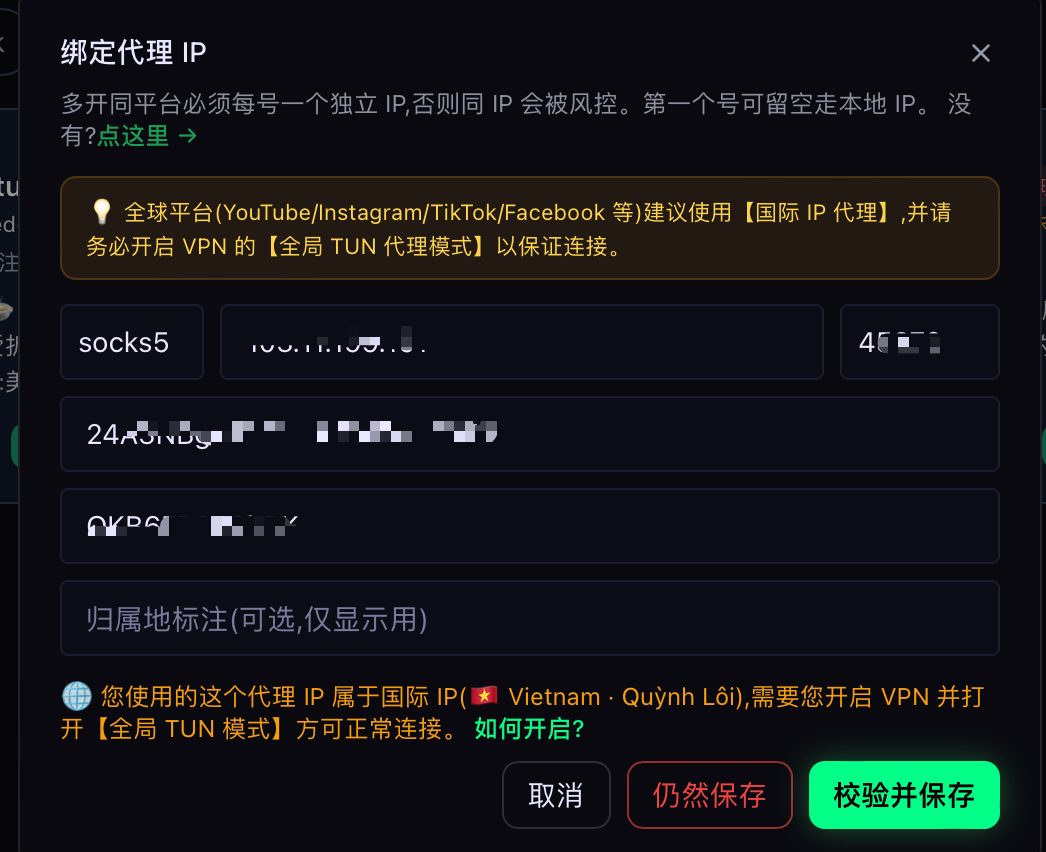
Accounts judged to operate in the same device or network environment risk batch suppression. That means per-account browser profiles with fixed (non-drifting) fingerprints and long-term bound IPs. Background: what is an antidetect browser.
Worth noting: API-based tools cannot give you this. When posting flows through official platform APIs, you inherit whatever that integration exposes — which is fine for brand accounts and structurally limited for matrix operation. It is also why API-based tools generally cannot reach platforms without open publishing APIs at all.
2. Independent content generation per account
Not one post distributed twenty times. Twenty accounts each generating against their own niche, persona and keywords, so the outputs differ structurally rather than by find-and-replace.
3. Human-like pacing
Quantities as ranges, intervals as ranges, scheduling inside a window rather than on the hour, and rest days. Twenty accounts firing simultaneously at 20:00 is a pattern no fingerprint hides.
The hidden cost nobody prices in: your own time per account
Subscription cost is the number people compare. It is rarely the number that decides whether twenty accounts is sustainable.
Work out the per-account minutes instead. Every account needs its content decided, its output reviewed, its comments handled, its login kept alive, and its performance glanced at. Say that is fifteen minutes a week per account, which is optimistic. Across twenty accounts that is five hours a week — most of a working day, every week, before you have made a single piece of content.
This is why matrix operations tend to collapse somewhere between account eight and account fifteen rather than at a billing threshold. The subscription scaled fine. The operator did not.
The implication for tool choice is specific: at this scale you should weight per-account overhead far above per-account price. A tool that saves three dollars a month per account but adds five minutes of weekly handling per account is a bad trade at twenty accounts. Things that genuinely reduce overhead — batch review in one pass instead of twenty logins, login sessions kept alive automatically, failures on one account not stopping the rest — are worth more than a cheaper tier.
Ask any candidate tool one question: what does adding the twenty-first account cost me in minutes, not dollars?
So what should you actually use?
Honestly, it depends on which sentence is true for you:
- "20 brand channels, one company, content already produced." → A scheduler is right. Blotato on price, Buffer if you want the mature product, Hootsuite if you need approvals and client reporting. See the Hootsuite price analysis.
- "20 separate identities in the same niche, one operator." → A scheduler is the wrong category entirely. You need isolation and independent generation, and no amount of calendar UI substitutes.
- "20 accounts, and content production is my bottleneck." → Fix production first. Scheduling an empty calendar is not a problem worth paying to solve.
Case 2 is the one NoobClaw was built for: accounts run locally in isolated fingerprint profiles under your own logins (no credentials handed over), each account generating content against its own niche, persona and keywords so outputs are not interchangeable, and every quota expressed as a random range rather than a fixed number. It is not a cheaper scheduler — it is a different answer to a question schedulers were not asked.
Conceptual background: what is a social media matrix and how to build one.
FAQ
Is 20 accounts even allowed?
Platforms do not generally cap how many accounts one person may create. What they act on is accounts that appear to be one automated operation — which is a function of environment, behaviour and content similarity, not headcount. Twenty differentiated accounts are safer than three identical ones.
Can I just use one scheduler plus one antidetect browser?
You can, and plenty of people do. The gap is that the scheduler will still push identical content to all twenty, so you have solved the device layer and left the content layer wide open. If you go this route, generate content per account separately even if you publish through the scheduler.
What about API-based tools with 20-account plans?
They are fine when the accounts are legitimately separate brands with their own content. The limitation shows up when you need platforms without open publishing APIs, or when you need the accounts to look independently operated rather than centrally managed.
How many accounts should one person actually run?
Fewer than most people attempt. The realistic ceiling is set by how many accounts you can give a genuine angle to, not by what your tooling supports. Ten accounts with distinct niches and real oversight will out-earn thirty running the same template, and they will survive policy enforcement that the thirty will not. If you are unsure, add accounts one at a time and stop at the point where you notice you have stopped reading their comments.
The short version
At 20 accounts, the cheapest tool is rarely the right tool, and the most expensive one is rarely built for you either.
Ask what your accounts need to look like, not what your calendar needs to look like.