
Blotato vs Buffer (2026): One Bills Accounts and AI Credits, the Other Bills Channels. Where Each One Gets Expensive
- They meter different things. Buffer charges per connected channel on a tiered scale ($6 down to $1 a channel on Essentials, monthly billing). Blotato charges a flat price for a bucket of accounts (20
- On today's prices Buffer Essentials is cheaper below 5 accounts (Buffer Team below 3) and again above 40; Blotato is cheaper from 5 to 40 accounts against Essentials (3 to 40 against Team), because it
- The headline price hides a second limit on both sides: Blotato Starter only posts to 3 TikTok accounts per 24 hours and meters AI generation in credits; Buffer caps "unlimited" scheduling at 5,000 pos
- Blotato's own documents disagree with each other on four points we checked today (voice credits, what happens to credits on cancellation, scheduling horizon, refund window). Plan on the stricter readi
If you are comparing Blotato and Buffer, the monthly price is the least useful number on either page. Buffer's bill grows with every account you connect. Blotato's bill stays flat until you cross 20, 40 or 100 accounts, and then jumps. So the cheaper tool depends almost entirely on how many accounts you run and whether you need AI to generate images and video for them.
We re-read both pricing pages, Blotato's machine-readable rate card and help center, and Buffer's machine-readable pricing file on September 25, 2026. Every number below comes from those pages on that date. Where the vendor's own documents contradict each other, we say so and show both.
What does Blotato charge for, and what does Buffer charge for?
Buffer sells channels. Its machine-readable pricing file defines a channel as "one social account you connect", and bills each one on a tiered scale: on Essentials the first 10 channels cost $6 each, channels 11 to 25 cost $4, 26 to 50 cost $3, and every channel past 50 costs $1 (monthly billing). Team runs $12, $4, $3 and $2. Yearly billing lowers the first tier to $5 and $10, which is the "$5" you see on the pricing page. There is a Free plan with 3 channels and 10 queued posts per channel.
Blotato sells buckets. Its rate card (self-dated "Effective as of: 2026-09-10") lists Starter at $29 a month for 20 connected accounts and 1,250 AI credits, Creator at $97 for 40 accounts and 5,000 credits, and Agency at $499 for 100 accounts and 28,000 credits. There is no free plan. Credits pay for AI image and video generation; extra credits cost $6.00 per 1,000. Blotato's pricing FAQ says "each credit roughly maps to a generated image or a few seconds of generated video."
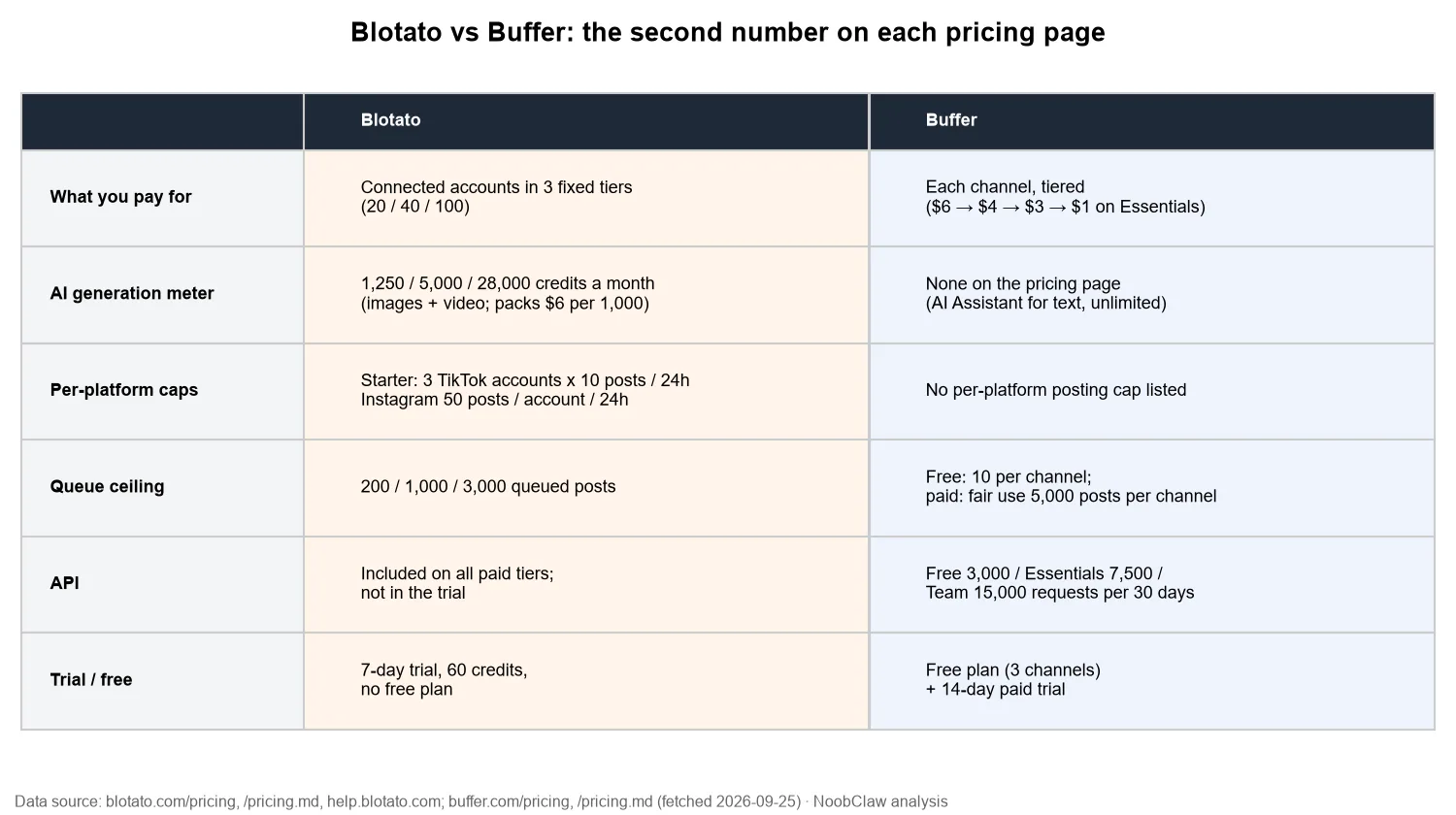
That is the whole comparison in one sentence: Buffer prices the number of places you publish to, Blotato prices a bundle of places plus a monthly budget for generated media. Buffer's pricing page lists an AI Assistant for writing and repurposing text, unlimited on every plan, and no image or video generation. Blotato also calls writing unlimited. The real difference in the "AI" column is generated visuals, not captions.
At how many accounts does Blotato become cheaper than Buffer, and when does it flip back?
Using monthly billing on both sides and each vendor's published tiers:
| Connected accounts | Buffer Essentials | Buffer Team | Blotato |
|---|---|---|---|
| 3 | $18 | $36 | $29 (Starter) |
| 5 | $30 | $60 | $29 (Starter) |
| 20 | $100 | $160 | $29 (Starter) |
| 40 | $165 | $225 | $97 (Creator) |
| 41 | $168 | $228 | $499 (Agency) |
| 50 | $195 | $255 | $499 (Agency) |
| 100 | $245 | $355 | $499 (Agency) |
The Buffer figures for 3, 5 and 50 channels match the example table Buffer prints in its own pricing file; the rest follow from its tier rates. We checked that the tiers are progressive (each rate applies only to the channels inside that band) by reproducing Buffer's own 25- and 50-channel examples.
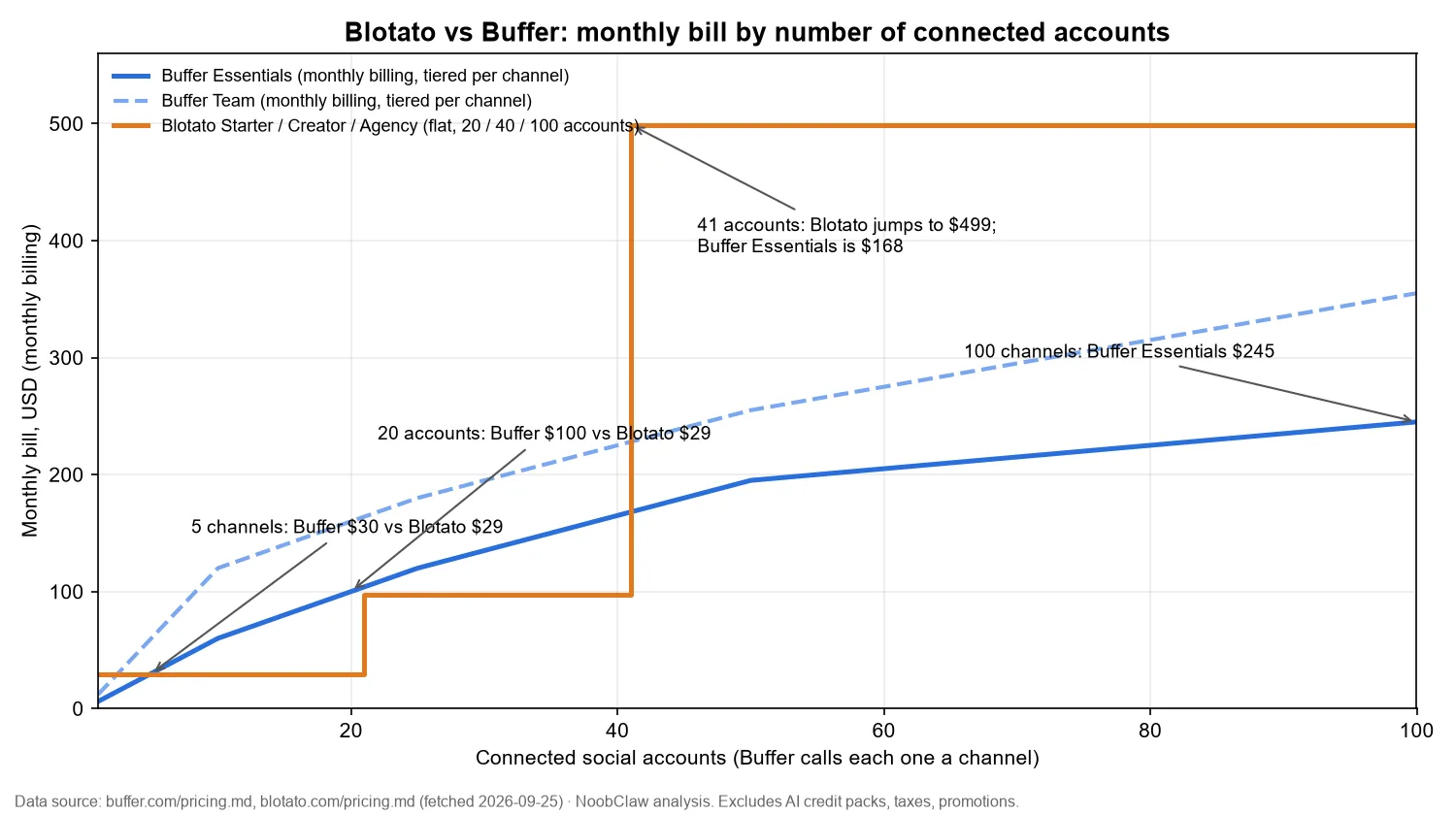
Two crossings matter. Buffer Essentials is cheaper up to 4 accounts ($24); at 5 it costs $30 against Blotato's $29. Buffer Team, at $12 a channel, already costs more than Blotato from 3 accounts ($36). From there to 40 accounts Blotato is far cheaper per account. Then Blotato has no tier between $97 and $499 and no way to buy single accounts; the only add-on it sells is credits. Account 41 costs you $402 a month more on Blotato and $3 more on Buffer Essentials.
Buffer charges for the next account. Blotato charges for the next bucket. Count your accounts a year from now, not today, before you pick.
Yearly billing does not change the picture much: Buffer's yearly rate saves "approximately 2 months", and Blotato's rate card says yearly "saves about 17%: you pay for 10 months and get 12", selectable only from its billing portal rather than the pricing page.
Which limits only show up after you have paid?
Blotato's account count is not a per-platform count. Its social accounts help page says that on Starter "you are limited to posting to 3 distinct TikTok account IDs per rolling 24-hour window, with 10 posts per account", and that this is where the "900 TikTok uploads/month" on the pricing page comes from: "3 accounts x 10 posts/day x 30 days = 900/month. There is no monthly counter." If most of your 20 accounts are TikTok, Starter is effectively a 3-account plan for TikTok. The same page caps Instagram at 50 posts per account per 24 hours, and lists YouTube at 10 uploads per channel per day on Starter (25 on Creator), a limit the same page says YouTube, not Blotato, enforces. That sits oddly with the rate card's claim that Blotato's caps are "stricter than the platforms' own limits".
Credits run out faster on video. A Blotato customer wrote on Trustpilot in May 2026 that "I can create one two-minute video in vertical format for the cost of my subscription", while praising the API. That is one user's experience, not a rate, but it is consistent with the vendor's own "a few seconds of generated video" per credit.
Buffer's "unlimited" has a number. The pricing FAQ says unlimited scheduling "is subject to our fair use policy, which caps usage to 5000 posts per channel", adding "no one has ever exceeded this cap." Its API is included even on Free (1 key, 3,000 requests a month) and rises to 7,500 and 15,000 on paid plans, but the 15-minute limit is 100 requests on every tier.
Blotato's documents disagree with each other. We compared four Blotato sources on the same day and found four conflicts:
- Voice: the Creator card and FAQ on the pricing page say credits cover "images, videos, and voice"; the rate card says credits are not spent on "AI voiceovers (powered by ElevenLabs)".
- Cancellation: the rate card says remaining credits "stay usable until the paid month ends, then expire"; the billing help page says that when you cancel, "All remaining AI credits are deleted" and "All scheduled posts stop and will not be published", immediately.
- Scheduling horizon: the rate card lists 9 months, 1 year and 2 years by tier; the billing help page says 9 months "on every plan".
- Refunds: the pricing FAQ says to email "within 14 days"; a founder reply on Trustpilot (April 21, 2026) cites a "30-day money back guarantee".
Buffer has one of its own: its FAQ promises a "20% discount" for annual billing while the same file says yearly "saves approximately 2 months", which is about 16.7%, and every worked example matches the smaller figure. Our rule for all five: budget on the stricter reading and get the generous one confirmed in writing.
Buffer vs Blotato: which one should you pick?
Pick Buffer if you run fewer than 5 accounts on Buffer Essentials (fewer than 3 if you need Buffer Team), or more than 40; you write or design your own posts; you want a free plan to start; or you care what happens when a trial ends unpaid: Buffer's FAQ says the account drops to Free and scheduled posts still publish unless channels are locked for exceeding three. (Buffer's pricing file does not describe what happens when a paid plan is cancelled, so this is not a like-for-like comparison with Blotato's cancellation terms.) Buffer also supports more surfaces for automatic publishing, including Google Business Profiles and Mastodon, which Blotato's nine-platform list does not include.
Pick Blotato if you run roughly 5 to 40 accounts spread across platforms (not mostly TikTok on Starter), and you actually need generated images or short video every week, ideally driven through its API, MCP server or n8n and Make nodes. Budget credits from your video length, not from the headline allowance. And test in the web app first: the billing help page states that "Generating an API key ends your free trial immediately" and starts the paid plan.
The case against each is real. Buffer produces no visuals, so a production-heavy operator pays for a second tool, and the flat-rate argument Blotato makes in its own Blotato vs Buffer post holds in that 5-to-40 band (that post is the vendor comparing itself, so read it as such). Blotato's flat price stops being flat at 41 accounts, by its own rate card its posting caps are stricter than the platforms' own, and its paperwork is inconsistent enough that billing questions are where its low-star reviews cluster (we went through them in our Blotato reviews breakdown).
Both tools publish through official platform APIs and both assume you already know what each account should say. If your accounts sit in different niches and need different posts plus day-to-day engagement (likes, follows and comments on other accounts' posts), that is a third kind of tool. NoobClaw is one example: a desktop app that generates content per account from each account's niche and persona and runs it in local browser sessions you log into yourself. The trade-off is that your computer has to be on, and browser automation is not an officially authorized publishing route the way an API is. Blotato's own help center warns that "Connecting a brand new account to automation is the fastest way to get shadowbanned or flagged as a bot", which applies to every tool on this page.
More detail on each side: what Buffer's Free plan really allows, which gates stay shut during a Blotato trial, and options for TikTok-heavy account sets.
FAQ
Is Blotato cheaper than Buffer?
Between 5 and 40 connected accounts, yes, on September 2026 prices: 20 accounts cost $29 a month on Blotato Starter and $100 on Buffer Essentials (monthly billing). Below 5 accounts Buffer Essentials is cheaper (Buffer Team only below 3), and from 41 accounts Buffer is cheaper again because Blotato's next tier is $499. If you buy extra Blotato credits for video, add $6 per 1,000.
Can I use Blotato and Buffer together?
Yes. You can generate in Blotato and schedule in Buffer. You then pay both meters, Blotato's bucket and Buffer's per-channel rate, so it only makes sense if Buffer's collaboration features (approvals, unlimited team members on Team) are worth that. Compare it with how Buffer prices against a per-seat tool if team size is the real driver.
Do Blotato credits roll over, and what happens when I cancel?
Blotato's rate card and llms.txt say "Credits roll over month to month." What happens on cancellation is less clear: the rate card says credits stay usable until the paid month ends, while the billing help page says credits are deleted and scheduled posts stop immediately. Until Blotato reconciles the two, assume the help page's stricter version and do not cancel mid-month with posts still queued.
Sources
- Buffer Pricing (machine-readable rate card, tier table, FAQ) — Buffer — pricing last updated November 2025, fetched 2026-09-25 — https://buffer.com/pricing.md
- Buffer pricing page — Buffer — fetched 2026-09-25 — https://buffer.com/pricing
- Blotato Pricing (rate card) — Blotato — effective 2026-09-10, fetched 2026-09-25 — https://www.blotato.com/pricing.md
- Blotato pricing page and FAQ — Blotato — fetched 2026-09-25 — https://www.blotato.com/pricing
- Billing, credits and plan limits — Blotato Help Center — fetched 2026-09-25 — https://help.blotato.com/settings/billing-and-credits.md
- Social accounts and posting restrictions — Blotato Help Center — fetched 2026-09-25 — https://help.blotato.com/settings/social-accounts.md
- Blotato llms.txt — Blotato — last updated 2026-09-17, fetched 2026-09-25 — https://www.blotato.com/llms.txt
- "For the money it's okay." (customer review) — Trustpilot — 2026-05-27 — https://www.trustpilot.com/reviews/6a17a76edd33d15ce7045e27
- Review with founder reply citing a 30-day money back guarantee — Trustpilot — review 2026-01-26, reply 2026-04-21 — https://www.trustpilot.com/reviews/697843b16d46483e7514ee88
- Blotato vs Buffer: An Honest 2026 Comparison (vendor-authored) — Blotato blog (Sabrina Ramonov) — 2026-07-09, updated 2026-09-14 — https://www.blotato.com/blog/blotato-vs-buffer