Blotato Free Trial: API Access, Credits and Billing Triggers
- The current web trial lasts seven days and excludes API access.
- Blotato’s API document says generating a key ends the trial and starts paid Starter immediately.
- Trial generation credits are limited; credits, exported assets and publishing status are different units.
- A web trial does not prove API integration, account permission, audience response or a refund outcome.
Blotato’s free trial and its API access are different offers. The current official API page says the seven-day web trial excludes API access and that generating an API key ends the trial and starts a paid Starter subscription immediately. That makes key generation a billing decision rather than a harmless trial check. This review explains the documented boundary, limited trial credits and questions to answer before purchase. Official terms were checked October 11, 2026; no subscription or API key was activated for this article.
Use the trial to inspect eligible web outputs. Decide whether to start paid API access before generating a key, then verify the actual billing confirmation.
Understand the documented paid-key trigger
Blotato’s current API page explicitly states that API key generation ends the trial and immediately starts a paid Starter subscription. The article therefore replaces the old uncertainty about whether a trial key is available with that documented condition. Do not activate a key simply to check whether the API works for free. First decide who can authorize the purchase, which billing account should pay and what acceptance check would justify keeping the service.
The pricing FAQ also describes conversion to a paid subscription after the seven-day trial unless canceled. Keep that end-of-trial condition distinct from the earlier paid-key trigger. Read the billing confirmation shown in your own account and preserve the applicable plan, amount and timing. This article has not observed a checkout, cancellation or refund and cannot promise how a disputed charge will be resolved. Documentation can establish the stated offer; your account record establishes the transaction you actually authorized.
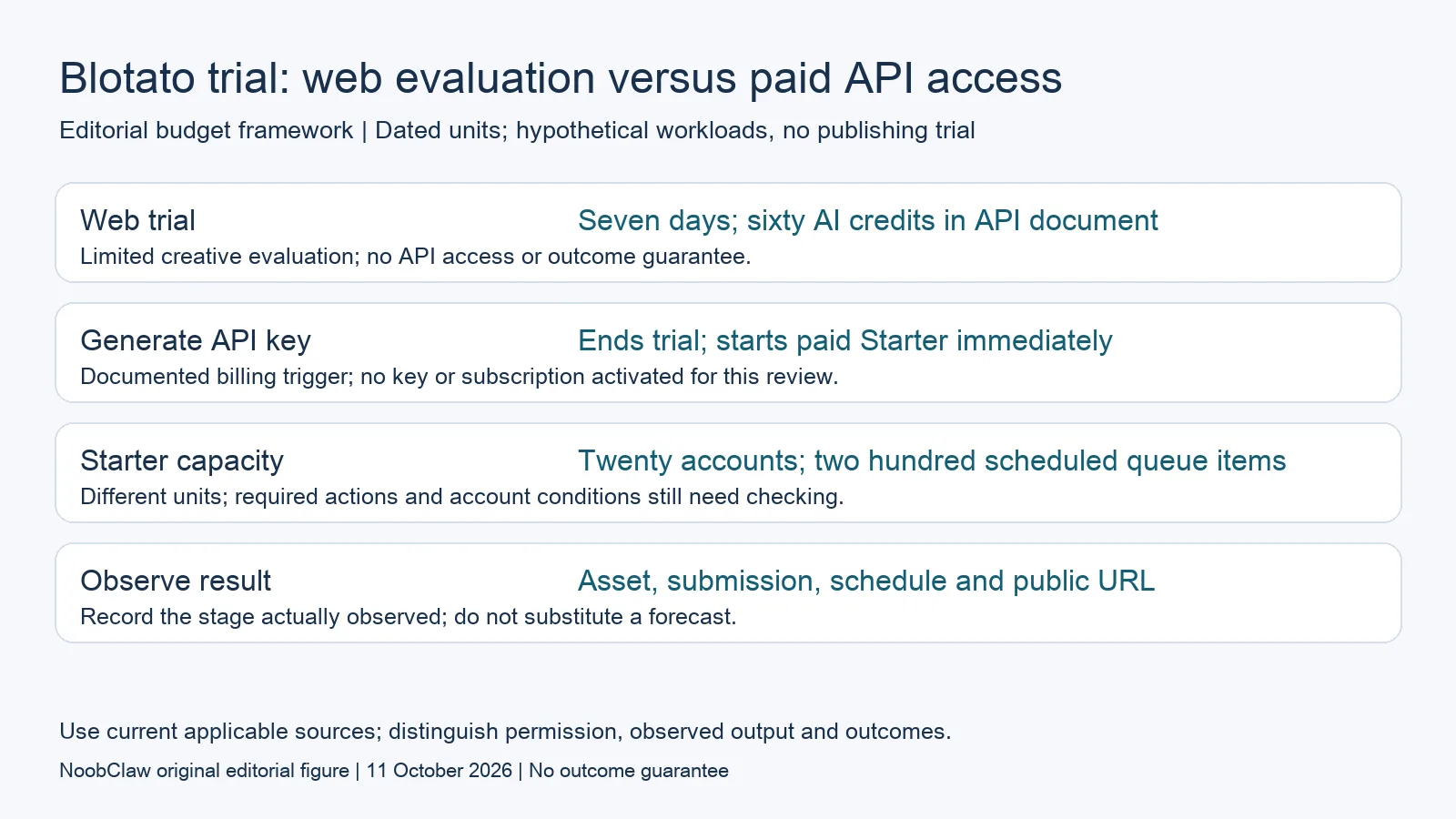
- Web trial: Seven days; sixty AI credits in API document. Limited creative evaluation; no API access or outcome guarantee.
- Generate API key: Ends trial; starts paid Starter immediately. Documented billing trigger; no key or subscription activated for this review.
- Starter capacity: Twenty accounts; two hundred scheduled queue items. Different units; required actions and account conditions still need checking.
- Observe result: Asset, submission, schedule and public URL. Record the stage actually observed; do not substitute a forecast.
Use the trial for the deliverable it actually includes
The API document lists a seven-day web trial with sixty AI credits and no API access. The pricing FAQ describes limited image and video generation during the trial. These statements do not establish how many finished, approved videos a particular brief will produce. Credits are a service meter, not a quality score. A rejected draft, a revised scene and an accepted export also represent different points in the creative process.
Prepare a small representative brief with the target format, essential facts and acceptance criteria. For a community event, that might mean the actual date, venue, booking destination and the exact intended language. Record what the web interface returns and which requested details still need editing. The trial can support that bounded observation; it cannot establish API authentication, automated submission, final publication or performance on an external platform. Do not treat fluent output as factual approval.
Check paid account and queue capacity separately
The current API document lists twenty connected accounts and a two-hundred-item scheduled queue for Starter. Each Facebook Page or LinkedIn company page counts as its own connection under the documented definition. That differs from counting a brand name or a client folder. Before selecting a plan, list the actual connected destinations and the maximum simultaneous queue you need. A lower average posting frequency does not change the number of accounts in the inventory.
A hypothetical client inventory of four brands, each with an Instagram account, a Facebook Page and a LinkedIn company page, contains twelve connections. It fits inside twenty only on that stated connection dimension. It does not establish that every required action, asset format or team process is supported. Likewise, a planned queue of one hundred and fifty items is a queue-capacity scenario, not proof that those items will be accepted or successfully published. Keep the eligibility checks separate from the arithmetic.
Keep generation, submission and publication evidence apart
An exported asset is not an API submission, and a submission identifier is not the final public post. Blotato’s API page documents later published, scheduled and failed states. If you subsequently authorize paid access, define the intended timing and final-state check before running the integration. Preserve the identifier and the relevant status; check the destination URL when the item should be public. An item legitimately scheduled for later requires a different check from an immediate publication.
Trial conclusions should name only the stage actually observed. For example, you can record that a web run produced an asset whose dates were reviewed, while leaving API integration untested. You cannot call that a verified publishing workflow. The same discipline applies when comparing another provider: ask for the exact supported operation and observed result. No trial duration by itself proves reliability, client approval or a suitable ongoing budget.
Make a bounded purchase decision from actual requirements
Before starting a paid plan, put the required accounts, queue capacity, production needs and responsible operator in one evaluation record. Separate documented limits from unresolved questions and observations from forecasts. If the required action is not supported, a discounted subscription is still unsuitable. If the uncertainty is output quality, inspect the returned asset before moving a whole client inventory. This is a practical acceptance decision, not a prediction that a particular provider will improve reach.
Compare alternatives on the same missing deliverable. A service with a free API allowance may still have account, queue or usage conditions; a production tool may return a video without providing a scheduler integration. The NoobClaw local record below provides one bounded production observation with known limitations. It does not validate Blotato’s trial or prove a replacement for its paid API. Keep any later audience clicks, paid sales and external publication evidence in their own records rather than using the trial result as a conversion claim.
Choose the output you need: post-caption drafts, opening-line drafts or spoken-script drafts. These text tools have a limited anonymous allowance; they do not transcribe or publish a video.
For the related content and workflow decisions, read Blotato API Alternatives: Access, Channels and Status Checks and Blotato Pricing: Plans, Credits and Account Limits. Each review has its own evidence and scope.
A local export demonstrates only its recorded output
NoobClaw publishes this article. Its public October 10, 2026 execution record documents one local creative run: 441 English input characters became a 32.6-second video at 1080 × 1920 pixels and 30 frames per second. This establishes an input and exported file, not scheduler integration, client approval, external publication or audience response. Generic or off-topic footage needs scene-by-scene review; voice quality and footage rights were not independently approved. Use this bounded record to evaluate a production deliverable independently of an API subscription.
The script-to-video guide and public creative execution record document a local video result, not external-platform publication. Check the current product offer against the supported action you need.
Frequently asked questions
Can I use a Blotato API key during the free trial?
The current API document excludes API access from the trial. It says generating a key ends the trial and starts paid Starter immediately. Treat that as a purchase decision, not a free test.
Does the trial guarantee a certain number of finished videos?
No. The stated trial credits do not establish a count of approved outputs. The brief, generation operation and required edits matter; inspect the actual result and applicable meter.
Does testing web generation confirm a working publishing API?
No. Web output, API authentication, submission and final publication are distinct observations. This article has not activated an API key, submitted a post or tested a cancellation or refund.
Sources
Official material reviewed on October 11, 2026. Document conditions apply to their stated service and scope; the editorial examples are explicitly hypothetical.