How Many Creators Use AI? Survey Figures and Their Limits
- The inspected surveys describe different creator populations and behaviors.
- A documented percentage needs its sample, question and fieldwork period.
- Self-reported business improvement is not a controlled performance result or your campaign’s expected CTR.
There is no single documented percentage here that represents every content creator’s current AI use. YouTube/NRG and Adobe report useful figures, but they ask different populations about different behaviors. Keep those definitions attached to each percentage before using it in a presentation or product decision. This review returns to the inspected original report and releases, excludes unverified claims from statistics roundups and does not average incompatible survey results into a global adoption rate.
Match the source, its conditions and the result you can actually observe.
The figures that can be stated with their samples
YouTube’s Human Creativity and AI report gives 72% for surveyed US video posters aged 14–44 who had used AI to create or edit an image or video. Its Google/NRG footnote identifies April 2026 and a sample of 694. That population is people who posted a video in the previous year, not a sample specifically of professional YouTubers. The report’s self-featured AI-video figure uses a different base and should not be silently substituted for adoption.
Adobe’s October 2025 release reports 86% actively using creative generative AI. Its Harris Poll methodology describes more than 16,000 creators across eight countries, surveyed in September 2025, publishing digital content at least a few times monthly. It focuses on emerging and semi-professional creators rather than full-time traditional creative professionals. Those definitions matter: the release’s geographic breadth does not make its figure a probability sample of all creators everywhere.
Adobe’s June 2026 release reports 87% of creators using or having tried creative AI saying it accelerated business or audience growth, and 57% saying outputs usually need moderate or extensive editing. The methodology describes more than 16,000 respondents in eight countries in May 2026, with an income-generating creator definition. These findings are self-reports with specific bases; the release does not supply an overall adoption percentage equivalent to its 2025 figure.
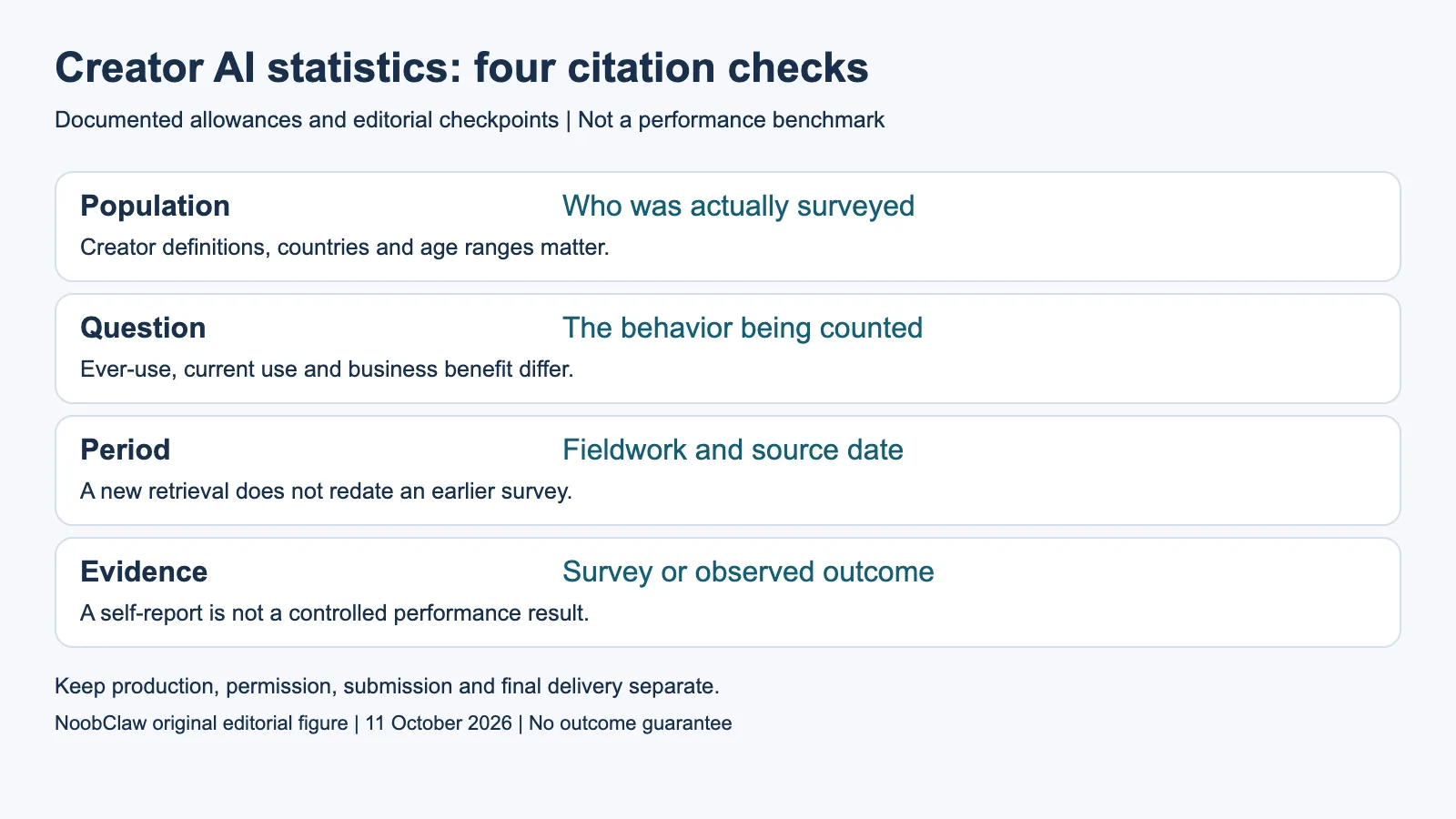
- Population: Who was actually surveyed. Creator definitions, countries and age ranges matter.
- Question: The behavior being counted. Ever-use, current use and business benefit differ.
- Period: Fieldwork and source date. A new retrieval does not redate an earlier survey.
- Evidence: Survey or observed outcome. A self-report is not a controlled performance result.
Why a higher number does not settle the comparison
A person who once used an image-editing feature can answer an ever-use question positively without using AI every week. Another may use a creative assistant regularly without generating an entire video. Determine the behavior counted before deciding two figures disagree. A change in question wording can change the measured quantity, but these sources do not establish that every observed difference comes only from wording rather than underlying behavior.
The populations also differ in country, age, activity and income criteria. Keep those definitions beside the survey rather than replacing them with the same short word, creators. Comparing two samples can provide context while failing to establish a time trend. A year-to-year adoption claim would need appropriately comparable measures and populations, not simply the publication years printed above different findings.
Record who produced or commissioned the research as provenance, not as proof that the result is false. Google/NRG and Adobe/Harris Poll are identifiable sources for these particular findings. Their commercial interests do not certify a specific recruitment bias or respondent outcome that the documents do not disclose. If sampling or fieldwork details remain absent for a desired comparison, retain that gap instead of diagnosing motives or inventing a representative population.
Cite the statistic without changing its meaning
A responsible summary names the sponsor or research partner, the fieldwork period, population, sample and measured behavior. Paraphrase narrowly and link the original document. If a subsequent article changes ever-use into regular use, or a self-report into measured growth, it is answering a different question without new evidence. Recheck the original methodology before carrying a short attractive number into your own copy.
For a hypothetical presentation worksheet, create separate rows for adoption, reported workflow use and reported business benefit. Put the relevant sample or subgroup beside each row. Do not average the percentages or subtract them as if the same people answered the same question. These organizational choices are a citation method, not a new analysis of respondent-level data or a claim that we have access to the raw survey responses.
Keep source dates distinct from retrieval dates. Re-reading a 2025 release today does not turn its fieldwork into 2026 evidence. Likewise, a report’s publication date does not define every survey period in its footnotes. If a rounded figure or subgroup cannot be resolved from the original, omit it or describe the unresolved scope. This article provides no certified thumbnail-CTR increase, recovery rate or universal business return from using AI.
Use surveys for context and an output test for the task
An adoption survey can explain why a category deserves investigation, but it cannot tell you whether a particular asset suits your audience. Start with the deliverable: an accurate script, relevant media, clear sound and reviewable subtitles. Define what a person must approve before publication. A tool being popular in a surveyed group does not establish quality, rights, platform permission or a better search result for your product.
NoobClaw’s public case records a 441-character English script exported locally as a 32.6-second video at 1080×1920 and 30 fps. Some footage needed relevance review; listening quality and stock rights were not independently approved. That is a concrete local output observation, not a survey of creators, platform publication or performance experiment. NoobClaw publishes this article and has a commercial interest in creative tools, which does not change the limits of either kind of evidence.
For your own evaluation, retain the input, output, necessary edits and final acceptance decision. Measure the intended outcome separately if you publish: a completed asset, observed audience response, relevant traffic or paid purchase are different events. No surveyed percentage supplies your expected click-through rate. Choose the tool and workflow from the documented task and your own observations, using these surveys as attributed context rather than a promise of results.
For the related content and workflow decisions, read AI UGC Creator: Jobs, Deliverables and Disclosure and Machine-Readable Pricing: Check Costs, Units and Conflicts. Each review has its own evidence and scope.
NoobClaw publishes this article. Its script-to-video guide and public creative execution record document a local video result, not external-platform publication. Check the current product offer against the supported action you need.
Frequently asked questions
What percentage of creators use AI in 2026?
The inspected sources do not establish one global percentage. State the documented figure with its specific population, fieldwork and question.
Can Adobe’s 2026 business-benefit figure be called adoption?
No. It describes self-reported benefit among creators using or having tried creative AI, not the proportion of all creators adopting it.
Does the YouTube report measure professional YouTubers?
Its cited US sample is online people aged 14–44 who posted video in the previous year. Do not rename that population as professional YouTubers.
Sources
Sources inspected on October 11, 2026. Prices retain the specified currency, billing frequency and counting unit. Same-day reused copies retain their original retrieval receipts. Instagram Help was read in its Chinese-language rendered body. The Fast Track application returned an unavailable-region notice in the anonymous retrieval; no individual eligibility or current complete program terms are certified. The Sprout Help body was read through public web retrieval after native HTTP403. Survey fieldwork dates and populations are separate from retrieval dates. Workloads are illustrative; one local creative output does not establish publication, account protection, growth or paid conversion.