
Does Posting Time Matter on TikTok? What to Check
- Posting time matters on TikTok, but less than best-time charts suggest. TikTok's own list of recommendation factors (interactions, video information, device and account settings) does not name upload
- TikTok's official advice is to use the Followers tab: post on your followers' most active days, "at most, two hours before the activity peaks." That is scheduling around your own audience, not a unive
- Three studies that publish a method disagree on basics. Buffer (7.1M posts) ranks Sunday 9 a.m. as the best slot; Sprout Social (about 2 billion engagements) calls Sunday the worst day; Metricool, as
- Timing decides the outcome in two cases: short-shelf-life content, and accounts whose early views come from their own followers. Everyone else should test two slots from their own data and compare med
Yes, posting time matters on TikTok, but it is a smaller lever than the colour-coded charts imply, and TikTok's own guidance points you to your own analytics rather than any chart. The For You feed ranks videos by predicted interest for each viewer, and a video can keep being recommended after the hour you posted it. Timing earns its keep in two specific situations, described below.
We re-read TikTok's official material and three "best time" studies that publish a method on September 26, 2026. The studies contradict each other on something as basic as whether Sunday is the best or the worst day, and working out why tells you how to use them.
Does posting time actually matter on TikTok? What TikTok says
TikTok's newsroom explainer on the For You feed lists the factors its recommendation system weighs: user interactions, video information "like captions, sounds, and hashtags", and device and account settings, the last of which "receive lower weight." Upload time is not on the list, though TikTok introduces it as factors "including things like" these, so it is a set of examples rather than a complete formula. The same page says "neither follower count nor whether the account has had previous high-performing videos are direct factors."
Where TikTok does talk about timing, it frames it as reaching your followers. Its Creator Academy analytics guide says: "Use follower activity as your programming calendar guide, aka when to post," and adds, "We suggest posting on the most active days of the week and, at most, two hours before the activity peaks on those days in order to catch that earlier audience and build momentum before the peak."
The analytics overview tells you where that data lives. The Followers tab breaks your audience's activity down "by hours and days," and the Viewers page has "Most active times," covering when your viewers were active "in the last 7 days." Analytics can be pulled for up to 365 days at a time.
Our reading: TikTok treats timing as a way to put a new video in front of the people most likely to respond first, then lets interest signals take over. That is why your own follower data beats any cross-account average.
A chart built from other people's accounts tells you when their audiences were awake. Your Followers tab tells you when yours is.
Why do "best time to post on TikTok" charts disagree?
Because they measure different accounts with different metrics. Here are three 2026 studies that at least say what they measured:
- Buffer looked at "the median engagement rate across 7.1 million posts published through Buffer." Its single best slot is Sunday at 9 a.m., and Saturday is its best day. Buffer says its data team adjusted the times to be "universally applicable" but does not publish how.
- Sprout Social (updated March 2026) analyzed nearly 2 billion engagements across 307,000 profiles belonging to 30,000 customers, from November 27, 2025 to February 27, 2026, in local time. Its answer is Tuesday to Thursday, 2 to 6 p.m., and it calls Sunday the worst day.
- Metricool analyzed 2,314,756 posts from more than 92,000 accounts. According to Net Influencer's summary of the report, it puts the global viewing peak at 6 to 9 p.m., with 8 p.m. the busiest hour.
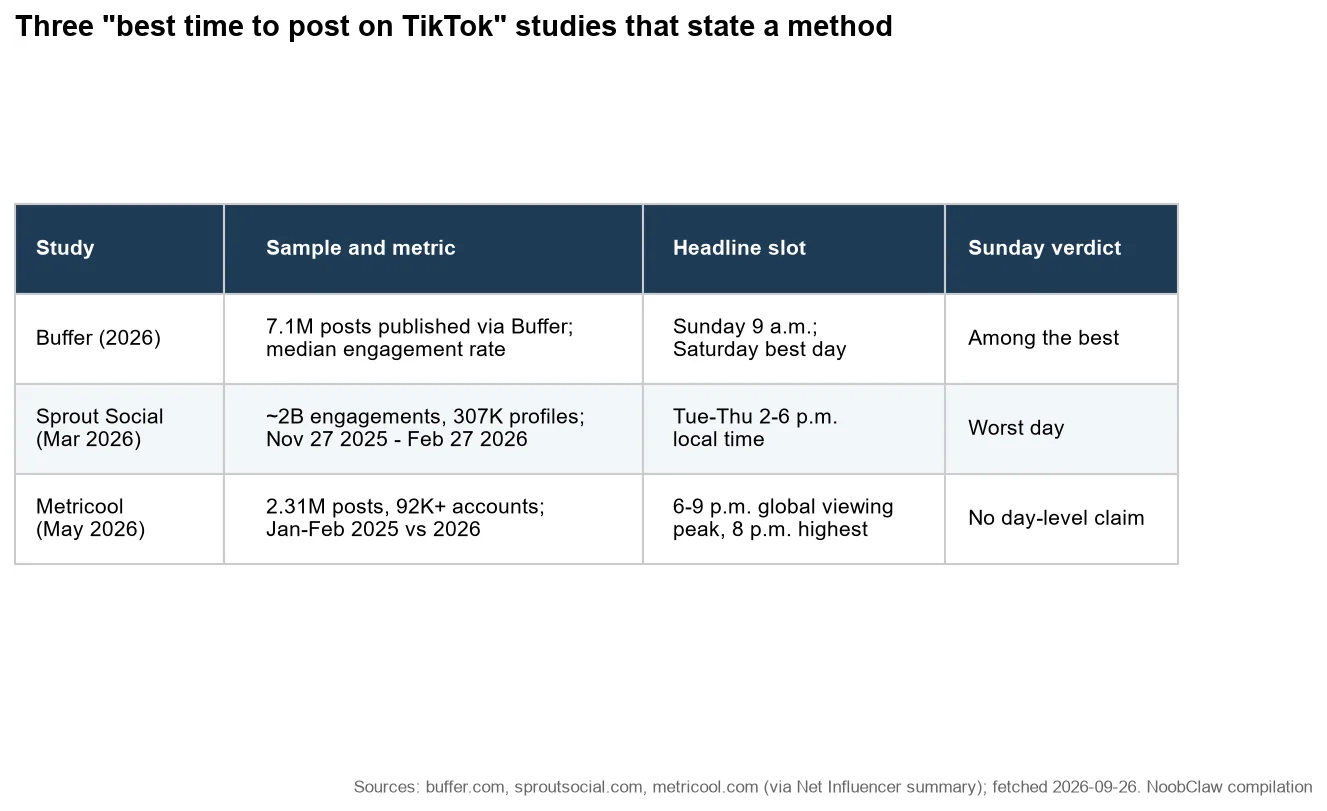
None of these is wrong on its own terms. Buffer's sample is Buffer users; Sprout's is mostly brand customers; Metricool counts views, not engagement rate. When the sample changes, the "best" Sunday becomes the "worst" Sunday. That clash is the most useful thing in the whole genre: if two large, documented datasets cannot agree on the day, a single slot from either one cannot be the answer for your account. Treat them as a starting guess when you have no data of your own.
The two cases where timing decides the outcome
Case 1: content with a short shelf life
If a video is tied to something happening now, such as a news reaction, a trend at its peak or a live event, timing is most of its value. Being four hours late to a trend that peaks within a day is the difference between riding it and documenting it. Even ordinary posts have a short working life: per Net Influencer's summary of the Metricool study, 96% of a post's total reach and nearly 98% of its interactions arrived within the first ten days. For time-sensitive topics that window is hours, not days.
Our own trending archive shows how fast topics turn over. NoobClaw saves a once-a-day snapshot of the Hacker News, Reddit and Google Trends top lists. Of the 50 Hacker News items on each day's page from September 22 to 25, 2026, only 2, 3 and 0 were still there the next day; Reddit's list carried over 3, 2 and 0 items, and Google Trends' 0, 1 and 0. The "Italian parliament votes for return to nuclear energy" story, sixth on Hacker News in the September 24 archive, was on none of the lists by September 25. These are not TikTok charts, a once-a-day snapshot cannot show hourly peaks, and Hacker News ranks partly by age, so read this as a pattern rather than a measurement: on these lists, a news hook rarely survives a second day.
Case 2: accounts whose early views come from their own followers
TikTok's "two hours before the peak" advice only makes sense if followers are part of a video's first audience. For accounts with a loyal following, a LIVE schedule or a running series, posting while those followers are awake shapes the early response. Many creators describe this as follower-first testing; it is a working model inferred from analytics, not a published TikTok rule.
For a typical account the effect is smaller than people assume. In the same Metricool study, again per Net Influencer's summary, the Following feed produced 2% of views and views from profile pages 11%, against 73% from For You. If most of your views come from strangers, the hour matters less than whether the first two seconds make them stop. That is where the first hour on TikTok is really decided.
How do you find your own best time to post on TikTok?
This takes about two weeks:
- Open TikTok Studio, then Analytics, then Followers, and note your followers' most active days and hours.
- Pick two slots: one about two hours before a peak (TikTok's suggestion) and one off-peak.
- Alternate between them for ten posts, keeping topic, format and length as steady as you can.
- Compare the median views per slot, not the best post in each group.
- If the medians are close, stop optimizing the clock and work on the opener.
TikTok's own Creator Academy makes the same point with a real creator. Its analytics guide profiles Hunter Clark (@hiddenmoviedetails), who uses analytics "to help him know the exact moment viewers drop off a video" and to "see if his captions and hashtags are helping his videos get discovered." That is not a posting-time story, and we are not claiming timing grew his account. It is the habit this test depends on: reading your own numbers instead of someone else's chart.
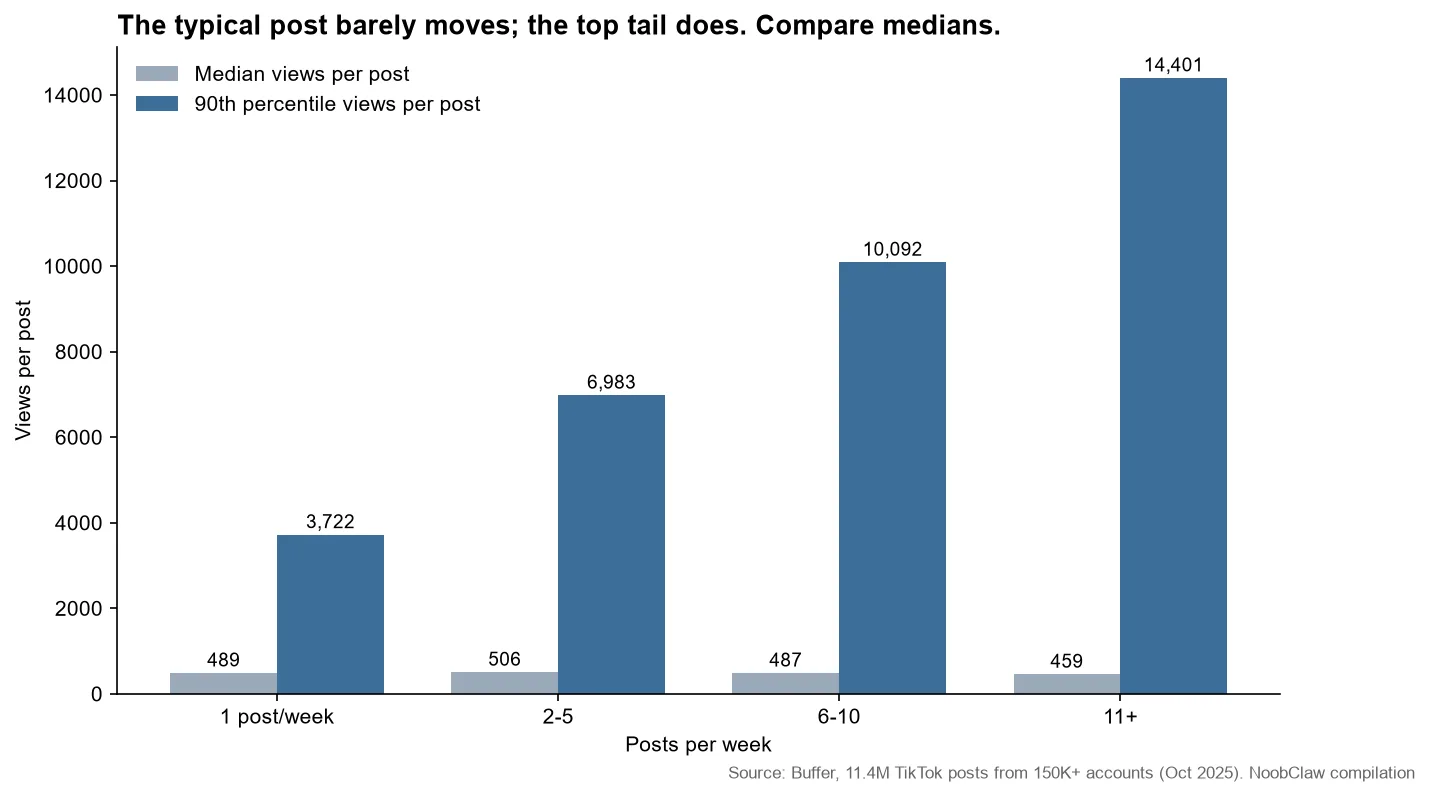
Why medians? TikTok views are heavily skewed. Buffer's posting-frequency study of 11.4 million posts from more than 150,000 accounts found median views per post stayed around 500 at every cadence (489 at one post a week, 459 at 11+), while the 90th percentile rose from 3,722 to 14,401. One breakout video in a ten-post test will swamp the average and send you chasing a slot that was never the reason.
If the slot you pick is inconvenient, TikTok's Video Scheduler is built into TikTok Studio's upload settings. When TikTok announced it in 2021, it allowed 15 minutes to 10 days ahead and required a Business Account for desktop scheduling. Buffer's May 2026 guide reports it now works for business or creator accounts and up to 30 days ahead. Other guides still give 10 days, so treat the Schedule toggle on your own upload page as the current rule. We compare other options in our free TikTok scheduler roundup.
If you run several accounts, the same logic applies per account. Each account has its own Followers tab, and a cooking account and a finance account rarely peak at the same hour, so one clock for all of them uses the wrong input. Two practical limits: apps posting through TikTok's official API share a Direct Post cap that TikTok's developer guidelines say is "typically around 15 posts per day" per creator account, and cadence matters more than clock time (see how often to post on TikTok).
NoobClaw, for example, lets each account's video task run at a set daily time (with a small random offset) or at a random point in a 09:00 to 23:00 window. If an account has enough follower data, the set time taken from its own Followers tab is the better choice.
FAQ
What is the best time to post on TikTok?
For your account, it is in TikTok Studio under Analytics, then Followers. TikTok suggests posting on your followers' most active days, up to two hours before the peak. Published charts are averages across other accounts, and the documented ones disagree with each other, so use them only until you have your own data.
Does posting late at night hurt reach on TikTok?
Not by itself. Recommendations are ranked by predicted interest, so a video posted at 3 a.m. can still be recommended later. Late posting hurts in the two cases above: time-sensitive content, and accounts whose early response depends on followers who are asleep.
Should I delete and repost a TikTok video that flopped at a bad time?
Usually no. TikTok's newsroom says the For You feed does not "recommend duplicated content," so an identical re-upload may not get a second chance, and deleting throws away the first video's data. A new video that changes the opener is the better test. We cover the details in posting the same video twice on TikTok.
Sources
- How TikTok recommends videos #ForYou · TikTok Newsroom · 2020-06-18 · newsroom.tiktok.com
- Analytics: video performance · TikTok Creator Academy · accessed 2026-09-26 · tiktok.com/creator-academy
- Understanding your analytics · TikTok Creator Academy · accessed 2026-09-26 · tiktok.com/creator-academy
- Best Time to Post on TikTok in 2026 (7.1M posts) · Buffer · 2026 · buffer.com
- Best times to post on TikTok in 2026 · Sprout Social · 2026-03 · sproutsocial.com
- TikTok Study 2026 · Metricool · 2026-05-12 · metricool.com
- TikTok Content Volume Up Nearly 80% In Early 2026 · Net Influencer · 2026 · netinfluencer.com
- How Often Should You Post on TikTok? (11.4M posts) · Buffer · 2025-10 · buffer.com
- Introducing Video Scheduler (2021 announcement; limits may have changed) · TikTok For Business · 2021-07-16 (updated 2025-07-22) · ads.tiktok.com
- How to Schedule TikTok Posts · Buffer · 2026-05-05 · buffer.com
- Content Sharing Guidelines · TikTok for Developers · last updated 2026-08-04 · developers.tiktok.com