Can You Post the Same Video Twice on TikTok? What to Check
- You can. TikTok's Community Guidelines (version effective September 24, 2026) contain no rule against re-uploading your own video, no cooling-off period and no "duplicate penalty". The originality rul
- The cost is distribution, not punishment: the second upload starts with zero history, competes with the first one, and meets an audience that partly already swiped past it.
- Before re-uploading, check why the first one stalled. TikTok says For You ineligibility "will appear in the TikTok analytics tool", that few views "doesn't necessarily mean it broke a rule", and that
- Re-posting a restricted video from another account is named as circumvention, and an account that keeps posting ineligible content can be made ineligible as a whole. Neither is triggered by one honest
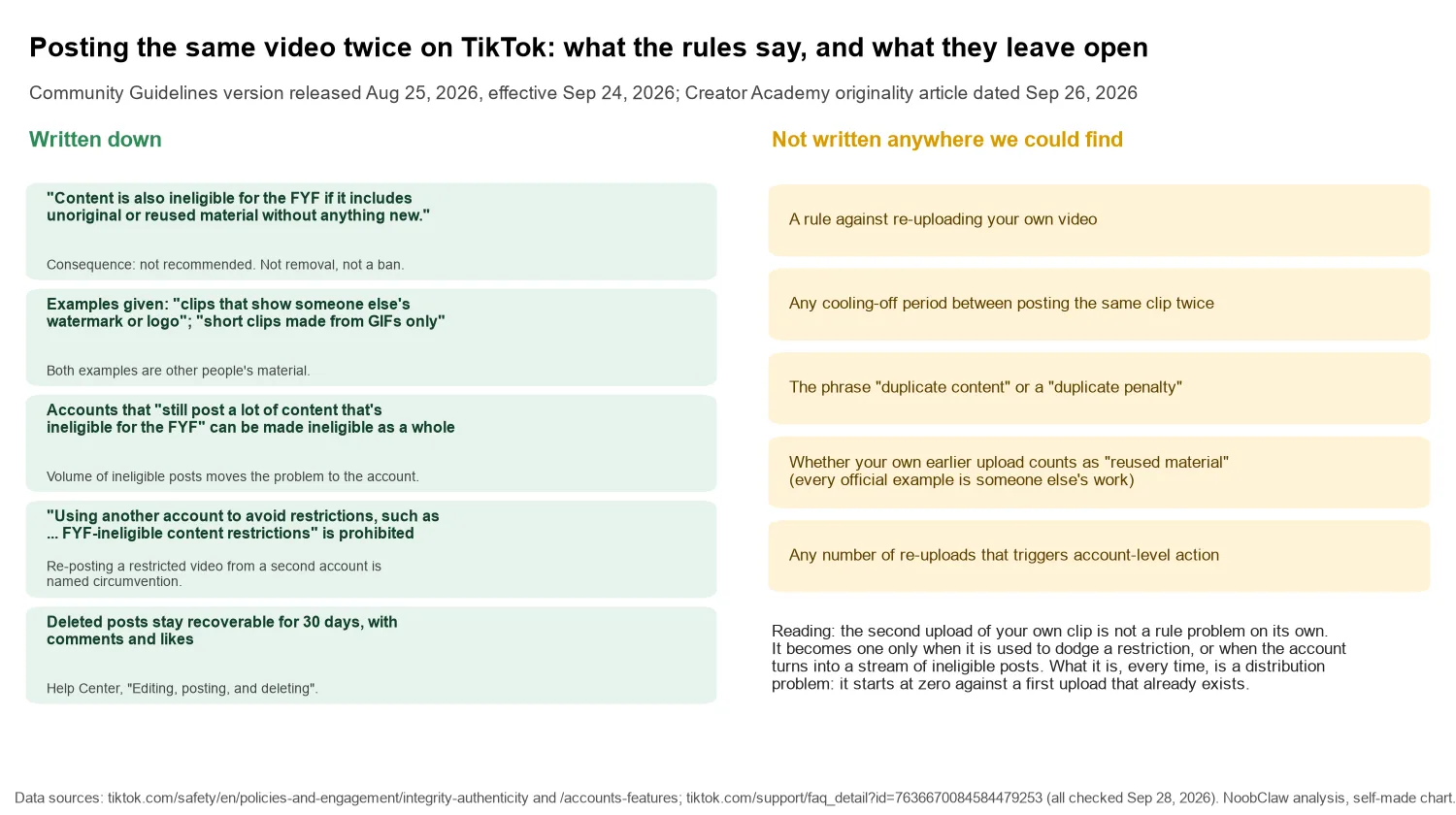
Yes, you can post the same video twice on TikTok, and nothing in the rulebook stops you. We read the Community Guidelines version that took effect on September 24, 2026 and TikTok's own originality article, and neither contains a rule against re-uploading your own video, a waiting period, or the phrase "duplicate content". What they contain is a rule about "unoriginal or reused material without anything new", and the consequence for that is not a ban but not being recommended. The one official sentence on the subject is older and lives outside the rulebook: TikTok's 2020 explainer of the For You feed says the system doesn't recommend "duplicated content, content you've already seen before, or any content that's considered spam" (How TikTok recommends videos #ForYou, June 18, 2020). That is a distribution statement, not a penalty, and it is the mechanism behind everything below.
So the real question is the one people type next: does it work, and is it bad? Usually it does not work, for a reason that has nothing to do with punishment. Upload two starts from zero, competes with upload one for the same viewers, and meets people who already saw it. Whether it is worth doing depends on why the first one stalled, and TikTok gives you a way to check that first.
What do TikTok's rules say about posting the same video twice?
Search TikTok itself for "posting same video multiple times" and the first screen argues with itself: one creator says never repost the exact same video because your account "will get flagged for unoriginal content", another says don't be scared to post a banger a second time. We pulled the actual guideline text on September 28, 2026.
The originality rule, in the Integrity chapter: "Content is also ineligible for the FYF if it includes unoriginal or reused material without anything new." The examples listed are "Reused or unoriginal content posted without creative edits, such as clips that show someone else's watermark or logo" and "Low-quality or minimally edited content, such as short clips made from GIFs only". Both are about other people's material; whether your own earlier upload counts as "reused" is not addressed anywhere on the page. The consequence is ineligibility for the For You feed, and TikTok's For You feed standards add that "Even if a video doesn't make it to the FYF, people may still find it through search or by going to a creator's account." Not removal, not a strike.
Two more sentences matter for habits rather than one-offs. The Accounts chapter says "accounts that don't break the rules still post a lot of content that's ineligible for the FYF. In those cases, we may make the account and its content ineligible for the FYF and harder to find." And the prohibited list includes "Using another account to avoid restrictions, such as comment blocks or FYF-ineligible content restrictions". That second one is the two-account case, covered in posting the same video on two TikTok accounts; it says nothing about posting twice from the same account.
TikTok's Creator Academy restated the policy on September 26, 2026: unoriginal content is copied, "largely repurposed from another source without adding any creative edits", "combined from multiple sources with little or no additional information", or carries "someone else's visible watermark or superimposed logo"; it "may be removed from the For You feed" and is ineligible for Creator Rewards, which "uses 'originality' as a key metric". Three of the four are explicitly someone else's work; the fourth is about adding nothing. So TikTok has not said your own re-upload is safe, and has not said it is unoriginal; it has said what happens to an account that posts a lot of ineligible material.
Nothing in the rules stops the second upload. Nothing in the rules helps it either: it starts at zero, in a feed where the first one already exists.
Why did the first upload underperform, and does a second one fix it?
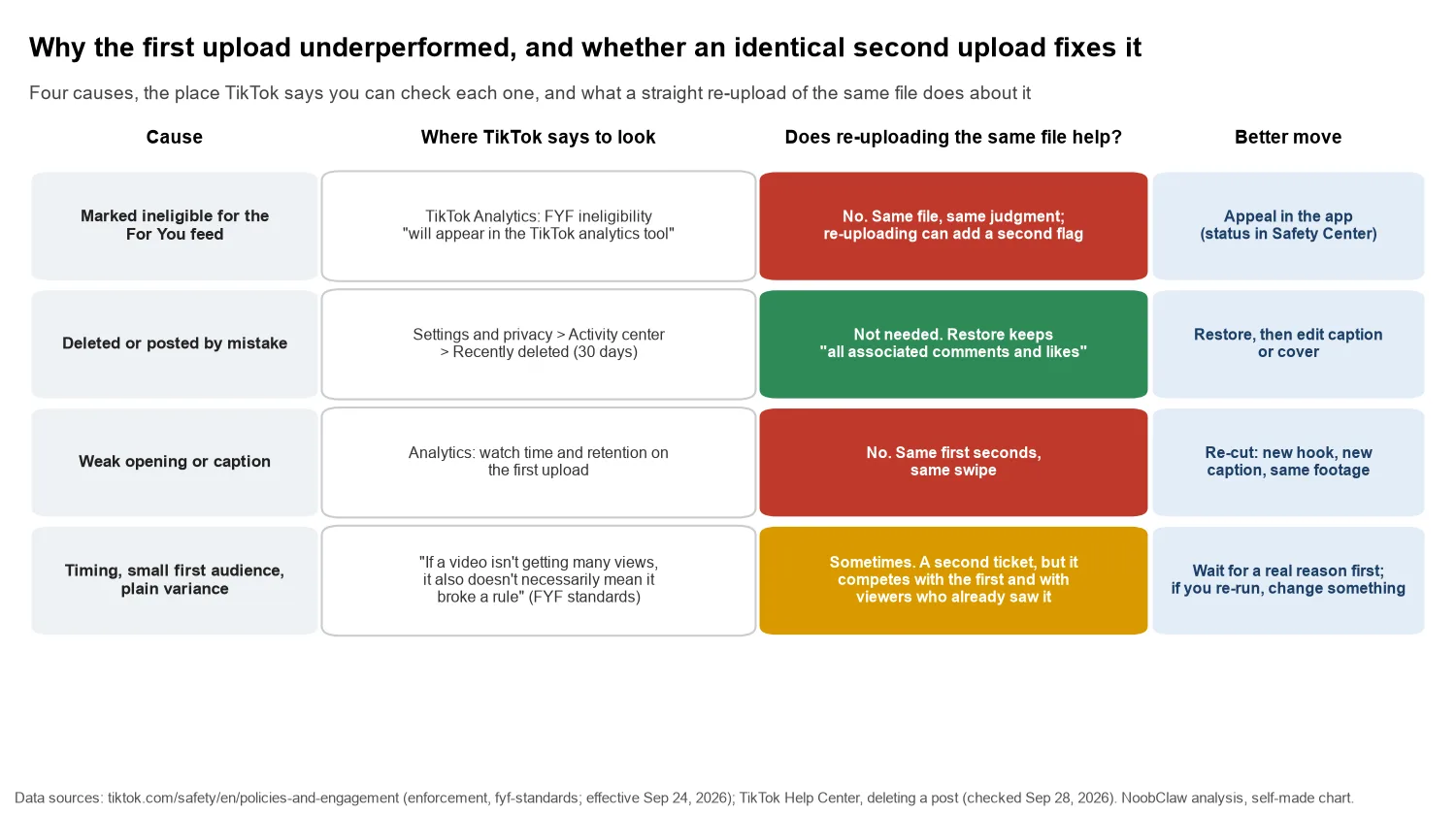
"Should I post it again" is really "why did it stall", and TikTok points to different places for different answers. The For You standards say: "If a video isn't getting many views, it also doesn't necessarily mean it broke a rule." The enforcement chapter says that when a video is made ineligible for the For You feed, "this information will appear in the TikTok analytics tool", and that you can appeal and track the appeal in the in-app Safety Center. Four causes cover almost every case, and a straight re-upload only helps with one.
- It was marked ineligible. Analytics shows it. Uploading the same file again invites the same judgment, and now you have two flagged posts. The move is the appeal.
- You deleted it, or posted by mistake. The Help Center says a deleted post "remains in our system for up to 30 days before being permanently deleted", and once you restore it "you'll also recover all associated comments and likes" (Settings and privacy, Activity center, Recently deleted). If you already deleted it and are weighing restore against re-post, deleting and reposting on TikTok walks through what resets.
- The opening or caption was weak. Same first seconds, same swipe. The originality article says it directly: "Think your content is original, but still not getting many views? It may be due to a lack of community engagement rather than being ineligible for the FYF." The fix is a re-cut with a new hook. If only the caption or cover is wrong, editing the existing post is covered in editing a TikTok after posting.
- Timing, a small first audience, plain variance. The only cause where an identical second upload can genuinely land differently, and the one people assume by default. Buffer's analysis of 11.4 million TikTok posts (October 8, 2025; its own users' accounts, so a vendor sample with a stated method) reported that posting more often lifted the 90th-percentile post from 3,722 to 14,401 views while the median barely moved (489 to 459). That is the shape of a second upload: another ticket in the same draw, not a better ticket.
The part guides skip is audience overlap. Whoever swiped past the first upload is a poor bet to stop for the second; TikTok's standards say the system is built to show "not just the same kinds of videos over and over", and its 2020 explainer says it does not recommend "content you've already seen before". If the first was barely shown, the re-run has a real chance; if it was shown widely and ignored, the re-run inherits the verdict.
When is posting the same video twice the right call?
Three situations, in our judgment. The first upload was barely delivered: a few dozen views, nothing ineligible in analytics, posted at a dead hour or on a brand-new account. The content is date-bound: an event or deadline that lands again on the next occurrence. Or you are testing one variable on purpose: same footage, different hook or cover, posted far enough apart that the two do not compete on the same day; that is a re-cut with a control, and it teaches you something a plain re-upload cannot.
Creators run this experiment in public. One posted the same clip three times with different metadata and reported that "They all performed the same"; another documented reposting one video three times and compared the results. Both are single-creator self-reports, but they point the same way as TikTok's text: what you change decides whether a re-run means anything.
The wrong call is the common one: a video got fewer views than you hoped, nothing looks wrong, and you re-upload it unchanged an hour later, splitting one audience and, done often enough, drifting the account toward "a lot of content that's ineligible". Spacing is in how long to wait between TikTok posts.
What should you do instead of re-uploading the same file?
Work down the list in the order the platform's pages suggest. Open analytics on the first upload: if it is marked ineligible, appeal from the post; if not, read how many people saw the first seconds and left. Views that stall at a round figure are usually variance rather than a threshold, explained in stuck at 200 views. If you deleted it, restore it within the 30 days and fix the caption or cover there. If the opening is the problem, re-cut it: new first two seconds, new on-screen line, new caption, same footage, the only version of "posting it again" that adds the "anything new" the guidelines ask for. If nothing was wrong and the audience was tiny, change at least the cover and first line and re-run on a different day.
For anyone running several TikTok accounts, the temptation is the same file on every handle, and there the rules do have teeth: "Spreading violative content across multiple accounts" and using another account "to avoid restrictions" are both named, and the September 24 version added that bans can extend to "associated accounts". NoobClaw is one tool built for the other approach: each account gets its own posts generated from its own niche and persona, published from your own logged-in browser, so the accounts share a workflow rather than a video file. It does not change how TikTok judges any single upload.
FAQ
Does TikTok punish you for posting the same video twice?
Not as a rule. The guidelines have no penalty for re-uploading your own video; the originality rule targets "unoriginal or reused material without anything new". What they do say is that an account posting "a lot of content that's ineligible for the FYF" can be made ineligible as a whole, and that using another account to get around a For You restriction is prohibited.
Is it better to delete the first one before posting again?
Usually not. Deleting throws away the first upload's likes, comments and remaining reach, and a deleted post can be restored within 30 days with its engagement intact. Delete when the file itself has an error you cannot edit out.
How long should you wait before posting the same video again?
TikTok publishes no interval. The practical constraint is audience overlap: the longer the gap and the more you change (cover, first line, caption), the less the two uploads compete for the same viewers.
Sources
- Community Guidelines: Integrity and Authenticity — TikTok — released August 25, 2026, effective September 24, 2026 — https://www.tiktok.com/safety/en/policies-and-engagement/integrity-authenticity
- How TikTok recommends videos #ForYou — TikTok Newsroom — June 18, 2020 — https://newsroom.tiktok.com/en-us/how-tiktok-recommends-videos-for-you
- Posting Same Video Multiple Times (TikTok search page) — TikTok — checked September 28, 2026 — https://www.tiktok.com/discover/posting-same-video-multiple-times
- Community Guidelines: Accounts and Features — TikTok — effective September 24, 2026 — https://www.tiktok.com/safety/en/policies-and-engagement/accounts-features
- Community Guidelines: For You feed standards — TikTok — effective September 24, 2026 — https://www.tiktok.com/safety/en/policies-and-engagement/fyf-standards
- Community Guidelines: Enforcement — TikTok — effective September 24, 2026 — https://www.tiktok.com/safety/en/policies-and-engagement/enforcement
- Editing, posting, and deleting (Recently deleted, 30 days) — TikTok Help Center — checked September 28, 2026 — https://www.tiktok.com/support/faq_detail?id=7636670084584479253
- TikTok Originality Policy — TikTok Creator Academy — September 26, 2026 — https://www.tiktok.com/creator-academy/en/article/tiktok-originality-policy
- How often should you post on TikTok? (11.4 million posts) — Buffer — October 8, 2025 — https://buffer.com/resources/how-often-should-you-post-on-tiktok/
- "I posted the same video three times" (creator self-report) — @megan.davis.babb on TikTok — checked September 28, 2026 — https://www.tiktok.com/@megan.davis.babb/video/7496215469922209054
- "I reposted a tiktok video 3 times. here's the results" (creator self-report) — @brandnat on TikTok — checked September 28, 2026 — https://www.tiktok.com/@brandnat/video/7118007833307680002