How Long Should You Wait Between TikTok Posts?
- The cited TikTok documents do not establish a universal waiting timer between ordinary posts.
- Buffer’s weekly frequency groups do not prove a required hourly gap.
- Choose slots around reviewed content, then record the interval and comparable observation times.
- Randomized timing is not an account-protection guarantee.
If you have two TikTok posts ready, there is no universal waiting interval established by the recommendation documents cited here. Choose the next slot around a finished, reviewed post and a schedule you can sustain. If you want to learn whether spacing helps your account, record the interval and compare similar content rather than treating a countdown as a distribution rule.
That is a narrower answer than “spacing never matters.” It may matter for your audience or operating schedule. What we cannot substantiate is a promise that waiting a specific number of hours prevents a restriction or unlocks more views.
What do official recommendations tell you about timing?
TikTok’s recommendation guidance discusses interactions, content information and user information, including time zone and day. It does not specify a mandatory creator waiting timer between ordinary posts. Absence of such a timer from this document is not proof that every possible frequency pattern is acceptable.
Use the platform notices and conditions that apply to your actual action. If the application displays a restriction, do not keep retrying merely because your calendar says it is time to publish. Account check describes checks for listed account features or posts. It does not certify a schedule as safe or predict a post’s distribution.
For ordinary planning, separate publication readiness from audience availability. Readiness means the script, media, caption, rights and intended destination have been reviewed. Availability is a hypothesis about when interested viewers may encounter the post. You can choose a slot for practical reasons without claiming that the slot was required by an algorithm.
A chosen posting gap is a planning decision until your own observations support a more specific conclusion.
For example, holding a second tutorial until a teammate can check the demonstration is a defensible workflow decision. Waiting because someone online says “three hours is always safe” is not the same kind of evidence. When recording the reason for a slot, name the real constraint: review coverage, an event deadline or a schedule experiment.
Does posting-frequency research establish an hourly gap?
No. Buffer’s original TikTok frequency analysis, published 8 October 2025, describes 11.4 million posts from more than 150,000 accounts. Its groups are weekly posting frequencies. A result about posts per week cannot establish whether two posts should be thirty minutes, three hours or a day apart.
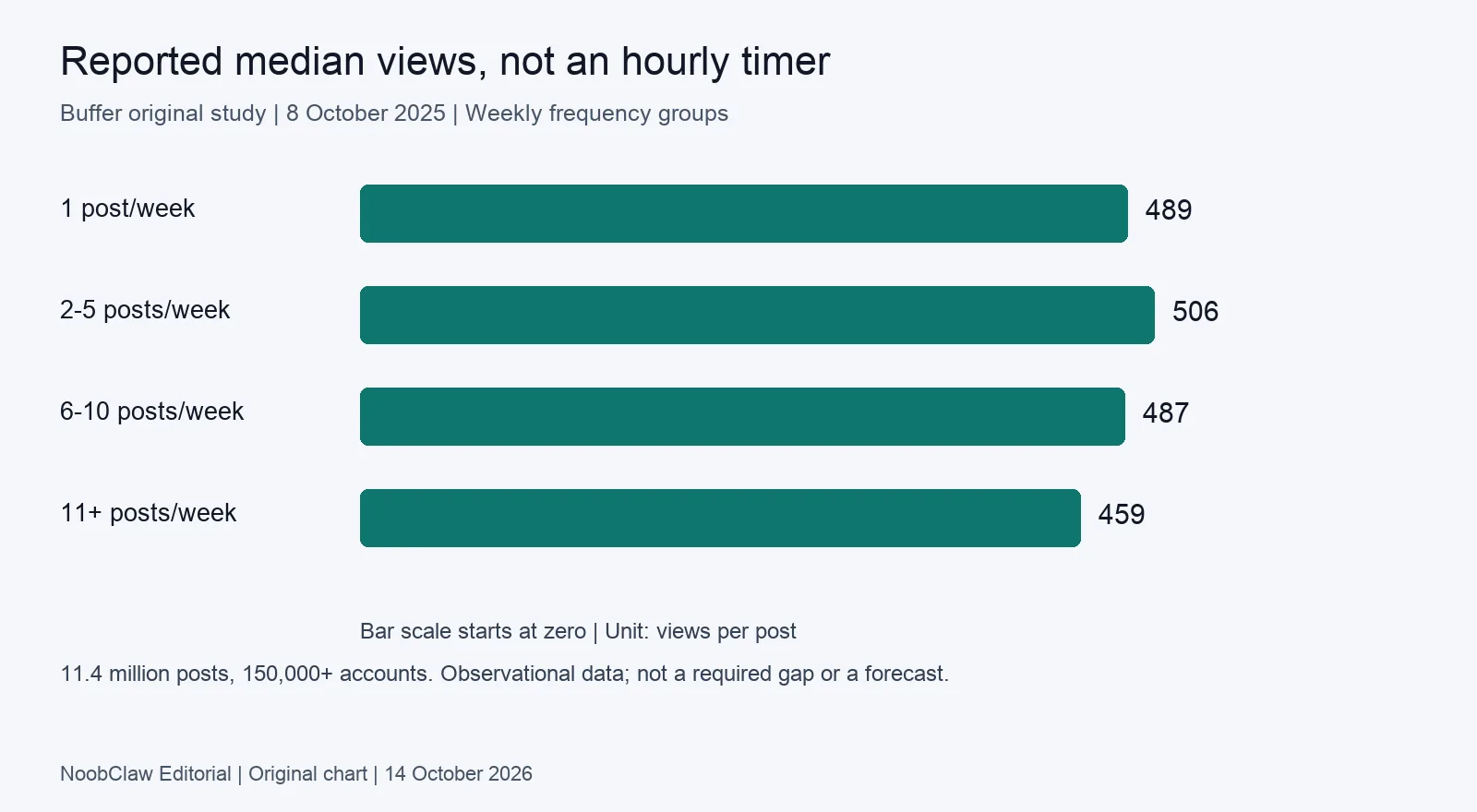
| Posts per week | Reported median views per post | Reported 90th-percentile views |
|---|---|---|
| 1 | 489 | 3,722 |
| 2–5 | 506 | 6,983 |
| 6–10 | 487 | 10,092 |
| 11+ | 459 | 14,401 |
The reported medians remain close while the upper-tail values differ substantially. Buffer describes fixed-effects regression and other account comparisons. Those methods are useful context, but they do not make the published group table a randomized spacing experiment. Do not interpret the values as a forecast for your next video or carry them across to Instagram as measured Instagram results.
Our interpretation is to separate production capacity from evidence about timing. More finished drafts give you more scheduling options. That alone does not mean your typical post will improve, nor does it show that posts compete for an identical fixed pool of followers. The research is worth reading for weekly cadence; it leaves the specific hourly question open.
How can you pick and evaluate a practical schedule?
Start with the number of reviewed posts you can actually produce. Then choose slots that fit your workflow. If both drafts are ready and have different purposes, publishing close together is a possibility to assess, not a rule we can universally endorse. If one needs revisions, hold it for that reason. You do not need to invent an algorithmic explanation for an editorial decision.
Keep a small log. Record the account, post URL, topic, format, length, publication time, gap since the previous post and observation time. Add available performance fields and any notices. Use the same measurement age when comparing posts: observing one shortly after publication and another much later makes the view totals hard to interpret.
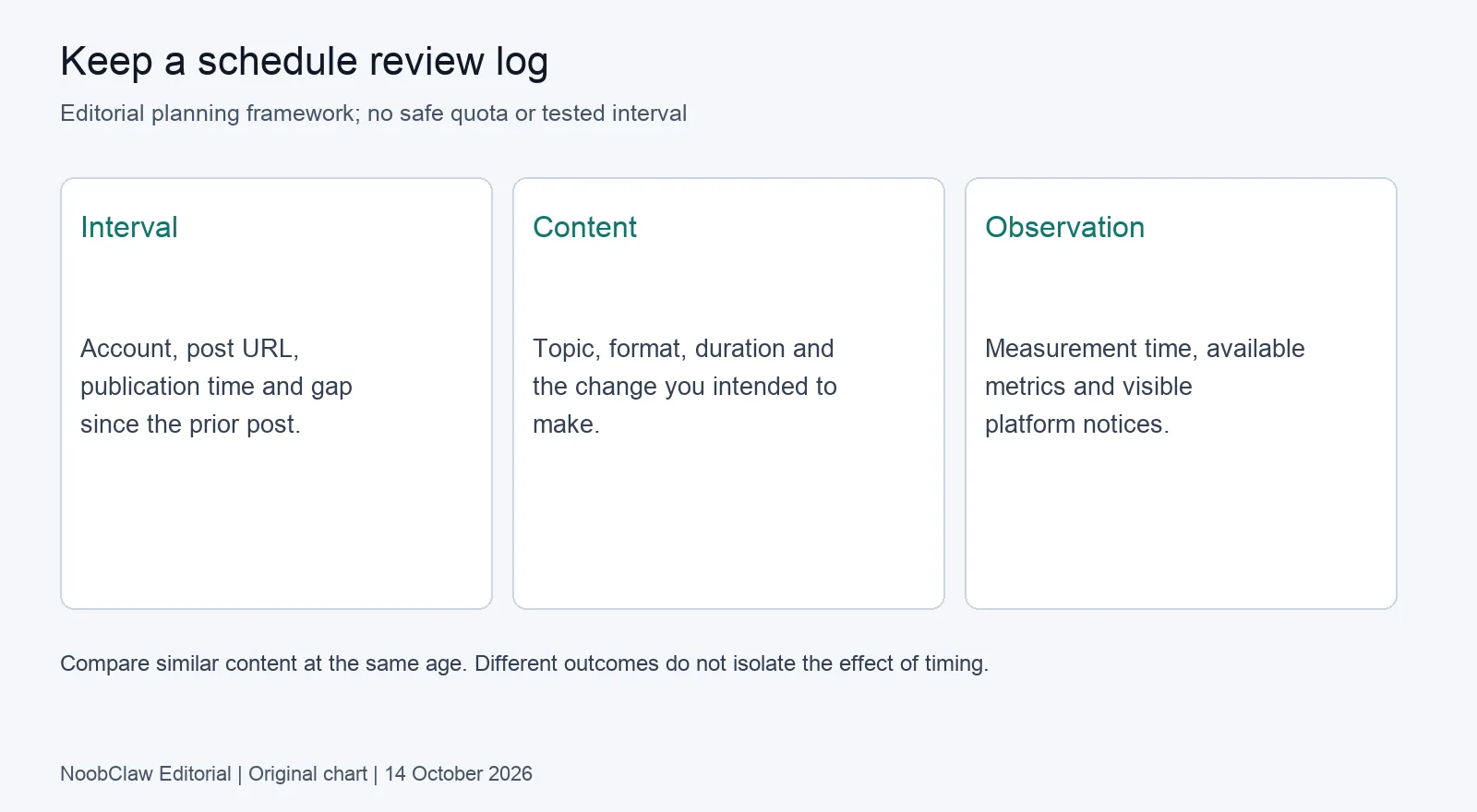
When feasible, avoid changing the topic, format and interval all at once. That is advice for clearer learning, not a claim that you can fully control viewers or recommendations. If a later slot coincides with more views, describe the observation first. Consider different subject matter, an event or a stronger demonstration before crediting the clock.
Use ranges and exceptions honestly in your own calendar. A time-sensitive announcement may need a different slot from an evergreen explanation. A schedule for one account need not be copied to another. Keep the comparison within the relevant account and content purpose; synchronized low counts across different accounts are not enough to identify a common penalty.
For a stalled post, the 200-view checks separate platform notices from editing hypotheses. For removal decisions, the delete-and-repost analysis addresses a separate question. Changing the gap is not a substitute for understanding a notice or correcting a factual mistake.
Where can content tools help with the schedule?
Use tools to prepare work you can review, rather than to defend an unsupported daily quota. The TikTok script generator can help organize a spoken draft. Keep the draft’s claims traceable and check whether it has a real demonstration or explanation. The availability of another generated script does not mean the queue needs another published post.
Our documented desktop case from 10 October 2026 used a 441-character supplied English script and produced one 32.6-second, 1080 × 1920 local MP4 with an audio stream and observed subtitles. It used a manual, non-repeating, local-only configuration. It tested neither a repeated schedule nor a TikTok publication. Those boundaries matter if you are buying software to solve the production side of this question.
Some automatically selected stock footage needed a closer relevance check. That observation favors leaving review capacity in the schedule; it does not quantify how much time any user needs. A shorter queue of reviewed drafts may be more workable than a full queue whose footage, narration or source rights still need attention.
NoobClaw is one production option for this documented script-to-video route. Follow the desktop workflow Guide for prerequisites and review the current plan and credit conditions. Network access and the required account profile are part of the tested route. Text drafting, local export and external publication are separate stages. We do not offer a reach improvement or platform permission guarantee through randomized timing.
FAQ
Do I have to wait three hours before another TikTok?
The sources here do not establish that interval as a mandatory rule. Choose a slot you can explain and test it cautiously on relevant content. Follow any actual restriction or notice instead of assuming that a timer clears it.
Is posting twice close together automatically harmful?
We cannot establish that universal conclusion. Readiness, purpose and audience context differ. We also cannot promise that distinct videos or a particular daily count are always acceptable. Assess the actual content and platform conditions.
Can randomized posting times protect my accounts?
Randomness does not establish permission, account isolation or protection from enforcement. A scheduling feature can organize tasks; it does not demonstrate how TikTok evaluates them. Keep the content and the chosen publication route appropriate for their intended use.
Review note, 14 October 2026: Weekly frequency research is distinct from hourly spacing. This article treats the research as observational evidence and provides no safe daily quota or protection guarantee.
Sources
- How TikTok recommends content — TikTok Help Center — undated public guidance reviewed 14 October 2026.
- Your account status — TikTok Help Center — undated guidance reviewed 14 October 2026.
- How often should you post on TikTok? — Buffer original analysis — 8 October 2025; retrieved 14 October 2026.
- One local script-to-video workflow — NoobClaw — 10 October 2026; single-case limitations included.