Instagram Not Reaching Non-Followers? Eligibility and Reach
- Public-account recommendation eligibility is distinct from how much non-follower exposure a post receives.
- Read the actual Account Status notice; a clean screen does not establish a content-only cause or guarantee recommendations.
- The rolling 30-day route is specific to aggregator originality restrictions, not all low-reach situations.
- Trial Reels can inform a content comparison, but they are not a randomized controlled experiment or a recovery guarantee.
Low Instagram reach among non-followers can have more than one explanation. Start with the actual recommendation-eligibility decision and then examine the available organic reach data. An eligible account is not guaranteed recommendations, and a clean Account Status screen does not prove that strangers saw a post and swiped away. This article distinguishes the observations you can make from the causal claims they cannot support, before you rewrite content or try to appeal a restriction.
A status reading describes eligibility. A reach measurement describes exposure. Neither alone proves why a particular result happened.
Separate a recommendation decision from a quiet graph
Instagram’s eligibility documentation says recommendations help people discover public-account content from accounts they do not follow. It explicitly says eligibility does not guarantee that content will be recommended. If an account is ineligible, none of its content is recommended under that account decision, while followers can still encounter it. Read that as a description of the stated recommendation layer, not as proof that every viewer, surface or other account restriction has been diagnosed.
Professional Account Status can identify content or profile components affecting recommendation eligibility. The official documentation describes the applicable edit, removal and disagreement options and distinguishes removed content and unavailable features. If a notice is present, preserve its wording, affected item and date. If it is absent, record that no restriction is visible in the checked readout. Do not convert that into certainty that no restriction or technical issue exists, or certainty that the first three seconds caused the low reach.
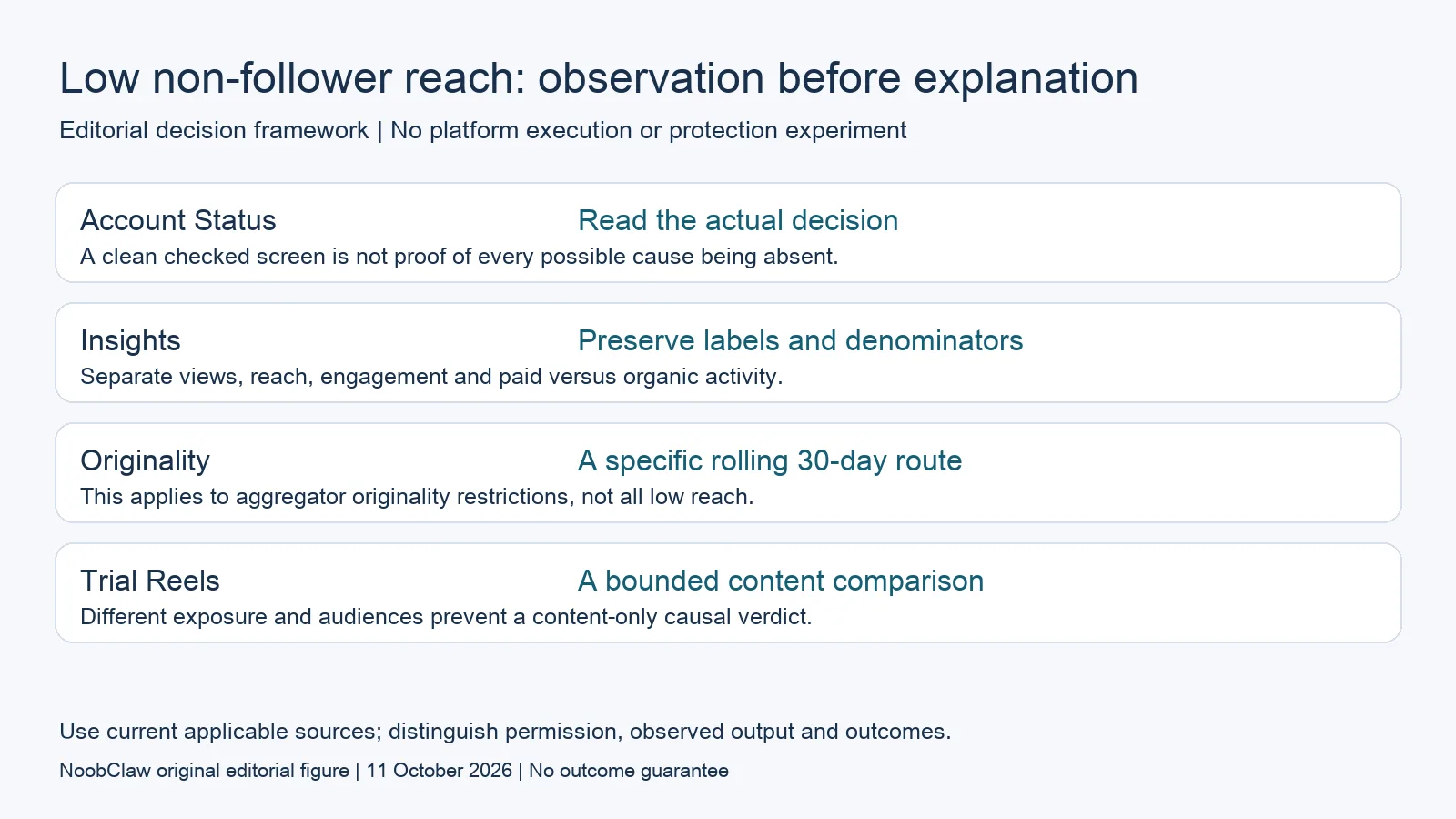
- Account Status: Read the actual decision. A clean checked screen is not proof of every possible cause being absent.
- Insights: Preserve labels and denominators. Separate views, reach, engagement and paid versus organic activity.
- Originality: A specific rolling 30-day route. This applies to aggregator originality restrictions, not all low reach.
- Trial Reels: A bounded content comparison. Different exposure and audiences prevent a content-only causal verdict.
Keep the originality window in its stated scope
Instagram’s April 30, 2026 announcement concerns aggregators primarily posting unoriginal photos, carousels or reels. It describes becoming eligible again when most recent material is considered original over a rolling 30-day period, with removal and appeal options also available. It does not identify originality as the statistically most common cause of every low-reach account. Its reported US share of original recommendations is a different measure and cannot establish that prevalence.
This update says it does not change how content from followed accounts is shown. That does not mean any follower-reach decline rules out a concurrent recommendation issue. Avoid using a 30-day countdown for a decision that cites a different condition. Review the specific rule and the appropriate route instead. Adding subtitles or a credit to someone else’s clip does not by itself meet the meaningful creative contribution described in the originality guidance, and rights to use the asset remain a separate requirement.
Compare like metrics and retain the missing information
When Insights supplies follower and non-follower information, record the metric’s exact label, post format, date and observation period. Views, accounts reached and accounts engaged are different measures. Do not combine an engagement split from one panel with a view count from another as if they had one denominator. Keep paid and organic activity separate wherever the available reporting permits. If a particular breakdown is unavailable, mark it unavailable instead of filling it with zeros.
Compare several reasonably similar posts, keeping topic, format and time since publication in view. A near-zero non-follower reading is worth investigating, but it does not prove ineligibility. A small nonzero reading does not prove that retention alone stopped distribution. A sudden change after an edit is an association that may guide another check; it does not isolate that edit from audience, exposure or account changes. Define the question before changing several parts of the workflow at once.
Use Trial Reels as a bounded comparison
Meta’s Trial Reels announcement describes showing reels to non-followers first, approximate engagement reporting after 24 hours, and optional sharing to followers based on performance in the first 72 hours. It also notes that some followers can still encounter a trial through other routes. These are product conditions, not a promise of a representative audience or equal exposure to two variants. Check the feature actually available to your account and its current options.
If you compare two openings, record each creative version, topic, publication time, observation period and reported exposure. Where you cannot establish similar audiences or sufficient exposure, keep that limitation with the result. A trial with little activity and a clean status does not measure content quality in isolation. It can help choose what to examine next, but it is not a randomized controlled test, an account-health certificate, a universal winning-hook detector or an appeal outcome.
What to change after the evidence is recorded
A visible eligibility decision calls for the action attached to that decision. A content review calls for examining the actual audience promise, opening, useful information, assets and rights. Those workstreams can proceed without claiming they have the same cause. For example, making an opening understandable without a running series may be a sensible editorial improvement; only a properly recorded outcome can show how viewers responded. There is no universal completion-rate threshold or guaranteed posting cadence established here.
For several accounts, keep each account’s actual notice, content purpose and results together. A tool-generated variant is not automatically original or appropriate simply because words differ. NoobClaw’s public local production record can support a limited creative-output claim; it does not demonstrate Instagram browser publishing, eligibility restoration or a successful multi-account distribution method. Choose content assistance for the work it can demonstrate, and let the platform’s documented account process govern the stated restriction.
For the related content and workflow decisions, read Instagram Recommendation Guidelines: Rules and Account Status and Instagram Broadcast Channels: Requirements and Missing Access. Each review has its own evidence and scope.
A production result is not a recommendation result
NoobClaw publishes this article, so its product example has a commercial interest. Its public execution record documents one local output: 441 English script characters became a 32.6-second, 1080 × 1920 video at 30 fps, with voiceover and subtitles. That supports a narrow statement about local production. It does not document an Instagram upload, recommendation eligibility, audience response, channel access, or an appeal result. Some stock imagery was not closely related to the script, and full audiovisual quality and asset licensing were not approved. Those limits matter here: producing another file is not the same as resolving a platform notice or proving that a post is original under Instagram’s policy. If you use a tool to develop a fresh opening, check the resulting claim, image, audio, rights and audience fit before publication. Keep the platform’s account decision and the creative output as separate records. The useful product question is whether the tool helps you produce and review material you can appropriately publish, rather than whether it promises to unlock reach. No such unlock is demonstrated by this case.
NoobClaw publishes this article. Its script-to-video guide and public creative execution record document a local video result, not external-platform publication. Check the current product offer against the supported action you need.
Frequently asked questions
Does clean Account Status mean the hook is the problem?
No. It describes the currently visible status, and eligibility does not guarantee exposure. Review the actual content and available reach evidence without assigning a sole cause the records do not establish.
Can I promise recovery after 30 days of original posts?
No. The published rolling window concerns a particular aggregator originality route, with removal and appeal options. It is not a deadline for every account decision or a guarantee that reach returns.
Is a Trial Reel a controlled experiment?
Not by itself. Instagram distributes the content under its own systems; comparable audiences and exposure are not established merely by making two trials. Record the differences and report the result as a limited observation.
Sources
Official material reviewed on October 11, 2026. Document conditions apply to their stated service and scope; the editorial examples are explicitly hypothetical.