
Instagram's Recommendations Guidelines, Explained (2026): What the Rulebook Lists, and What It Doesn't
- Instagram runs two rulebooks. Break the Community Standards and content is removed. Break the Recommendations Guidelines and the post stays up for followers but is not shown to non-followers in Explor
- The current Help Center text lists three content categories (safety-sensitive content, low-quality or unoriginal publishing, fact-checked false content) plus six account-level rules, including buying
- Eligibility can be account-wide: Instagram says that if your account is not eligible, none of your content will be recommended. Professional accounts can see this in Account Status, view a sample of t
- A single post stuck at zero views is usually something else. On September 23, 2026 a creator asked whether anyone else had Trial Reels "stuck at 0 views for hours" that day; check Account Status and y
On September 23, 2026 a creator asked on Reddit whether anyone else was "getting exactly 0 views specifically today": a Trial Reel had been "stuck at 0 views for hours" and was "not even showing up under my own hashtags." Is that the Recommendations Guidelines at work? Almost certainly not, and the way to know is to read what the guidelines actually say. They are short, they are public, and much of what gets attributed to them online is not in them.
This guide is built from the current text of Instagram's Help Center and Meta's Transparency Center, which we retrieved and read on September 25, 2026. The short version: the guidelines decide whether content from a public account can be shown to people who do not follow it. They do not remove anything, and they are checked in Account Status, not guessed from your insights.
What are Instagram's Recommendations Guidelines?
They are Instagram's standard for what it will push to strangers. The Recommendations on Instagram help page says the guidelines "are designed to maintain a higher standard than our Community Standards, because recommended content and connections are from accounts you haven't chosen to follow." Content that breaks the Community Standards is removed. Content that only falls short of the Recommendations Guidelines stays up.
The idea is older than most creators assume. Meta's Transparency Center describes a "remove, reduce, inform" strategy "that we've used since 2016", under which content that "doesn't violate the Community Standards, but might still be problematic or otherwise low-quality" may have its distribution reduced. The recommendation rules themselves were made public on August 31, 2020; Meta said it consulted "50 leading experts specializing in recommender systems, expression, safety and digital rights", a line the Help Center still carries.
Two scope limits matter. The recommendation eligibility page says "these guidelines only apply to public accounts and recommendations to people who don't follow you", and that "your eligibility for recommendations doesn't guarantee that your content will be recommended." Eligible means you are in the pool. Ranking still decides whether anyone sees you.
What do the guidelines actually list, and what is missing from them?
The Help Center names "three categories of content" that "are allowed on Meta technologies, but may not be eligible for recommendations", then a separate list for accounts:
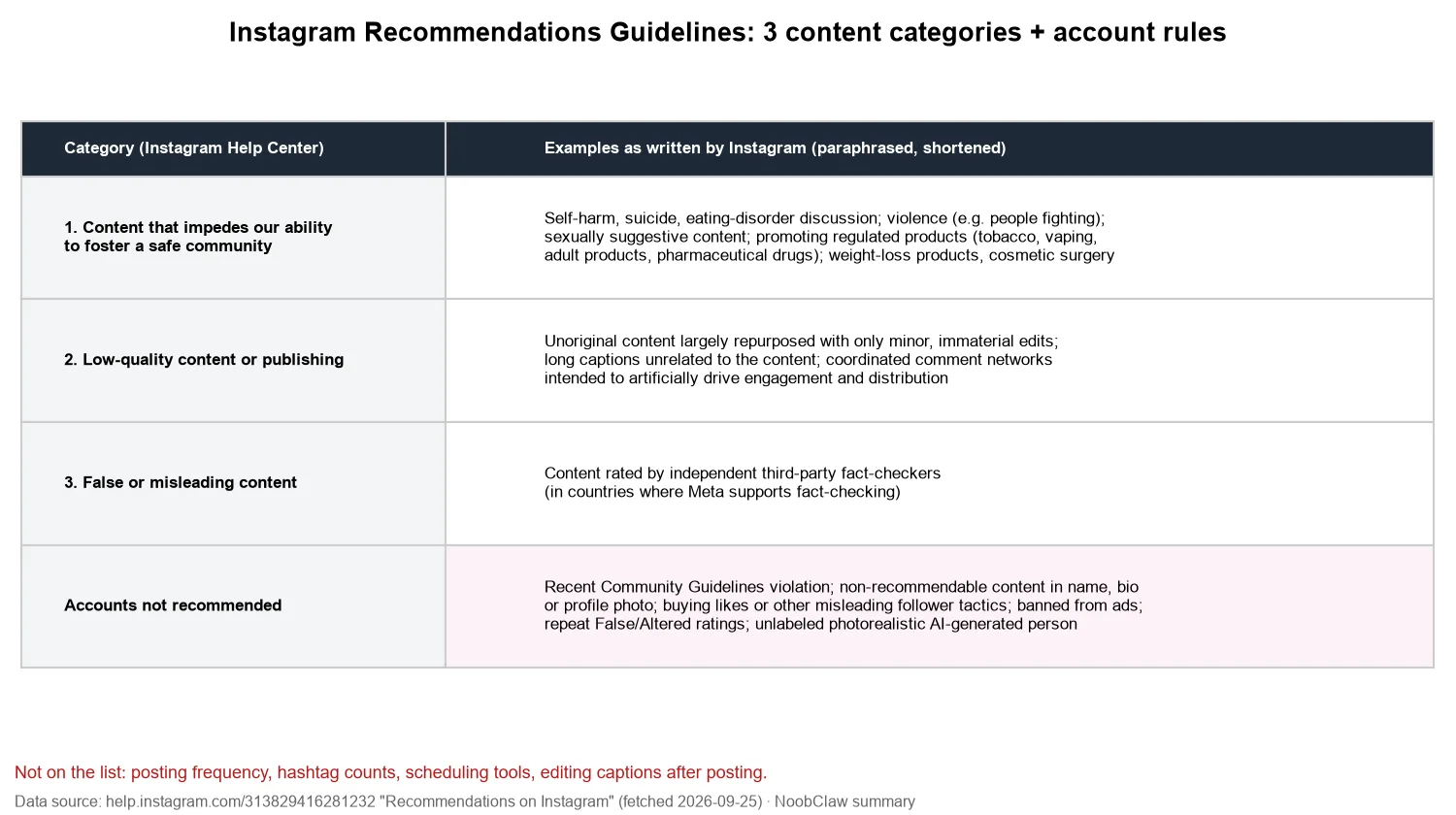
- Content that impedes our ability to foster a safe community: self-harm and eating-disorder discussion, violence such as people fighting, sexually suggestive content, and promotion of regulated products (tobacco, vaping, adult products, pharmaceutical drugs), weight-loss products and cosmetic surgery.
- Low-quality content or publishing: "Unoriginal content that is largely repurposed from another source with only minor, immaterial edits", plus "Long captions unrelated to the underlying content and coordinated comment networks intended to artificially drive engagement and distribution."
- False or misleading content: content rated by independent third-party fact-checkers, in countries where Meta uses them.
- Accounts it tries not to recommend: those that recently violated the Community Guidelines, show non-recommendable content in the name, bio or profile photo, "Repeatedly engaged in misleading practices to build followings, such as purchasing 'likes'", are banned from running ads, repeatedly posted content rated False or Altered, or repeatedly share "a photorealistic AI-generated person, unless the account has disclosed this by adding the AI-generated profile label".
Read it against what circulates online and the gaps are obvious. Posting frequency, hashtag counts, scheduling tools, and editing a caption after posting appear nowhere. Engagement bait and clickbait are on Meta's list of content it reduces in Feed, not on this recommendation list.
One number that circulates did have an official origin. The widely repeated "10 reposts in 30 days" threshold was real: it was part of Instagram's April 2024 originality announcement, which said that "in the coming months" accounts that "repeatedly (10 or more times in the last 30 days)" post content from other Instagram users that they didn't create or enhance in a material way would not be shown where it recommends content (Instagram's wording as quoted by Social Media Today, April 30, 2024; also reported by Digital Music News). Instagram's April 30, 2026 update, Rewarding original creators on Instagram, speaks only of accounts that "primarily post unoriginal content" and restates no count, so don't treat 10 as today's threshold.
Does one flagged post hide the whole account?
It can. This is the part most explainers skip, and the earlier version of this article did too. The first category itself ends with "Content shared by any account that doesn't meet our recommendation guidelines", and the eligibility page spells out the consequence: "If your account is not eligible to be recommended, none of your content will be recommended regardless of whether or not all of your content goes against our Recommendations Guidelines." The Account Status help page describes the trigger as having "recently or repeatedly posted content or have something on your profile (like your profile photo or bio)" that goes against the guidelines.
The Recommendations Guidelines judge a post, but the penalty is often paid by the account. That is why "my followers still see me, nobody new does" is the classic symptom.
Recent policy makes the account-level logic explicit. Instagram's April 30, 2026 update (covered the same day by TechCrunch) said accounts that primarily post unoriginal photos, carousels or reels "will no longer be shown in places where we recommend content", can regain eligibility when "most of their recently posted photos, carousels, and reels are considered original in a 30-day period", and that "75% of recommendations in the US" now come from original posts. On August 31, 2026 Instagram added that unlabeled AI-generated profiles it detects "can check Account Status to see if they're no longer eligible to appear in recommendations."
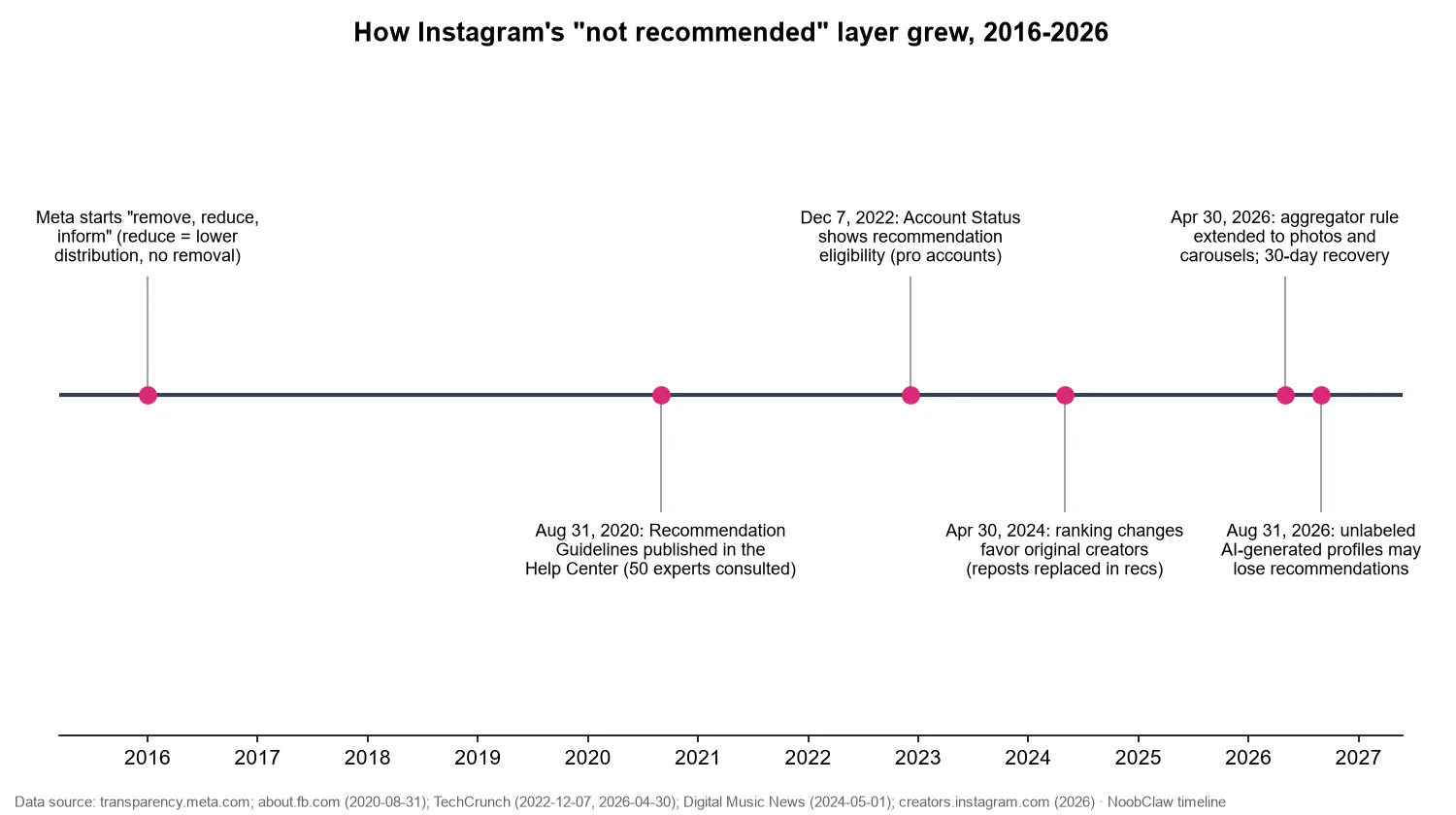
The fix path is inside the app. Since December 7, 2022, professional accounts can open Account Status and tap Recommendations Guidelines. The eligibility page says you can then "See if your content can't be recommended right now" and view a sample of it; the Account Status page adds that you can edit or remove it, or tap "Disagree with decision" so the review team takes another look. Instagram's pages attach no strike to this: under Meta's strike rules, strikes follow content that is removed ("we'll remove it and may then apply a strike"), and content that only misses the Recommendations Guidelines stays up.
Zero views: is it the guidelines or something else?
On September 23, 2026 a creator asked why a Trial Reel was "stuck at 0 views for hours" and missing from their own hashtags, adding that the account was otherwise healthy. That is one person's report, not proof of a platform bug. But the question they asked is the right first question: if many unrelated accounts report the same symptom on the same day, a guideline decision about your content is the least likely explanation.
Run four checks, in this order, before you change your content:
- Open Account Status and tap Recommendations Guidelines (step-by-step here). If it shows a problem, you have your answer and a sample post to act on.
- Compare follower and non-follower reach on five recent posts. If followers fell too, it is not a recommendation issue. Our eligibility guide walks through this split in detail; this page covers the rulebook, that one covers the status.
- Search for same-day reports. A cluster of identical zeros more likely points to a delivery problem than to a policy decision.
- Only then audit the last 30 days against the three categories above, looking for a pattern (reposts, recycled captions, a borderline product niche) rather than one bad post.
If you run several accounts, the second category deserves extra attention. "Unoriginal content" and "coordinated comment networks" describe exactly what a set of accounts sharing one clip and commenting on each other looks like. Giving each account its own material is the defensible pattern; tools such as NoobClaw generate posts per account for that reason, though no tool can guarantee eligibility. More on the aggregator side in why aggregator accounts stop getting recommended and on the vocabulary in non-recommendable vs shadowban.
FAQ
Do I get a strike for going against the Recommendations Guidelines?
Instagram's pages attach no strike to it. The content stays on Instagram and remains visible to followers; what changes is eligibility to be shown to non-followers. Under Meta's counting strikes page, strikes follow content that is removed for violating the Community Standards, which Account Status lists separately under removed content.
How long does it take to become eligible again?
Instagram publishes one window: for unoriginal-content cases, eligibility can return when most posts in a 30-day period are original. For other categories it gives no timer. Editing or removing the flagged content from Account Status, or asking for a review with "Disagree with decision", are the official routes.
Do the guidelines apply to private accounts?
No. Instagram says the guidelines only apply to public accounts and to recommendations to people who do not follow you; a private account's posts are shown only to followers it has approved.
Sources
- Recommendations on Instagram — Instagram Help Center — retrieved 2026-09-25 — https://help.instagram.com/313829416281232
- Recommendation eligibility on Instagram — Instagram Help Center — retrieved 2026-09-25 — https://help.instagram.com/653964212890722
- Check your Account Status on Instagram — Instagram Help Center — retrieved 2026-09-25 — https://help.instagram.com/338481628002750
- Reducing the distribution of problematic content — Meta Transparency Center — retrieved 2026-09-25 — https://transparency.meta.com/enforcement/taking-action/lowering-distribution-of-problematic-content/
- Recommendation Guidelines — Meta Newsroom (Guy Rosen) — 2020-08-31 — https://about.fb.com/news/2020/08/recommendation-guidelines/
- Instagram's new transparency tools will tell you if your content is ineligible to be recommended — TechCrunch — 2022-12-07 — https://techcrunch.com/2022/12/07/instagrams-new-transparency-tools-will-tell-you-if-your-content-is-ineligible-to-be-recommended/
- Instagram Updates Feed Algorithm to Prioritize Original and Emerging Creators — Social Media Today — 2024-04-30 — https://www.socialmediatoday.com/news/instagram-algorithm-prioritize-original-emerging-creators/714777/
- Instagram Algorithm 2024 Changes — Digital Music News — 2024-05-01 — https://www.digitalmusicnews.com/2024/05/01/instagram-algorithm-2024-changes/
- Rewarding original creators on Instagram — Instagram for Creators — 2026-04-30 — https://creators.instagram.com/blog/rewarding-original-creators-on-instagram
- Instagram cracks down on content aggregators — TechCrunch — 2026-04-30 — https://techcrunch.com/2026/04/30/instagram-restricts-reach-of-content-aggregators-in-new-crackdown/
- AI-generated profile label — Instagram for Creators — 2026-08-31 — https://creators.instagram.com/blog/ai-generated-profile-label
- Counting strikes — Meta Transparency Center — retrieved 2026-09-25 — https://transparency.meta.com/enforcement/taking-action/counting-strikes/
- Trial Reels getting 0 views today? (Stuck at exactly 0), opening post — Reddit r/InstagramMarketing — 2026-09-23 — https://www.reddit.com/r/InstagramMarketing/comments/1wo0uoc/trial_reels_getting_0_views_today_stuck_at/
Correction, September 25, 2026: this article was rewritten on this date. The earlier version (August 17, 2026) listed engagement bait and health or financial claims as Recommendations Guidelines categories; Instagram's current Help Center text does not (engagement bait appears on Meta's Feed reduction list instead). It also did not mention Instagram's statement that an account found ineligible has none of its content recommended, and it cited no sources. It also said there was no published timer for regaining eligibility (Instagram publishes a 30-day window for unoriginal-content cases) and that there is typically no notification (professional accounts can see recommendation eligibility in Account Status).