Metricool vs Meta Business Suite: Costs and Workflow Fit
- Metricool Free counts twenty actually published posts per calendar month, not twenty scheduled drafts.
- Metricool team approvals and API access require the eligible plan, not only enough brands.
- Meta’s dated Business Suite announcements do not certify today’s account limits or the best analytics for every task.
Use Metricool and Meta Business Suite as candidates for an actual publishing or reporting task. The important questions are the account and format, required report, people involved and current available controls. A first-party interface is not automatically the deepest possible analytics for every purpose, and a third-party subscription is not automatically useful just because your account list grows.
Compare the eligible configuration for the task, then verify the actual result.
What the current and historical sources establish
Metricool's specific Free-plan guide counts twenty actually published posts per calendar month, resetting on the first. Merely scheduled items and drafts do not count; publication on each network counts separately. Free supports one brand, excludes LinkedIn and X, and retains thirty days of analytics. Read that guide before treating a marketing scheduling label as a queue limit.
Meta's September 17, 2020 Business Suite introduction describes Facebook and Instagram posting, messages, notifications and insights in one interface. A March 28, 2022 small-business announcement includes Meta Business Suite among its free resources. Those are dated official records of the product and its positioning. They do not establish today's account-specific scheduling capacity, every supported format, a universal asset limit or comparative analytics superiority.
Accordingly, inspect the current interface and support available to your own account before relying on a Meta workflow. This article does not certify an unlimited native publishing allowance or a full current menu from a login page. If the needed control cannot be verified, keep that gap visible. Historical product availability and present suitability are related questions, but one is not a substitute for evidence of the other.
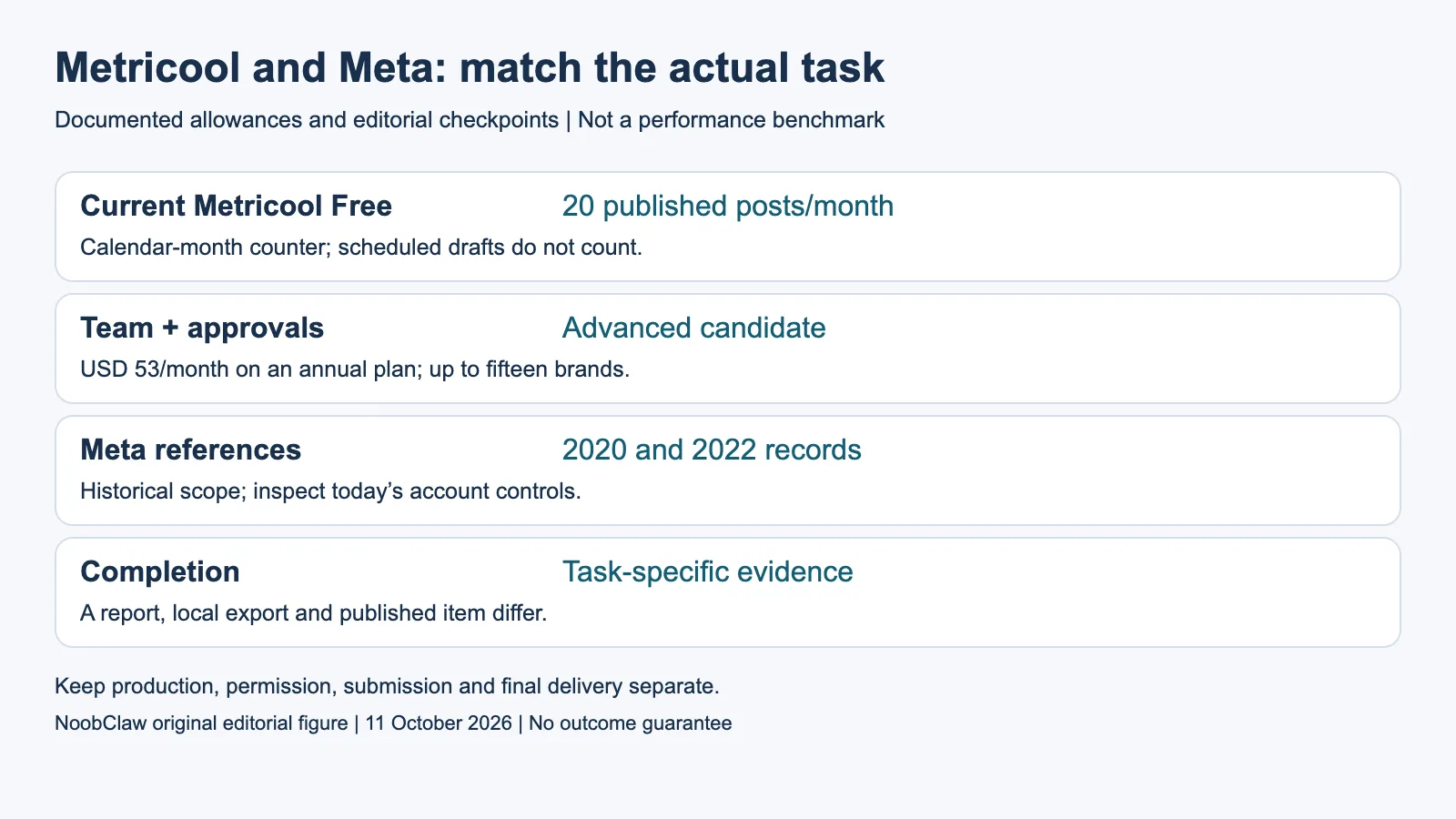
- Current Metricool Free: 20 published posts/month. Calendar-month counter; scheduled drafts do not count.
- Team + approvals: Advanced candidate. USD 53/month on an annual plan; up to fifteen brands.
- Meta references: 2020 and 2022 records. Historical scope; inspect today’s account controls.
- Completion: Task-specific evidence. A report, local export and published item differ.
Match Metricool’s billing term and feature gate
Record the selected currency, billing term, included inventory and applicable tax in the quote. An annual monthly equivalent is a way to express a yearly commitment; it is not a month-to-month invoice. Compare a complete configuration for the same brief rather than selecting the smallest number displayed in a pricing panel.
Team and client management, role control, post approvals and API access are part of the Advanced offer. If the project requires them, Starter's brand capacity is not enough to select the plan. Request the actual report you need before selecting extras. Keep its metric definitions and coverage in the acceptance brief, instead of assuming a broad analytics label satisfies every reporting requirement.
A monthly count of completed publications and a queue of waiting items measure different things. Keep those units separate when comparing free alternatives. An annual base price, an upload capacity and a report's coverage are different fields in the worksheet; none alone establishes the complete suitable configuration.
Worked requirements: single destination or client reporting
Consider two illustrative briefs. The first is one owner with an approved asset who needs to publish to an eligible Facebook or Instagram destination. Evaluate the controls actually available in the account's native workflow and compare them with the proposed supported publisher. If the native route completes the task, a subscription needs a separate practical benefit to justify its cost. This is a decision example, not a test of an unlimited native plan.
The second brief is two employees managing five client brands who need internal review and a reproducible combined report. Metricool Advanced at the fifteen-brand annual USD step has a $53 monthly equivalent, or $636 annually, before tax and extras. That documented candidate includes the relevant team and approval gate, but the team still needs to verify its exact report and account support. A report exists is a weaker acceptance condition than the agreed columns and time window match the source data.
For either brief, define acceptance before trying the workflow. Record the intended account, content format, audience, report metric and time zone. If two products label a metric differently, do not assume the values are directly interchangeable. Retain each metric's definition and observation window. This article does not claim one interface always contains more accurate data or that paying for a reporting plan produces more reach.
Evaluate the missing stage rather than the product category
A useful workflow can combine a preparation tool and a separate publisher or report. Name the missing stage first. A calendar does not settle asset rights, an AI draft does not establish a supported upload, and a report does not certify a cause of changing engagement. Ask each candidate for the exact supported action or output that would complete your brief, not an unbounded promise of management.
NoobClaw's public production example contains a 441-character script and a local 32.6-second video export at 1080 by 1920 pixels and 30 fps. Audio and subtitles were observed; footage relevance, voice quality and asset rights were not approved for release. It does not measure Meta or Metricool publication, analytics depth or account protection. No automatic independent-IP assignment or universal posting capability is established by that record.
The final decision should include the eligible offer, current account evidence, chosen workflow and unresolved checks. Keep a small trial and its actual result before committing a client roster. If the missing task is creative production, inspect the production workflow separately from the publishing plan. If the task is reporting, verify the report against the agreed metrics. This lets a buyer pay for a demonstrated need without treating first-party access, free pricing or automation as a universal answer.
For the related content and workflow decisions, read Metricool vs Rella: Brands, Seats and Approval Costs and Free Social Media Schedulers: Queue Limits and Plan Fit. Each review has its own evidence and scope.
NoobClaw publishes this article. Its script-to-video guide and public creative execution record document a local video result, not external-platform publication. Check the current product offer against the supported action you need.
Frequently asked questions
Is Meta Business Suite automatically better for every Meta task?
Historical first-party product descriptions do not establish comparative superiority for every current report, role or format. Inspect the current controls and define the result you actually need.
Did the twenty-five-brand Metricool dollar price change overnight?
Different selected billing terms do not prove a historical price change. Record the term and currency shown for the actual quote; this article makes no verified overnight-change claim.
Does a free or native interface mean unlimited publication?
No universal capacity is certified here. Check the actual account, format, permitted action and applicable limits; successful submission still needs its own publication result.
Sources
Official material read on October 11, 2026. Current vendor prices identify monthly payment or annual commitment, currency and counting unit. Meta product announcements retain their historical dates; they do not verify every current interface feature. Prices identify their billing term; vendor allowances are not measured publishing results. Hypothetical inventory and cost examples are labeled; the public local-production record has its own limitations.