
How to Report AI Content on Instagram — And What Happens When Someone Reports Yours
- You can report AI content on Instagram from the post or profile menu (Options, then Report), but none of the nine report reasons Instagram lists is "AI". You pick the harm: nudity, scam, false informa
- Being AI-made is not a removal reason on its own. Meta said in 2024 it would stop removing content solely under its manipulated-video policy and label it instead; labels come from industry signals and
- Reports matter more than people think for lower-severity problems: since January 2025 Meta says it waits for a report before acting on less severe violations. For severe harm, an Oversight Board case
- If your own post is reported as AI, the report is anonymous and the outcome depends on whether a written rule was broken. AI persona accounts that skip the new AI-generated profile label risk losing r
Yes, you can report AI content on Instagram. What you cannot do is report it for being AI. We went through Instagram's own help page on reporting on 26 September 2026: it lists nine reasons a post can be reported, and not one of them mentions artificial intelligence. The reason you pick decides which rule your report is checked against.
Below: the viewer's side first, then the creator whose post was reported.
Can you report AI content on Instagram? The steps and the nine reasons
According to Instagram's help page on reporting a post or profile, you tap Options (the three dots) on the post and choose Report, or open the account's profile, tap Options next to the username and report the account. Stories, reels, messages and live broadcasts each have their own report entry, listed on the report content hub.
The same page lists the reasons you can currently report a post for:
- I just don't like it
- Bullying or unwanted contact
- Suicide, self-injury or eating disorders
- Violence, hate or exploitation
- Selling or promoting restricted items
- Nudity or sexual activity
- Scam, fraud or spam
- False information
- Intellectual property
A profile can also be reported for pretending to be someone else or for belonging to a child under 13. Reports are anonymous, with one exception spelled out on the page: intellectual property reports.
There is one place where the word "AI" does appear in the report flow: custom AI characters built in Meta's AI Studio. That help page gives a separate Report AI button inside the chat. It is for chatbots, not for AI-made posts in your feed.
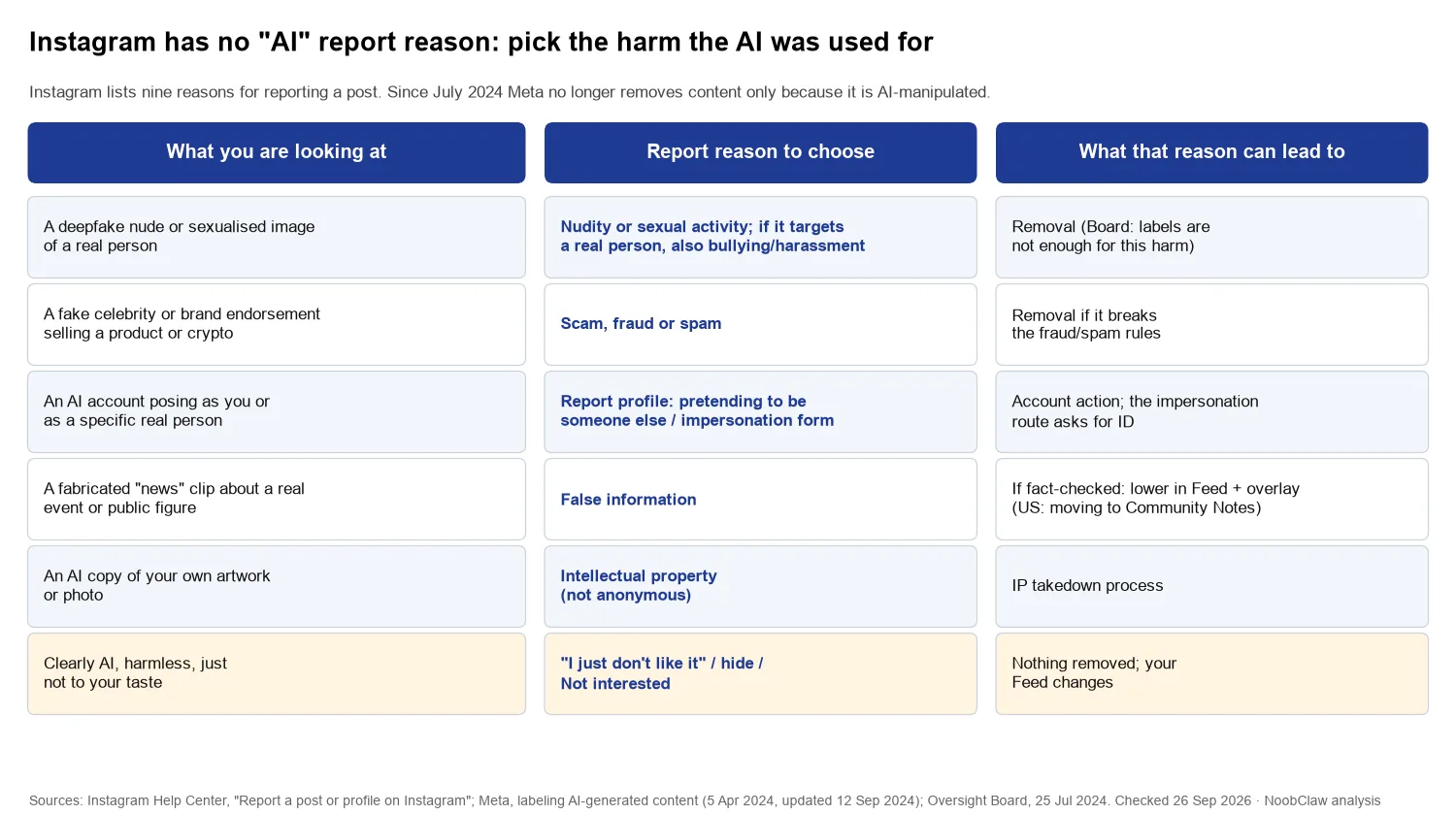
Why "it's AI" is not a report reason (and what to pick instead)
Meta made a deliberate choice here. In its April 2024 post on labeling AI-generated content, it said it would start labeling organic AI content in May 2024 and "stop removing content solely on the basis of our manipulated video policy in July." Labels, shown as "AI info" since a July 2024 update, are added when Meta detects industry-standard AI indicators or when the uploader discloses AI use. The same post draws the line that matters for reporting: Meta says it will still remove content "regardless of whether it is created by AI or a person" when it breaks another rule, such as bullying and harassment or voter interference.
So the technique is not the offence. The harm is. In practice:
- A sexualised deepfake of a real person: report it as nudity or sexual activity; if it targets a real person, bullying or harassment is also a fit, which is the policy Meta used in the case below. This is the harm where Meta's Oversight Board said labels are not enough.
- A fake celebrity endorsement for a product or a coin: scam, fraud or spam. Meta's January 2025 policy post names fraud and scams among the high-severity areas its automated systems still hunt for proactively.
- An AI account posing as you or a specific real person: report the profile for pretending to be someone else, or use the impersonation route, which also works if you have no Instagram account.
- A fabricated "news" clip about a real event: false information. Where Meta works with fact-checkers, content rated False or Altered is shown lower in Feed with an overlay, per Meta's 2024 description; in the US, Meta announced in January 2025 that it would end third-party fact-checking and move to Community Notes.
- An AI copy of your own artwork or photo: intellectual property, the one reason the help page says is not anonymous.
- Clearly AI, harmless, just not for you: "I just don't like it", or hide it. Nothing is removed; your Feed changes.
Reporting "it is AI" asks Instagram to enforce a preference. Reporting the impersonation or the scam asks it to enforce a rule it has written down.
An account that is obviously an AI-generated person but does not say so is handled through detection, not reports. Since its AI-generated profile label announcement, profiles that feature an AI-generated person and do not add the label "may see limits to their profile's reach," and unlabeled profiles it detects are notified. There is no report reason for "undisclosed AI persona" unless it is also impersonating someone or running a scam.
What happens after you report: the 48-hour case
Two official facts shape what happens after you report.
First, reports carry more weight for lower-severity problems than they used to. In "More Speech and Fewer Mistakes" (7 January 2025), Meta said its automated systems would focus on "illegal and high-severity violations" and that "for less severe policy violations, we're going to rely on someone reporting an issue before we take any action." For a misleading but harmless AI post, your report may be the only trigger.
Second, a report can time out, at least in one documented case. The clearest public record is the Oversight Board's decision on explicit AI images of female public figures (25 July 2024). An Instagram account that posted only AI-generated or manipulated images of Indian women shared a nude deepfake of a public figure. A user reported it for pornography; "as the report was not reviewed within 48 hours, it was automatically closed." The user's appeal to Meta was also closed automatically. Only after the user appealed to the Board did Meta remove the post, disable the account and add the image to its Media Matching Service bank, which removes copies automatically. Meta removed it under its Bullying and Harassment policy, not the pornography reason the user had picked, and the Board said it "does not yet have sufficient information on Meta's use of auto-closing generally." The Board added a line worth remembering: "Labeling manipulated content is not appropriate in this instance because the harms stem from the sharing and viewing of these images."
Our reading of that case, and of the January 2025 change: the report flow works best when the harm is clear and matches the reason chosen, and it is weakest when the reviewer has to infer the harm from "this looks fake." If a serious report is closed without action, appeal. People in the EU also have the Digital Services Act routes: an internal complaint that platforms must accept for at least six months after a decision (Article 20), and certified out-of-court dispute bodies (Article 21).
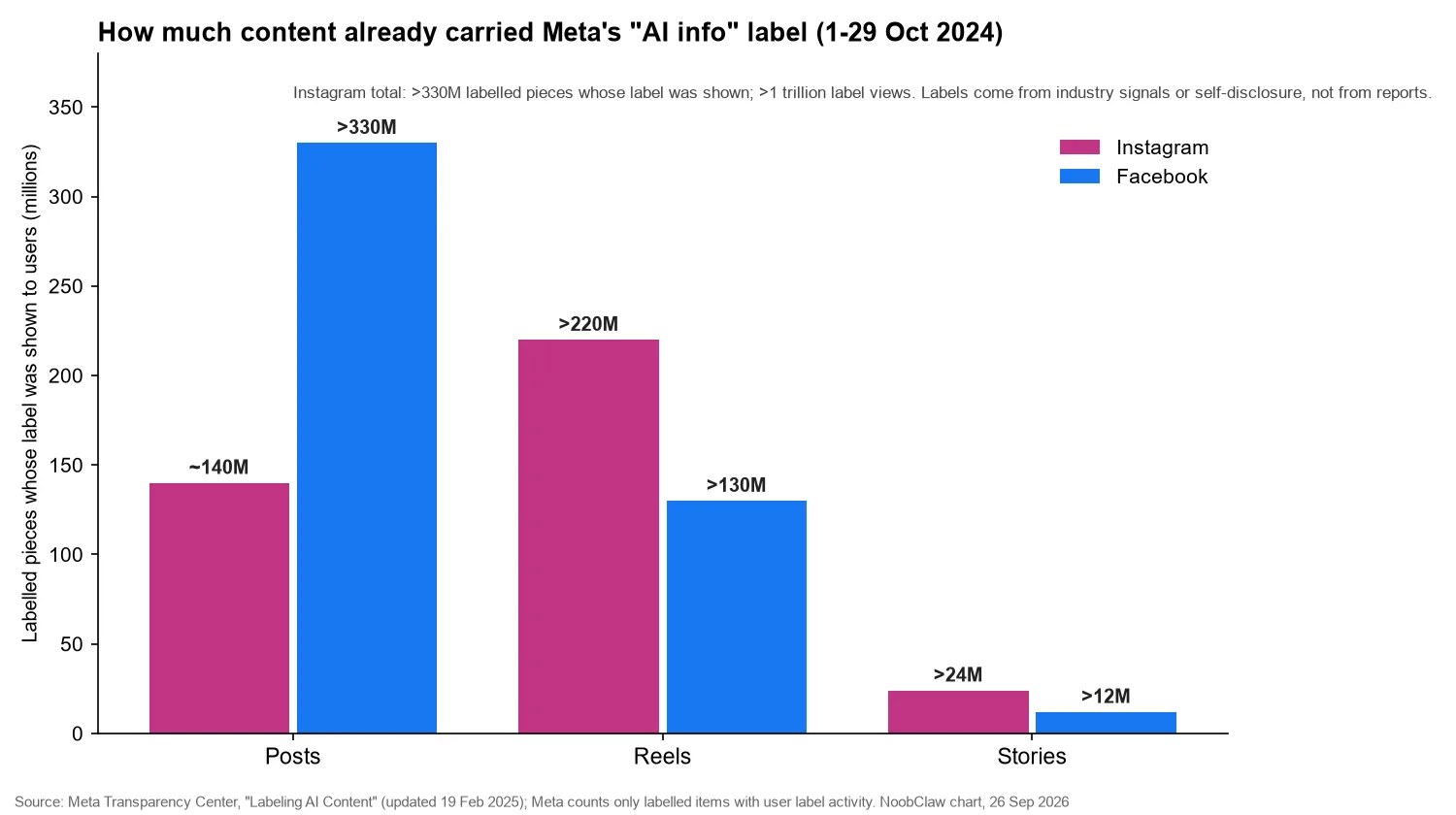
It also helps to see how much AI content is labelled without anyone reporting it. Meta's Transparency Center page on labeling AI content says that between 1 and 29 October 2024, over 330 million labelled pieces of Instagram content had their label shown to users, with over 1 trillion label views.
When someone reports your post as AI: what decides the outcome
If your post was reported: the report is anonymous, it is not a verdict, and being AI-assisted breaks no rule by itself. What decides the outcome is whether the post breaks a written rule under the reason the reporter chose.
Three things are in your control well before any report arrives:
- Disclose where it applies. Meta labels content when it detects industry signals or when you self-disclose at upload. Since a September 2024 update, content that was only edited with AI tools has its "AI info" label moved into the post's menu, while content Meta detects as generated keeps the visible label. A label is information for viewers, not a strike. Our guide on removing the AI label on Instagram explains why chasing it off is the wrong fix.
- Label an AI persona account. If the account features an AI-generated person, turn on the AI-generated profile label. Instagram says creators who add it proactively "will not see a change to their profile's reach," and unlabeled profiles that become non-recommendable have two paths back: add the label, or appeal through Account Status.
- Know where decisions show up. Content removals and feature limits appear in Account Status, and professional accounts also see their recommendation eligibility there; the steps are in our Instagram Account Status guide. Instagram's Account Status help page says that in most cases you get a warning before losing access to an account.
For anyone running several accounts, the unit that matters is the account, not the post. Instagram treats unlabeled realistic AI personas as an account-level problem in its recommendation rules, and repeatedly posting unoriginal content can make a whole account non-recommendable (details in what counts as original content). If you produce posts for several accounts with an AI workflow, NoobClaw included, the tool can make each account's content different, but the disclosure choices stay with you: the upload disclosure and the profile label are Instagram settings you turn on yourself.
FAQ
Will the person know I reported them?
No. Instagram's help page says reports are anonymous and "the account you reported won't see who reported them." The exception, per the same page, is an intellectual property report. Report because something breaks a rule, not to hit a competitor.
Can you report an Instagram account for being AI?
Only indirectly. There is no "this account is AI" reason. If the AI account is pretending to be a specific real person, report the profile for pretending to be someone else or use the impersonation form. If it sells something with fake claims, report it as a scam. An openly AI account that breaks no rule is not reportable as such; Instagram expects those accounts to carry the AI-generated profile label and limits the reach of those it detects without it.
My post got an "AI info" label I did not expect. Is that a penalty?
No. The label comes from industry-standard indicators written into the file by an editing or generation tool, or from your own disclosure; Meta says edited-only content now shows the label in the post menu rather than on the post. Check which app in your workflow writes provenance data (our note on why the Content Credentials label appears walks through it). If something affected your reach, that shows in Account Status, where you can request a review.
Sources
- Report a post or profile on Instagram — Instagram Help Center — accessed 26 Sep 2026 — https://help.instagram.com/192435014247952
- Report content on Instagram — Instagram Help Center — accessed 26 Sep 2026 — https://help.instagram.com/2922067214679225/
- Report a custom AI on Instagram — Instagram Help Center — accessed 26 Sep 2026 — https://help.instagram.com/1012385660561682/
- Report an account that's impersonating you on Instagram — Instagram Help Center — accessed 26 Sep 2026 — https://help.instagram.com/370054663112398
- Our Approach to Labeling AI-Generated Content and Manipulated Media — Meta Newsroom — 5 Apr 2024 (updated 1 Jul and 12 Sep 2024) — https://about.fb.com/news/2024/04/metas-approach-to-labeling-ai-generated-content-and-manipulated-media/
- More Speech and Fewer Mistakes — Meta Newsroom — 7 Jan 2025 — https://about.fb.com/news/2025/01/meta-more-speech-fewer-mistakes/
- New Decision Addresses Meta's Rules on Non-Consensual Deepfake Intimate Images — Oversight Board — 25 Jul 2024 — https://www.oversightboard.com/news/new-decision-addresses-metas-rules-on-non-consensual-deepfake-intimate-images/
- Labeling AI Content — Meta Transparency Center — updated 19 Feb 2025 — https://transparency.meta.com/governance/tracking-impact/labeling-ai-content/
- Introducing the AI-generated profile label — Instagram for Creators — 31 Aug 2026 — https://creators.instagram.com/blog/ai-generated-profile-label