
Same Video on Two TikTok Accounts: Posting vs Reach
- Multiple accounts do not guarantee recommendation eligibility for a duplicate upload.
- Unoriginal content may be ineligible for the For You feed; check the notice in Analytics.
- Do not use a second account to evade restrictions on another account.
- If a post or account is restricted, review the notice and use the available official appeal path.
You can have multiple TikTok accounts, but duplicating a video is not a guarantee of reach or recommendation eligibility. TikTok's Community Guidelines say it in plain words, "You can have multiple accounts—for example, for fan content or creative expression—but not to deceive others or break the rules", but that permission does not guarantee distribution for every duplicate upload. Check the rights to the video, the post's eligibility notice and any restrictions on either account before publishing.
What the guidelines do govern is what happens next. A duplicate raises a recommendation-eligibility question. TikTok has not explicitly explained how it treats a creator uploading their own video on a second account, so check the post's actual eligibility notice rather than predict its reach. For two specific setups it becomes an enforcement question, and since September 24, 2026 the worst case can reach both accounts at once. This page sorts the common two-account situations into those buckets. If you meant posting the same video twice on one account, that is a different mechanism, covered in can you post the same video twice on TikTok.
What do TikTok's rules actually say about one video on two accounts?
Three sentences do almost all the work, and we re-read each of them in the current guidelines (released August 25, 2026, in force since September 24, 2026) before rewriting this page.
The first is the permission quoted above. The second sits in the intellectual-property part of the Integrity and Authenticity chapter: "Content is also ineligible for the FYF if it includes unoriginal or reused material without anything new." The For You list under it names "Reused or unoriginal content posted without creative edits, such as clips that show someone else's watermark or logo."
Read those two lines closely and a useful distinction appears. The rule says "reused material without anything new"; it does not say "someone else's material". Its example, though, is about someone else's watermark. TikTok has not published how it treats a creator re-uploading their own clip on their own second account, so nobody outside TikTok can promise you it is exempt. Our reading: plan as if the second copy is judged like any reused clip, because that is what the sentence literally covers.
The third sentence tells you what "ineligible" costs: "Even if a video doesn't make it to the FYF, people may still find it through search or by going to a creator's account." The quoted guidance says people may still discover an FYF-ineligible post through search or the creator's profile. FYF ineligibility alone does not mean that every non-follower is unable to find it; check any separate restriction or removal notice.
Multiple accounts are not prohibited on their own. Recommendation eligibility and restriction-evasion questions depend on the content and account notices; the guidance does not give a universal verdict for every second-account upload of a creator's own video.
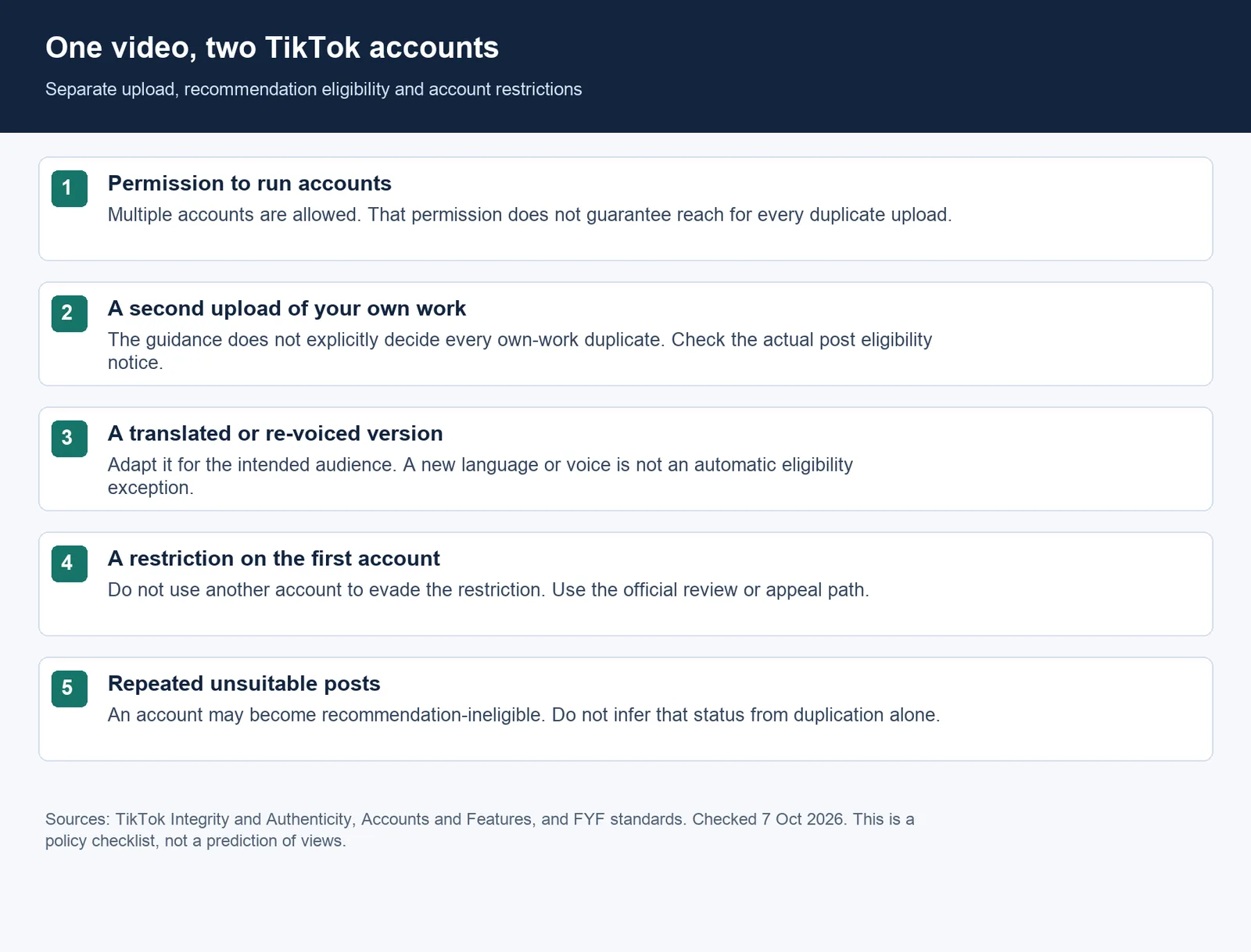
When does the second upload become a rule problem?
TikTok's official account and content guidance explains how to review an ineligible-post notice and appeal it. Its account recommendation guidance also covers repeated unsuitable posts. Checked October 7, 2026.
The next two cases concern rules stated in the guidelines rather than a prediction of how many views a duplicate will receive.
1. Account A's video was restricted, so you post it on account B
This one is written down almost word for word. The circumvention list in the same chapter includes "Using another account to avoid restrictions, such as comment blocks or FYF-ineligible content restrictions", next to "Spreading violative content across multiple accounts". So the most tempting move after a video stalls, "it got restricted here, let me try it on my other account", is the one move in this whole topic that TikTok names as deceptive behavior. The listed responses include banning your account, banning additional accounts you create, or restricting it.
You do not have to guess whether a video was restricted. The enforcement chapter says that "If your content is made ineligible for the FYF or otherwise restricted, this information will appear in the TikTok analytics tool", and that you "may appeal the decision" if you think it was an error. If the analytics show a restriction, appeal on account A. Do not route around it on account B.
A concrete policy update illustrates the difference between dates and account outcomes. The previous version became effective on September 13, 2025. The current version was released on August 25, 2026 and became effective on September 24, 2026. Its associated-account wording matters when the stated enforcement conditions apply; it is not evidence that uploading your own video twice triggers a ban. Read the current conditions and the actual notice before deciding what to do with the second account.
2. Account B mostly lives on copies of account A
The Accounts and Features chapter also describes account-level recommendation ineligibility for repeated unsuitable posts: "Sometimes, accounts that don't break the rules still post a lot of content that's ineligible for the FYF. In those cases, we may make the account and its content ineligible for the FYF and harder to find." If the backup repeatedly posts videos found unsuitable for the FYF, TikTok may make the account and its posts ineligible for recommendation. Running a backup or uploading your own work twice does not, by itself, establish that this account-level finding has been made.
What changed on September 24, 2026
The new version extended one sentence in the same chapter. The previous text said TikTok "may ban all of their accounts"; the current one reads "If someone seriously breaks the rules or tries to dodge enforcement, we may ban all of their accounts, including associated accounts." Posting one video on two accounts does not trigger that clause by itself. It can change the downside of case 1: dodging enforcement is one of its two triggers, and "associated" is not defined anywhere we could find. Treat your two accounts as one risk when you decide whether to route around a restriction.
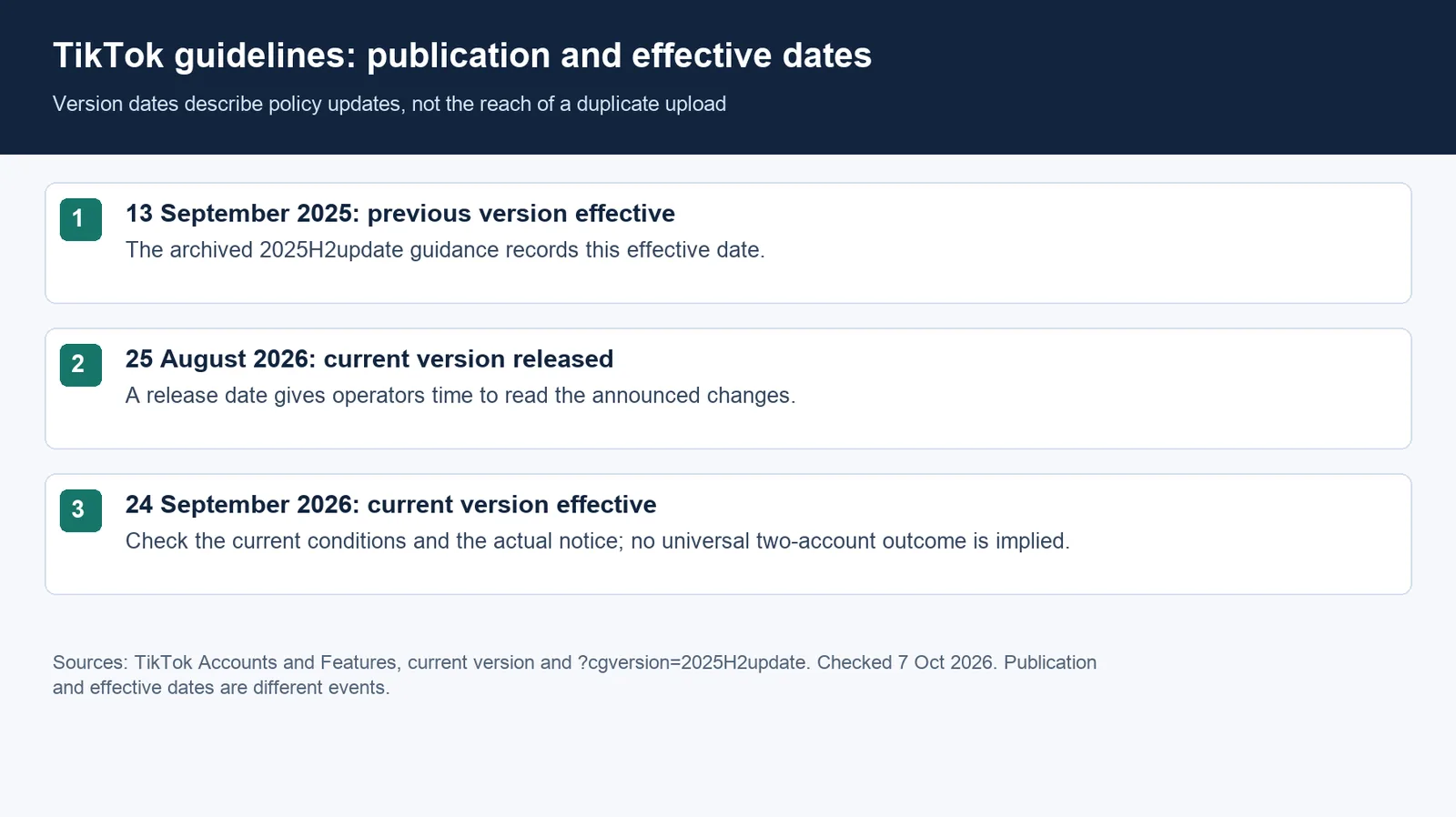
Which two-account setups are fine, and which are not?
The table covers five common two-account situations. The verdicts below follow from the three sentences above; where a row is our reading rather than written rule, it says so.
| Your setup | Verdict | What to do instead of a straight copy |
|---|---|---|
| Main account plus a backup that re-posts the same library | Multiple accounts are allowed; repeated FYF-ineligible posts may affect account eligibility | Give the backup a distinct purpose and check its actual recommendation status |
| Personal account plus brand account, occasional overlap | Multiple accounts are allowed; recommendation eligibility for a duplicate is not guaranteed | Post on the account whose audience it fits; mention it from the other one |
| English account plus Spanish account | The guidance does not specify whether a translated version qualifies as new content | Adapt the explanation and presentation for that audience; a new voice is not an eligibility guarantee |
| Video flopped on A, retry on B | No guarantee of recommendation; distinguish low performance from an active restriction | Consider a different opening as an editorial experiment; neither editing nor re-uploading guarantees recommendation eligibility |
| Video was restricted on A, post on B | Named as circumvention | Check analytics, appeal on A |
There is also a platform-native answer that sidesteps duplication entirely, if your app has it. In May 2024 Social Media Today reported TikTok testing collaboration posts: one post shown on the creator's and the collaborators' profiles, up to 5 invited creators, and invitations limited to four times a month. We could not find an official TikTok help page confirming a global rollout, so treat it as "check your own post screen", not as a feature everyone has. Where it exists, one post on two profiles is a different object from two uploads.
How do you reuse one idea on two accounts without reusing the file?
Publishing the same video on YouTube as well? Read the YouTube two-channel guide separately; TikTok permission does not establish YouTube monetization eligibility.
For the intended audience, consider a different opening, relevant footage or angle, or localized narration. These are editorial choices for making a useful version, not an official qualification checklist. TikTok has not published a universal threshold for a creator re-uploading their own work; a new caption, file edit or voice track is not a recommendation-eligibility guarantee.
Creating distinct versions requires additional production as account count grows. For a larger account set, the related workflow is covered in posting the same video on multiple TikTok accounts.
If you run several accounts and need content for distinct audiences, NoobClaw can generate scripts from each account's niche and persona. Its video workflows include translation and re-voicing, but output still needs review: a translated version is not a guarantee of originality or recommendation eligibility. Supported publishing tasks use the account's logged-in browser session. These are product mechanisms, not platform permission; distinct scripts do not establish that TikTok permits a multi-account automation workflow. Check the live workflow catalog for supported tasks and plan credits and account limits before choosing a setup.
FAQ
Can I post the same video twice on the same TikTok account?
A second upload is not a guaranteed reset or recommendation boost. Check analytics for an ineligible-post notice first. If a restriction is active, appeal it rather than using a new upload or account to bypass it. That single-account version is covered in can you post the same video twice on TikTok, and the delete-first variant in is deleting and reposting on TikTok bad.
Will TikTok ban both accounts if I post the same video on each?
Not for that alone. The "associated accounts" clause is triggered when someone "seriously breaks the rules or tries to dodge enforcement". An ordinary duplicate is neither. Reposting a restricted video on your second account is the scenario that gets closest, because it is listed as circumvention.
Does it matter that both accounts are on the same phone?
TikTok does not publish what makes accounts "associated", so no one can tell you which signals count. Having two accounts in the app is normal; the guidelines allow it. The device question is covered in managing multiple TikTok accounts on one phone. What you control is the part the guidelines do describe: what each account posts, and never using one account to get around the other's restrictions.
Sources
- Integrity and Authenticity (multiple accounts, FYF eligibility, circumvention) — TikTok Community Guidelines — released 2026-08-25 / effective 2026-09-24 (checked 2026-09-26) — tiktok.com/safety/en/policies-and-engagement/integrity-authenticity
- Accounts and Features (account-level FYF ineligibility, associated accounts) — TikTok Community Guidelines — effective 2026-09-24 (checked 2026-09-26) — tiktok.com/safety/en/policies-and-engagement/accounts-features
- Enforcement (analytics shows FYF ineligibility, appeals) — TikTok Community Guidelines — effective 2026-09-24 (checked 2026-09-26) — tiktok.com/safety/en/policies-and-engagement/enforcement
- For You feed standards — TikTok Community Guidelines — effective 2026-09-24 (checked 2026-09-26) — tiktok.com/safety/en/policies-and-engagement/fyf-standards
- TikTok Is Testing a Collaboration Feature for Posts — Social Media Today (Andrew Hutchinson) — 2024-05-13 — socialmediatoday.com
- Accounts and Features — TikTok Community Guidelines, archived 2025H2update — effective 2025-09-13, checked 2026-10-07 — TikTok archived guidelines
Correction, 7 October 2026: clarified recommendation eligibility and account-specific notices, removed unsupported reach or restoration predictions, and updated the explanatory charts.