T in Instagram Views Means Thousand: 1.2T = 1,200 Views
- T means thousand. "1.2T views" is roughly 1,200 views, not 1.2 trillion and not a separate metric.
- The source is the English (India) number format in the Unicode CLDR locale data that phones use: releases 39 to 44 abbreviated thousands as T (and lakh as L, crore as Cr). CLDR 45, released April 2024
- Android 13 and 14 ship CLDR 40 and 42. That is the most likely route for T onto phones set to English (India), and likely why the same letter shows up in Facebook and Snapchat counts too; Meta has not
- 30-second check: find a small, unabbreviated count on the same screen and compare, or look at your phone language. If it says English (India), T is thousand.
You opened your professional dashboard, saw "1.2T views" in the last 30 days, and searched what T means. Short answer: T means thousand. 1.2T is about 1,200 views. Your account did not get 1.2 trillion views, and T is not a new metric Instagram forgot to explain.
We rewrote this page on September 26, 2026 after checking where the letter actually comes from. An earlier version of our dashboard article called T a formatting error; that was wrong, and so was this page's old German analogy, which the locale data does not support. The real source turned out to be something anyone can verify: the number format for English (India).
What does T mean in Instagram views?
Phones do not invent their own abbreviations. Android formats numbers using locale data from the Unicode Common Locale Data Repository (CLDR), which defines how each language and region writes compact numbers like "1.2K" (the rules are in Unicode Technical Standard #35, Part 3: Numbers).
For English (India), CLDR's short format for a thousand was "0T" in releases 39 through 44. You can read it in the raw data: in the en-IN numbers file at CLDR 44.1.0 the entries are "0T" for thousands, "0L" for lakh (100,000) and "0Cr" for crore (10 million). In the same file at CLDR 45.0.0, thousands became "0K" again while L and Cr stayed. CLDR 39 was released on April 7, 2021 and CLDR 45 on April 17, 2024.
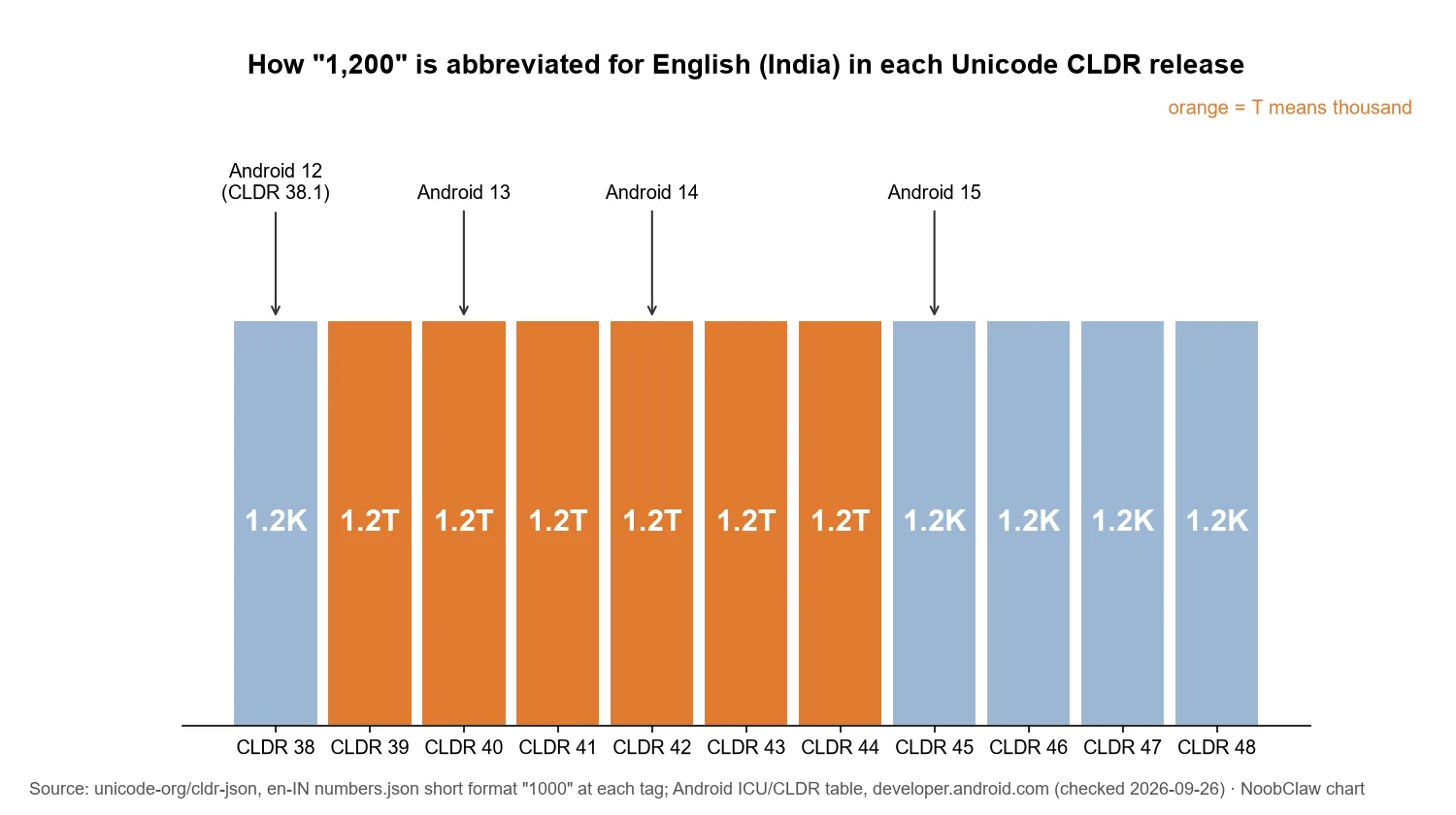
Now match that to phones. Android's own documentation lists the locale data each release ships: Android 13 ships CLDR 40, Android 14 ships CLDR 42, Android 15 ships CLDR 45 (Unicode and internationalization support, Android Developers). Android 12 shipped CLDR 38.1, before the T format appeared. So a phone on Android 13 or 14 set to English (India) writes 1,200 as "1.2T" in any app that asks the system to shorten the number.
T is not Instagram's letter. It is your phone writing "thousand" the way its English (India) locale data told it to.
A caveat we want to be clear about: Meta has not published how Instagram formats these numbers, and we have not seen Instagram's code. What we can say is that the English (India) locale data explains the letter exactly, including the other letters people ask about (L and Cr), while no Meta help page defines a "T" metric. The insights article lists views, viewers, interactions and followers, and views is simply "The number of times your content was played or displayed" (About Instagram insights).
The 30-second check
You do not need to trust us. Two ways to confirm it on your own screen:
- Calibrate against an unabbreviated number. Numbers under 1,000 are shown in full, with no letter. Find one on the same screen (a recent post with a three-digit count works) and compare it with the abbreviated figures around it. A post showing 870 sitting next to one showing 1.1T tells you T is a thousand, not a trillion.
- Check your phone language. On Android, open Settings, then System, then Languages. If the top entry is English (India), that is the format producing the T. If Instagram uses the system formatter, switching the phone to another English variant (US or UK) should turn T into K; updating to a newer Android release should do the same, because CLDR 45 and later use K. Switch back whenever you like: the data underneath does not change.
We have not tested whether Instagram's in-app language setting changes the letter, or every iPhone configuration; if the phone-language check doesn't settle it, the calibration method in step 1 is the reliable one.
Why search results say T means trillion
Some answers online read T as trillion, because in finance K, M, B, T is the usual ladder. That reading fails a one-second check: the whole world has about eight billion people, so 1.2 trillion views on one account's 30-day dashboard is not possible. When an answer requires the number in front of you to be absurd, it is matching the wrong context.
The searches themselves point at the real cause. On September 26, 2026, Google autocomplete for "1.2 t views" (India region) suggested "1.2 t views kitna hota hai" (how much is it), "1.2 t views in the last 30 days" and "1.2 t views means in facebook"; "t views in snapchat" completed to "1.2 t views in snapchat" and similar. The same letter appearing in Instagram, Facebook and Snapchat counts, asked about with Hindi phrasing, is exactly what a phone-level English (India) format would produce, and not what an Instagram metric would. On our own site, this page drew 43 different search queries in the 28 days to September 23 (Google Search Console), almost all variants of "t means in instagram" with a number in front.
What about K, L and Cr?
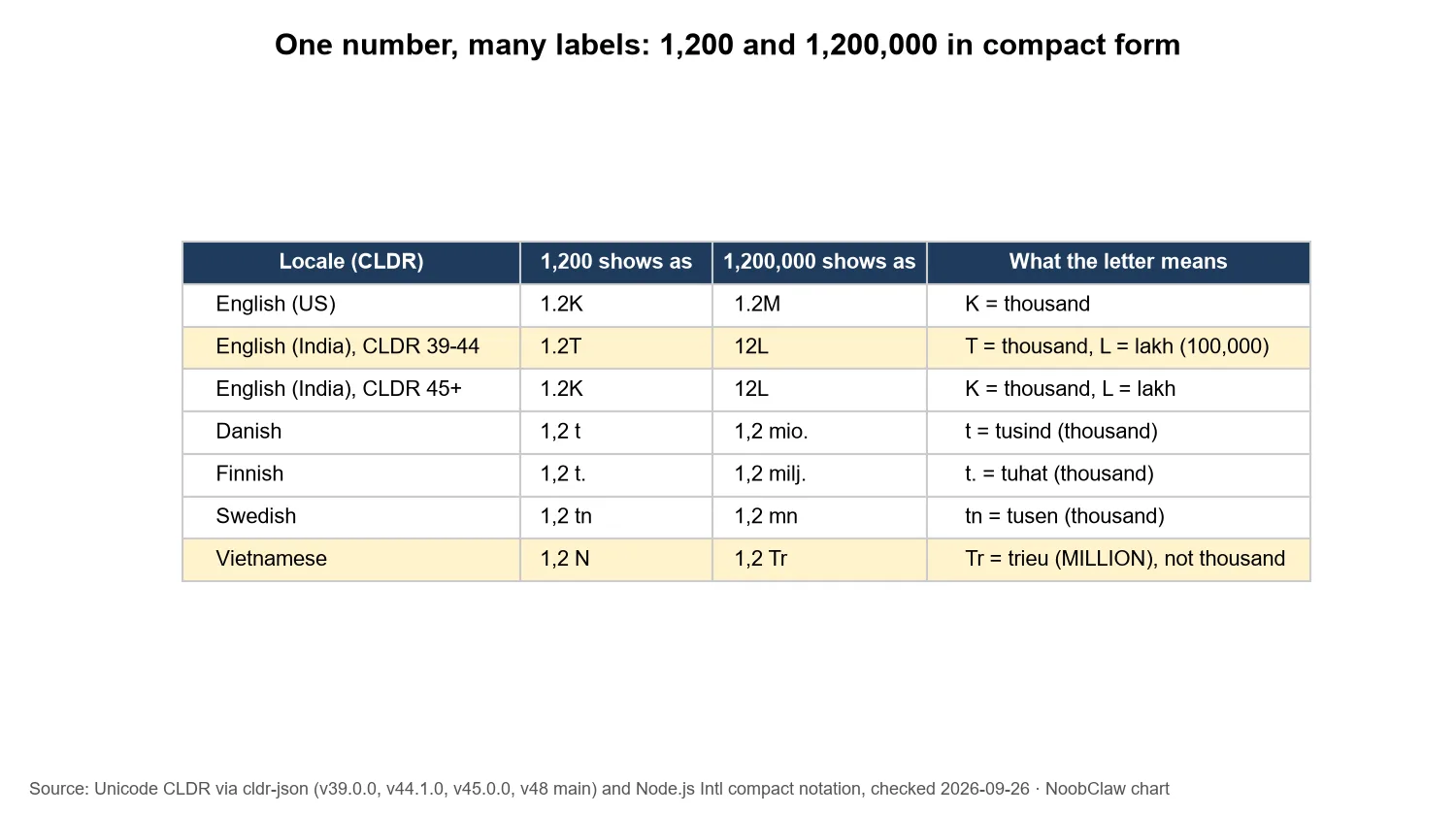
In the English (India) format that produces T:
- T = thousand. 1.2T is about 1,200; 17.7T is about 17,700; 40T is about 40,000.
- L = lakh, 100,000. 12L is 1.2 million.
- Cr = crore, 10 million.
- K = thousand in US or UK English, and in English (India) from CLDR 45 on.
So "difference between k and t in instagram" has a simple answer: none in value. Both mean thousand; which letter you see depends on the locale data behind the screen. If you see K in one place and T in another on the same phone, the likely reason is that different parts of the app format numbers differently. The value is the same.
One warning so you do not over-apply the rule: a T-like letter is not always a thousand in every language. In the CLDR data, Danish writes thousand as "t" and Finnish as "t.", but Vietnamese uses "Tr" for million (triệu) and "N" for thousand. If your phone is not in English, run the calibration check rather than assuming.
If you read dashboards for several accounts
This stops being a curiosity once you compare accounts, or once screenshots from a team member in India land next to yours. A spreadsheet typed by eye will quietly treat "1.2T" and "1.2K" as different things, or worse, read "12L" as twelve. Two habits prevent it: agree on one phone language for anyone who reports numbers, and record raw figures from each post's insights rather than abbreviated screenshots. The number format is presentation; what the dashboard figure actually counts is a separate question, covered in what dashboard views mean on Instagram.
Keep three layers apart when a number surprises you: the letter (formatting, harmless), the definition (views now pools Reels, posts, Stories, Live and ads, repeats included) and the trend (actual distribution). Only the third is about your content. If that one is falling, start with the follower versus non-follower split or why Reels get stuck at a view count.
FAQ
Is 1.2T views the same as 1.2K views?
Yes. Both are about 1,200. T is the thousand abbreviation in the English (India) number format of CLDR releases 39 to 44; K is the one used elsewhere and in newer releases.
Does the letter affect my reach?
No. It only changes how a number is written on your screen. Distribution is decided by what you post and how people respond, not by your phone's number format.
Why did T appear without me changing anything?
The likely trigger is a system update or a new phone that brought newer locale data while your language stayed on English (India), or a language setting chosen during phone setup. If T later turns back into K, a further update to CLDR 45 or later is the usual reason.
The takeaway: read T as thousand, confirm it once against a small unabbreviated number, and spend your attention on the trend line instead.
Sources
- en-IN numbers.json at CLDR 44.1.0 — Unicode Consortium (unicode-org/cldr-json) — 2023 — https://github.com/unicode-org/cldr-json/blob/44.1.0/cldr-json/cldr-numbers-full/main/en-IN/numbers.json
- en-IN numbers.json at CLDR 45.0.0 — Unicode Consortium (unicode-org/cldr-json) — 2024 — https://github.com/unicode-org/cldr-json/blob/45.0.0/cldr-json/cldr-numbers-full/main/en-IN/numbers.json
- CLDR 45 Release Note — Unicode CLDR — 2024-04-17 — https://cldr.unicode.org/downloads/cldr-45
- CLDR 39 Release Note — Unicode CLDR — 2021-04-07 — https://cldr.unicode.org/downloads/cldr-39
- UTS #35 LDML Part 3: Numbers (compact number formats) — Unicode Consortium — current — https://www.unicode.org/reports/tr35/tr35-numbers.html
- Unicode and internationalization support (ICU and CLDR versions by Android release) — Android Developers — read 2026-09-26 — https://developer.android.com/guide/topics/resources/internationalization
- About Instagram insights — Instagram Help Center — read 2026-09-26 — https://help.instagram.com/788388387972460