X API Free Tier: Current Credits, Costs and Posting Rules
- The current API uses metered credits; conditional free-credit incentives are separate from an unlimited free tier.
- An account-specific credit offer is not guaranteed, permanent or the same as xAI model credits.
- X prohibits non-API website scripting; a logged-in browser does not certify an automated posting route.
The useful answer to X API free-tier questions is the current offer, its conditions and the cost of your actual requests. The public documentation includes conditional credit incentives, so a blanket claim that there is no possible free credit is inaccurate. At the same time, those incentives do not create unlimited free posting. Determine what you need to read or publish, inspect the available account terms and separate API billing from platform automation permission.
Identify the exact action, counting unit and available evidence before choosing a workflow.
Distinguish request pricing from promotional credits
The current pricing page describes pay-per-use credits. Its selected rows price ordinary Post Create at $0.015 per request, creation with a URL at $0.200, and Post Read at $0.005 per resource. These units differ: a returned resource is not the same as a request. Check the actual endpoint classification and current rates before budgeting a workflow, rather than assigning one price to every call.
The separate incentive page describes up to $70: $20 for a first eligible card and a first successful auto-recharge match up to $50. Eligibility includes account payment history, card type and whether that physical card already earned the incentive. Rollout availability applies; turning on auto-recharge alone earns no match. Incentive credits expire after three months. This is conditional credit, not a recurring free tier or cash you can withdraw.
Keep an offer record with the applicable account, date, credit type and conditions. The documentation also discusses xAI API rewards; do not substitute those model credits for an X publishing balance. This article does not inspect your developer account, redeem an incentive or certify the amount you will receive. A public offer can justify checking eligibility without proving that a specific account is enabled or that its first project will have no costs.
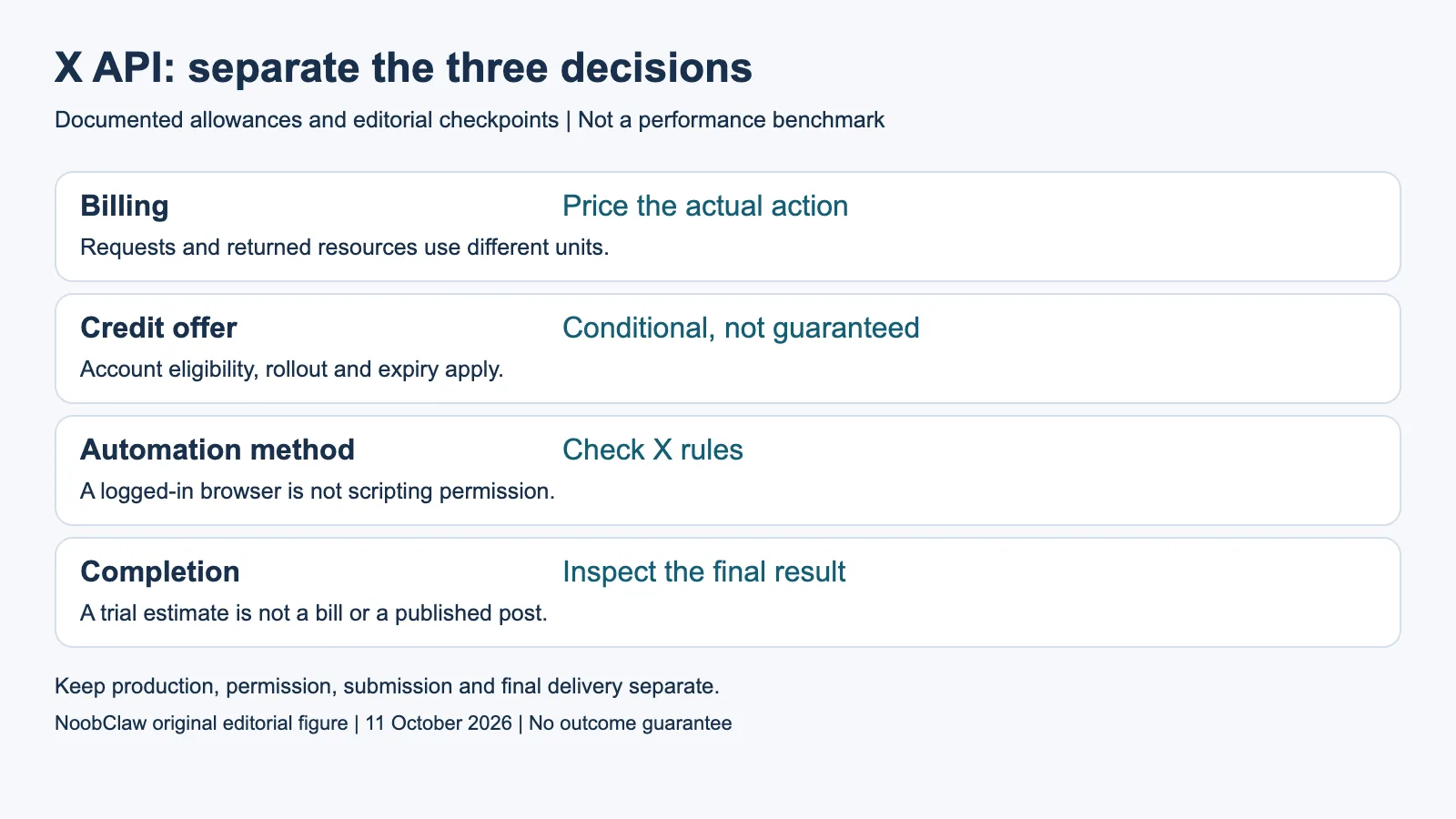
- Billing: Price the actual action. Requests and returned resources use different units.
- Credit offer: Conditional, not guaranteed. Account eligibility, rollout and expiry apply.
- Automation method: Check X rules. A logged-in browser is not scripting permission.
- Completion: Inspect the final result. A trial estimate is not a bill or a published post.
Calculate the requested work instead of a generic monthly price
Consider an illustrative requirement of one hundred ordinary creations, one hundred creations classified as including a URL, and one thousand standard returned Post resources. Using only the selected documented rows gives $1.50, $20 and $5, respectively: $26.50 in this simplified ledger. This is arithmetic for an invented workload, not a vendor invoice or a complete account quote. Other operations, applicable classifications and current conditions must be checked separately.
Build the workload from the actions you need. A dashboard brief and a publishing brief can have different read and write requirements even if both concern the same account. Record whether a number counts requests, returned objects, connected accounts or completed posts. When a vendor offers a subscription, request its included operations and its treatment of underlying usage instead of assuming that a flat price covers every possible action.
For a proposed trial, choose a small, bounded brief and a spending limit appropriate to that brief. Record the current balance and what the tool will attempt. A vendor's visible plan price, your developer credits and a model-generation allowance are separate fields. A failed action is not automatically unbilled, and an estimate is not an observed bill. Reconcile the actual account usage before expanding the trial or advertising a calculated saving.
Treat automation permission as a separate requirement
X's automation rules prohibit non-API automation such as scripting its website. An authenticated session, separate browser profile, chosen IP or human-like timing does not override that rule. The rules also require prior written approval for AI reply bots, and explicit consent for automated actions through another user's account. A paid API balance does not by itself satisfy every action-specific condition either.
Evaluate a tool by its documented action, supported platform mechanism and applicable account conditions. Ask whether it prepares text, creates a scheduled item or publishes through a permitted integration. These are different deliverables. A feature that runs successfully on a local machine is not automatically authorized by the platform, and a statement that a tool avoids developer billing does not establish that it is an acceptable automation route.
If you are comparing tools, keep the permission question next to the cost question rather than after a purchase. Inspect the current offer for X support, the relevant action, the included usage and the handling of an uncertain result. Do not predict that smaller products will disappear or that every price change is silently passed to customers. Those business outcomes require evidence about the named vendor, not an inference from the existence of API charges.
Check the missing stage and the actual result
A practical acceptance brief names the approved content, destination, intended audience and final evidence. Record a queued item separately from a completed publication. If a request is interrupted, investigate the existing result before sending another write. If a vendor cannot confirm support for the required action, record that gap. An absent or inaccessible document is not proof of a free feature, a private-only feature or an account restriction.
NoobClaw's public production record establishes a local creative output: a 441-character script and a 32.6-second 1080 by 1920 export at 30 fps. Its audio and subtitles were observed; the complete visual, voice and rights review was not approved for release. It does not establish X publication, a permitted website-scripting route, lower API spending or account protection. Use it only when evaluating the documented production stage.
Finish the comparison with the eligible current offer, your requested action inventory and the next bounded check. A conditional incentive may help an eligible trial, while metered usage remains a separate budget. A preparation tool may help produce material, while publication still requires its own permitted route and verified outcome. This avoids replacing a purchasing question with a broad claim about a free tier, a safe browser or inevitable vendor behavior.
For the related content and workflow decisions, read X Original Content Rewards: Eligibility and Automation Rules and Free Social Media Posting API: Access, Limits and Costs. Each review has its own evidence and scope.
NoobClaw publishes this article. Its script-to-video guide and public creative execution record document a local video result, not external-platform publication. Check the current product offer against the supported action you need.
Frequently asked questions
Are the promotional credits an unlimited free tier?
No. They are conditional incentives with eligibility and expiry. Inspect the actual offer available in your account rather than assuming permanent free usage.
Can I estimate every request with one endpoint price?
No. Identify the action and its billing unit. The worked ledger is deliberately limited to selected rows and an invented workload.
Does a browser session make automated posting permissible?
X specifically prohibits non-API website scripting. Authentication and pacing are not permission exceptions, and this article does not certify such a route.
Sources
Sources inspected on October 11, 2026. Current technical and pricing documents retain their operation, account scope, billing units and eligibility conditions. The Threads API overview was read in its retrieved German-language official variant. Native scheduling announcements are dated product records, not authenticated current-account tests. Reused same-day primary copies retain their original retrieval records; they are not new GETs. Worked workloads and costs are hypothetical. The public local-production example does not establish platform publication, account protection or a paid conversion.