AI Douyin Captions: Content Labels and Writing Guidelines
- No published Douyin or Chinese rule penalizes a caption for being AI-written. What is regulated is labeling, misleading claims and marketing, whoever wrote the words.
- China's AI Content Labeling Measures (in force since 1 September 2025) count text as AI-generated content, and Article 10 requires users who publish it to declare it with the platform's labeling tool.
- The caption patterns that actually cross lines are specific: invented first-person experience, "best" and "national-level" claims in promotions, experience-sharing posts with purchase links but no ad
- Enforcement so far is mostly correction: in its first two months, China's labeling campaign cleaned up more than 241,000 short videos, dealt with more than 21,000 accounts, and corrected or added labe
If you are about to let an AI write Douyin captions, the useful question is not whether Douyin can tell a model wrote them but which rules a caption has to pass. China's rules on AI content, advertising and labeling attach to what the caption says and whether it is declared.
An earlier version of this page told a first-person shadowban story with no test data behind it; it is gone. This version uses only rule texts, re-read on 26 September 2026, and official enforcement notices.
Will Douyin limit a post because AI wrote the caption?
Nothing we can find in Douyin's user agreement, its public notices or the national rules punishes AI-written text as such. Douyin does not publish its ranking signals, so nobody outside can prove a negative, but the old claim on this page that "template AI captions get throttled within a week" traces back to no rule or data.
What is on record points the other way. When Douyin launched its self-declaration label for staged or fictional content in 2024, it said it "will not limit a work's traffic because the author correctly added a label according to the norms", as reported by Southern Metropolis Daily (on Tencent News). It was not about AI labels specifically.
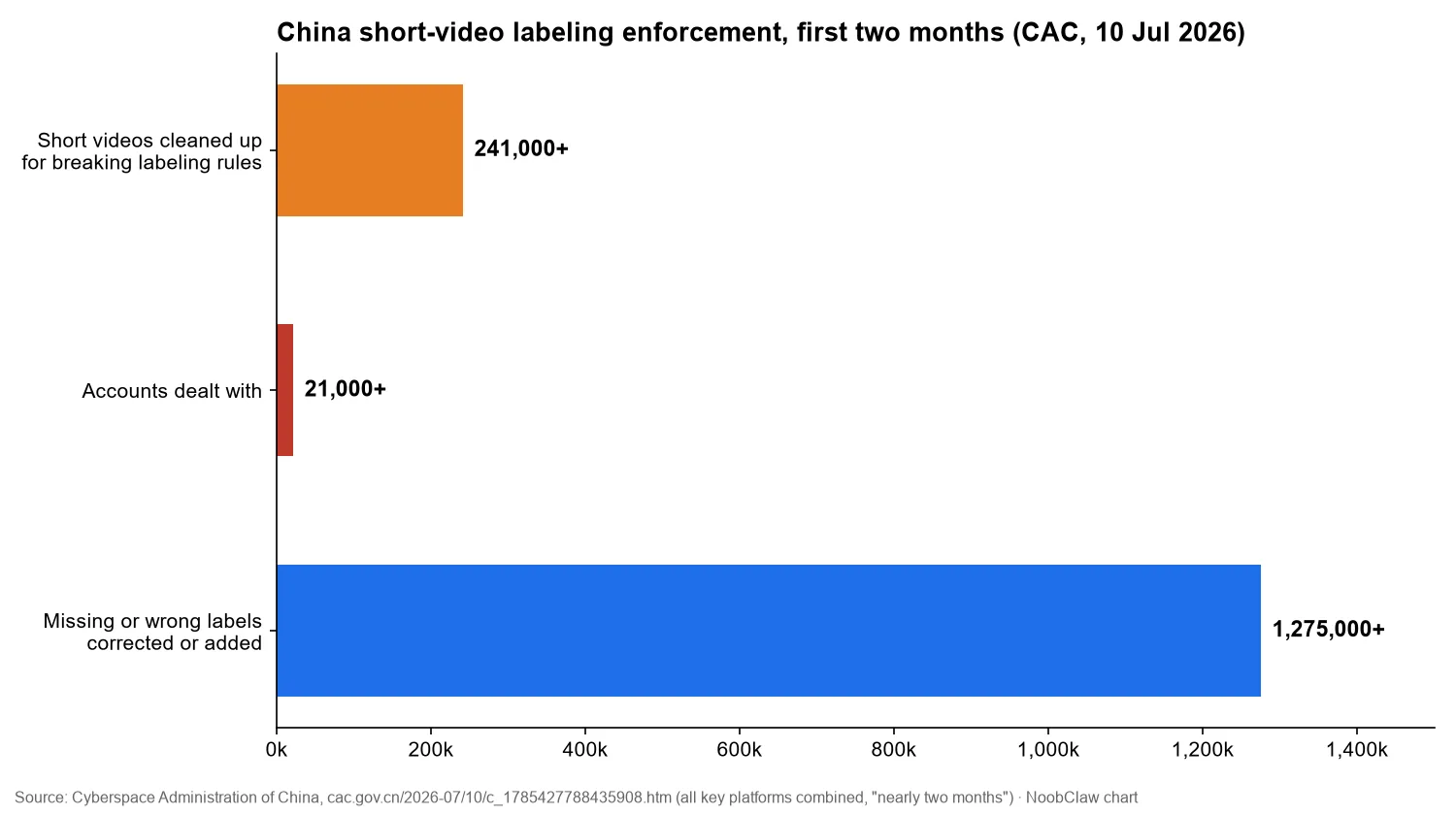
In its 10 July 2026 notice, the Cyberspace Administration of China (CAC) said platforms had cleaned up more than 241,000 short videos that broke the labeling rules, dealt with more than 21,000 accounts, and corrected or added labels more than 1.275 million times. The main tool is correction. The same notice pairs missing labels with staged or fabricated content, which is where account-level action tends to land.
Our reading: the realistic risk is not a hidden AI penalty but a caption that is undeclared, misleading or too promotional.
Does an AI-written Douyin caption need an AI label?
The legal starting point is the Measures for Labeling AI-Generated and Synthetic Content, issued by the CAC and three other ministries and in force since 1 September 2025 (Article 14). Article 3 defines AI-generated content as "text, images, audio, video, virtual scenes" made with AI, so text is included. Article 10 then says users who publish generated content "shall proactively declare it and use the labeling function provided by the service provider", and bans anyone from maliciously deleting, altering or hiding labels, or providing tools to do so. Separately, Article 17 of the 2023 Deep Synthesis Provisions requires providers of AI writing services to label output that may confuse the public; that duty falls on the service provider, and it sits alongside, not in place of, the user's own duty under Article 10 above to declare AI content when publishing (the 2025 Measures, Article 6, also require distribution platforms to check for and add labels). Article numbers and quotes are from the official texts linked here, checked on 26 September 2026; where our English summary and the Chinese original differ, the original governs.
Douyin's own documents add two layers. Its user agreement (in force since 20 February 2026) asks for a prominent label on non-real audio and video made with generative AI, "or other information content that may cause the public to confuse or misidentify" it (clause 4.5). And in May 2026 Douyin issued "Content Labeling Usage Norms" that, according to its 3 September 2026 notice, require creators to add the "content generated by AI" label when publishing content made with Douyin's AI effects "or third-party AI tools". The same notice says Douyin adds visible labels to suspected AI content, writes hidden labels into all AI content on the platform, and is auditing older posts.
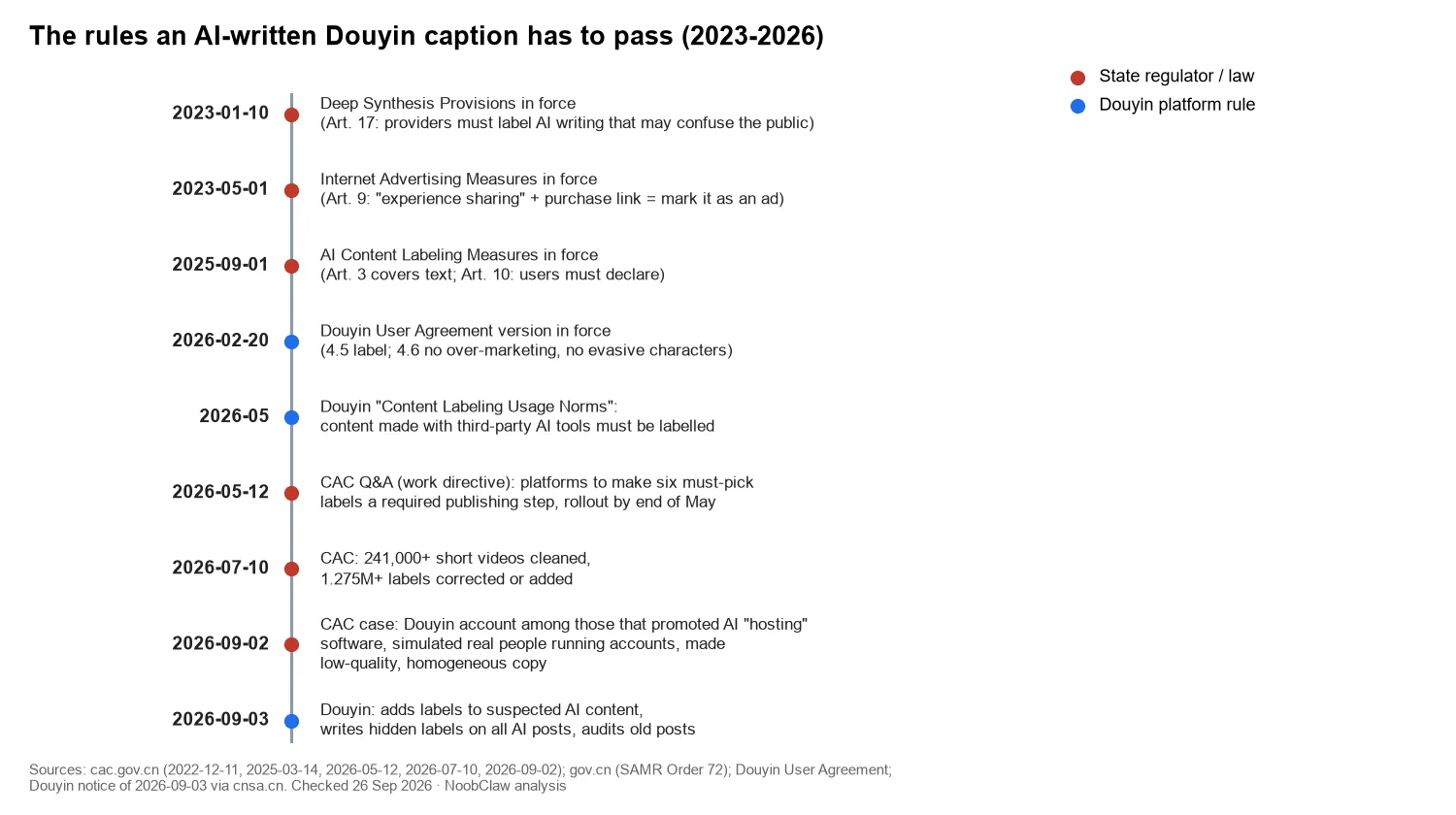
No rule text we found says whether a short caption on your own real footage, lightly drafted by AI, triggers the declaration. The definition in Article 3 does not exclude it; Douyin's agreement ties its label to content that could mislead. Our working rule for operators, which is a judgement, not an official line:
- If AI produced the substance (the voiceover script, the image-and-text post, the visuals), declare it with Douyin's own declaration option, as Article 10 and the May 2026 norms describe.
- If AI only tidied a caption you would stand behind as your own words about your own footage, the texts are ambiguous. Declaring costs little; not declaring bets on an interpretation nobody has confirmed.
- Never remove or hide a label a tool or Douyin has applied. That part of Article 10 is unambiguous.
There is also a separate step. In a 12 May 2026 Q&A, the CAC said it had directed platforms to make content labels a required step for publishing short videos, with 12 leading platforms, Douyin among them, to roll this out progressively by the end of May. This is a CAC work directive rather than a regulation. There are six must-pick labels, including "contains AI-generated content" and "contains marketing information". Choosing "no label needed" on a post that is AI-generated or promotional is a mislabel, and the CAC counts mislabels alongside missing ones.
The rules do not ask who wrote the caption. They ask whether it is declared, whether it is true, and whether it is selling something.
Which caption patterns actually cross the line on Douyin?
Each pattern below hits a specific rule; AI makes them cheap to repeat.
| Caption pattern | Rule it runs into | Do instead |
|---|---|---|
| Invented first-person experience in a promotion ("tried it for a month", "my go-to") | Advertising Law Art. 38: when the post is an ad, endorsers may not recommend goods they have not used; Art. 28 on misleading ads | Describe real use, or leave experience claims out |
| "Best", "top-grade", "national-level" wording in a promotion | Advertising Law Art. 9(3) bans "national-level", "highest-level", "best" and similar terms | Drop absolute terms; state checkable facts |
| Experience-sharing or review post with a purchase link and no ad mark | Internet Advertising Measures Art. 9 (in force 1 May 2023): must be clearly marked "advertisement"; plus the "marketing information" label | Mark it as an ad and pick "contains marketing information" |
| Homophones, symbols or split characters to slip past review | Douyin user agreement 4.6: no "character combinations deliberately used to evade technical review", no over-marketing | Write the plain word |
| Accounts run by an AI "hosting" tool that simulates real people and posts low-quality, look-alike copy at volume | CAC "Qinglang" AI campaign, stage two: AI "hosting" that simulates real people to register and operate accounts in bulk, and "batch-generating and publishing low-quality, homogeneous copy" | A person owns each account and reviews what it posts |
| News reposted or summarized without naming the source | CAC action of 27 July 2026 on self-media that did not label information sources | Name the source |
The rule summaries in this table are ours; the linked Chinese originals govern.
Two of these have Douyin cases in official notices. In its 2 September 2026 stage-two report, which counts 5.61 million items cleaned and 49,000 accounts dealt with, the CAC listed a Douyin account among accounts that promoted AI "hosting" software, "simulated real people operating accounts and interacting in comments, and generated large volumes of low-quality, homogeneous copy". All three elements are in the case, not only the copy. In its 27 July 2026 action on unlabeled sources (3,704 accounts dealt with), the first case named a Douyin account for reposting or lightly compiling international news without naming the source.
Readers catch template copy faster than rules do. On Reddit, a social media manager described a client who switched all captions to an automated tool: every post opened the same way "and was stuffed with random emojis", until the client's own sales team "asked why we sounded like a bot". One person's account, not a study, but it points the same way: readers notice template copy before any rule does.
What should an AI caption workflow for several Douyin accounts look like?
For a matrix, that means:
- Each account gets its own copy. Sameness is only one part of what the CAC described: its campaign notice also lists AI "hosting" that simulates real people to register and operate accounts in bulk, and comment manipulation. Distinct copy per account does not, by itself, take a workflow outside that description; a person owning each account and reviewing what it posts matters as much.
- No invented experience. Tell the model the account's real facts and forbid first-person claims it cannot know.
- Declaration happens at publish time, on Douyin. Article 10 asks for the platform's own labeling function. If your publishing tool does not tick Douyin's declaration, route AI-generated posts through a review step where a person does.
- Promotional posts get treated as ads. "Marketing information" label, an ad mark when there is a purchase link, and no absolute claims.
- A person reads before it goes out and can answer "is this true, and is it labeled".
For how other platforms handle AI labels, see AI content disclosure rules by platform; for building the review step itself, see why the review step is where AI content workflows break.
FAQ
Is it illegal to remove an AI label from Douyin content?
Article 10 of the AI Content Labeling Measures says no organization or individual may maliciously delete, alter, forge or hide the labels the Measures require, or provide tools or services that help others do so. Douyin also says it re-labels suspected AI content, writes hidden labels into AI content published on the platform and is auditing older posts, so removing a label is both prohibited and unlikely to stick. For how that plays out on another platform, see what a "Content Credentials" label means.
My AI tool exported the text without any label. Do I still need to declare it?
Yes. Under Article 9 a provider may hand over unlabeled content only after its user agreement makes labeling your duty (and it keeps logs for six months or more). Article 10 puts the declaration on you.
Does declaring AI content reduce reach on Douyin?
Douyin has not published data. The closest statement is its 2024 remark on the staged-content label, reported by Southern Metropolis Daily (on Tencent News): correctly labeled works will not have traffic limited for that reason. Since missing labels mostly get corrected, an undeclared AI post is likely to end up labeled anyway, without your say in how.
Sources
- Measures for Labeling AI-Generated and Synthetic Content — CAC and three ministries — 2025-03-14 — https://www.cac.gov.cn/2025-03/14/c_1743654684782215.htm
- Provisions on Deep Synthesis of Internet Information Services — CAC, MIIT, MPS — 2022-12-11 — https://www.cac.gov.cn/2022-12/11/c_1672221949354811.htm
- Douyin notice on one year of AI labeling — China Netcasting Services Association (reprint) — 2026-09-03 — http://www.cnsa.cn/art/2026/9/3/art_1957_49264.html
- Douyin User Service Agreement — Douyin — 2026-02-13 — https://sf3-cdn-tos.douyinstatic.com/obj/ies-hotsoon-draft/douyin_agreement/agreements.html
- Q&A on short-video content labels — CAC — 2026-05-12 — https://www.cac.gov.cn/2026-05/12/c_1780328273108117.htm
- Action on unlabeled short videos — CAC — 2026-07-10 — https://www.cac.gov.cn/2026-07/10/c_1785427788435908.htm
- Action on unlabeled information sources — CAC — 2026-07-27 — https://www.cac.gov.cn/2026-07/27/c_1786897886145841.htm
- Qinglang AI campaign notice — CAC — 2026-04-30 — https://www.cac.gov.cn/2026-04/30/c_1779289298718765.htm
- Qinglang AI campaign stage-two report — CAC — 2026-09-02 — https://www.cac.gov.cn/2026-09/02/c_1790099041364574.htm
- Advertising Law (2021 amendment) — SAMR — 2021-04-29 — https://www.samr.gov.cn/zw/zfxxgk/fdzdgknr/fgs/art/2023/art_5474cf75173c45d6a0379730fb4e8d97.html
- Measures for the Administration of Internet Advertising — SAMR, via gov.cn — 2023-02-25 — https://www.gov.cn/zhengce/202305/content_6858084.htm
- Douyin on its staged-content label (report) — Southern Metropolis Daily, via Tencent News — 2024-05-28 — https://news.qq.com/rain/a/20240528A03SAL00
- User post on AI captions — Reddit r/SocialMediaManagers — 2026-09-21 — https://www.reddit.com/r/SocialMediaManagers/comments/1wm3oje/a_client_secretly_replaced_my_caption_copy_with/