Competitor Audience Research: Public Comments
- Public comments can reveal questions, not a representative customer list.
- Follower snapshots and ad archives have different scopes and limitations.
- Turn reviewed observations into substantiated briefs; public visibility is not consent to contact.
Competitor audience research can help you understand the questions people ask, the explanations they find unclear and the content formats they respond to. Public comments are useful observations for that job. They are not a representative audience census, a verified customer list or permission to contact everyone who appears in a thread.
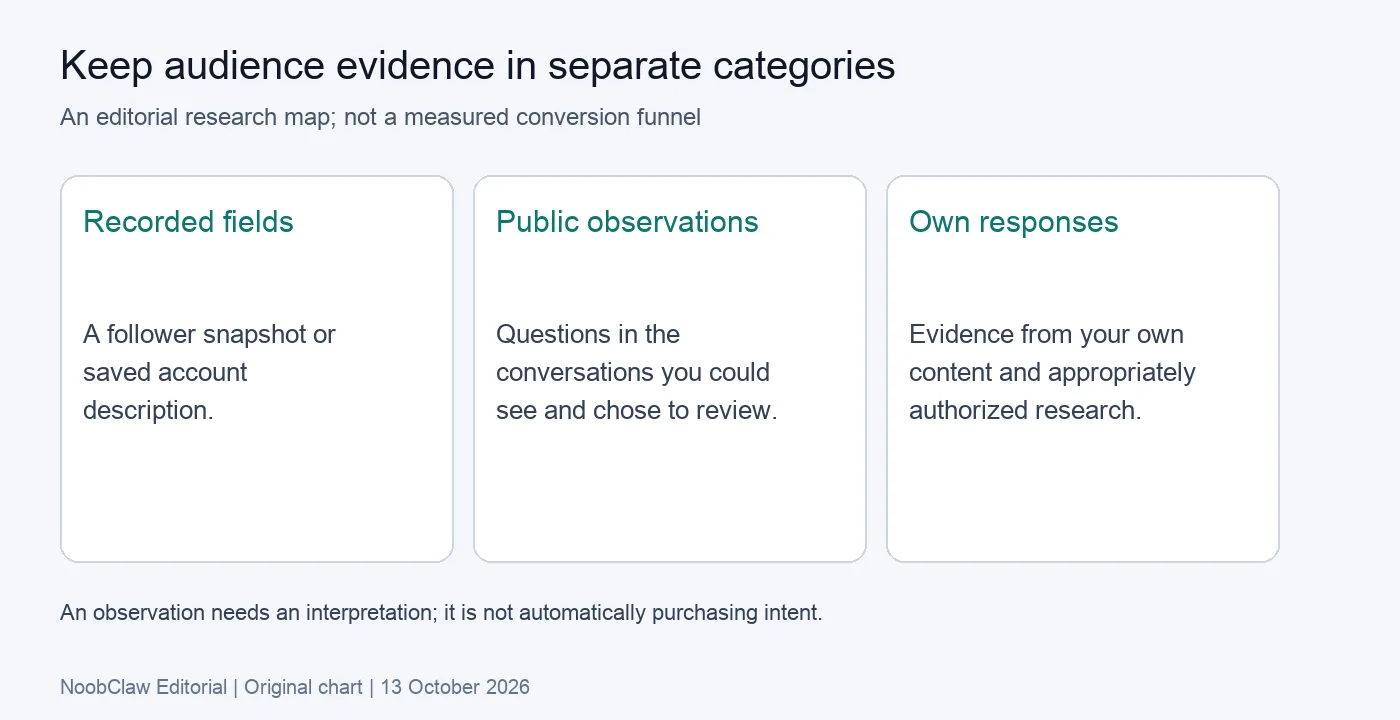
For a creator or small team, the practical goal is to improve a content brief. Keep the observation, your interpretation and the next content decision separate. A follower count can describe an account's recorded scale; a comment can reveal a question in one context. Neither tells you that the person will buy your product or respond to an automated message.
Use the conversation to improve your explanation, not to turn strangers into a presumed customer list.
What can a follower snapshot actually establish?
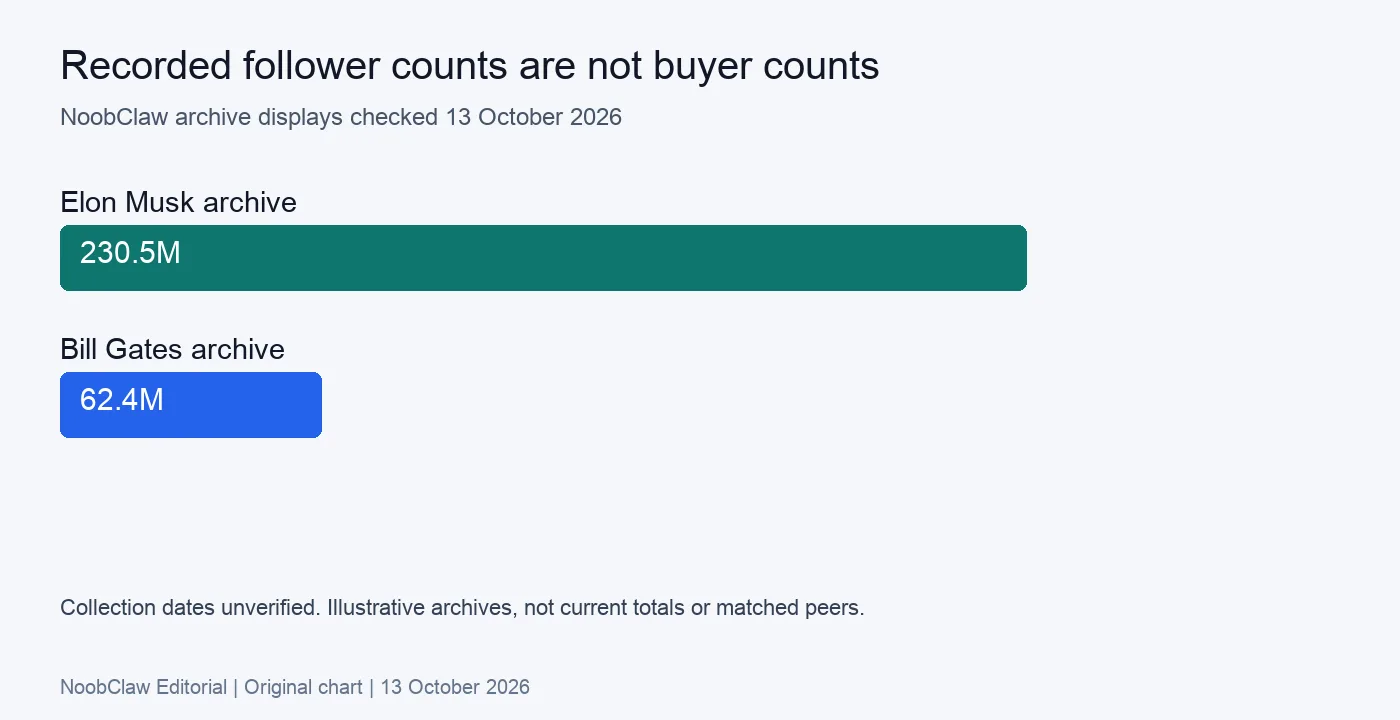
The NoobClaw Elon Musk archive displayed a 230.5 million follower snapshot when checked on 13 October 2026. The Bill Gates archive displayed 62.4 million. The pages explicitly identify the fields as recorded account data and link to the original X profiles. Their collection dates were not independently established in this check.
Those are useful examples of the boundary between a stored field and an audience conclusion. The displayed counts do not establish current follower totals, active readers, purchasers or people who would be interested in your content. These high-profile accounts are also not a matched competitor set for an arbitrary business; do not use the comparison as a market-share calculation.
When you choose actual peer accounts, explain why they are relevant. Compare the audience problem, content type and offer rather than simply selecting the largest follower numbers. A specialist account with a similar editorial job may provide more useful material for your brief than a broadly famous account serving many unrelated interests.
How should you read public comments without overstating them?
Start with a research question. You might ask which part of a setup explanation confuses readers, what comparison they request or what practical condition changes their decision. Review posts where that question is relevant, and retain the context needed to understand a comment. A response under a joke may serve a different purpose from a question under a demonstration.
Keep a short observation note: the source post, date observed, topic, question and a possible content response. Paraphrase the substance when a verbatim quote is unnecessary. Avoid collecting identifying details that do not help answer the research question. The purpose is to learn how to explain the topic, not to assemble personal profiles from scattered remarks.
Also record how you encountered the conversation. Comments can be sorted, moderated, removed or selected by your own research choices. A set of visible replies is therefore a convenience sample of what you could observe. Repeated questions can suggest a useful explanation, but their frequency in your notes does not automatically measure demand across the platform.
Our recommendation is to treat the note as a hypothesis for a content brief. If readers keep asking about a prerequisite, test a clearer explanation of that prerequisite. Then assess the response to your own authorized content and research. Do not label a question as purchasing intent unless you have evidence for that interpretation.
What does an ad archive add, and what does it leave out?
Meta's Ad Library launch explanation describes a searchable source of advertising transparency. It can provide another way to examine public creative and advertiser context. That is a different kind of observation from an organic comment thread, so keep the sources labeled separately.
Retention also depends on the category and context. In its February 2026 US midterm announcement, Meta says qualifying political and social-issue ads are stored in the public Ad Library for seven years. This is a category-specific example, not a claim that every commercial ad in every country has that retention period.
For a content decision, ask what the observed creative explains and what it asks the reader to do. Compare the claim, supporting material and next step with the questions in your notes. Public availability does not establish that an ad performed well, that the visible audience matches your own, or that the advertiser's message should be copied.
This is where a common inference can go wrong. Seeing several creative variants may tell you that variants exist. It does not, without additional evidence, identify the winning variant or its conversion rate. A transparent research record should state the observation and leave the missing performance information missing.
How do you turn observations into an original brief?
Write the audience question in plain language, then identify evidence your own organization can contribute. If people ask how a workflow handles a failed step, show a real result or a documented limitation you can substantiate. If you have not tested the behavior, identify what needs verification before making a claim.
Keep source facts distinct from creative choices. The brief can specify an explanatory angle, vocabulary and format. It cannot transform another person's experience into your own testimonial. An AI draft that says “I tried this” still needs the underlying experience, even when the sentence sounds natural and fits the account's tone.
A useful working sheet has an observation column, an interpretation column, an evidence column and a draft decision. This is an editorial framework rather than a validated scoring formula. Its value is that another reviewer can see where a claim came from and where your judgment began. Leave room for a competing interpretation of the same conversation.
For example, a question about cost may mean the offer is confusing, the pricing page is hard to find, or the person is evaluating a purchase. Do not select the most commercially attractive explanation without evidence. A clearer cost explanation can be worth producing even before you know which interpretation is right.
Where can NoobClaw fit into this research workflow?
NoobClaw's existing tools and documented workflows can help turn a supported brief into text or a video draft. The content-generation analysis explains the distinction between caption text, spoken scripts and assembled video outputs. The account archives used above supply recorded fields and source links; they do not supply a verified buyer list.
Use a writing tool after the interpretation has been reviewed. Supply the topic and facts you can substantiate, choose the account context needed by the workflow and inspect the output. A generated draft is an editorial proposal. It should not be treated as a source proving the audience claim that prompted it.
Research access and automated contact are separate decisions. X's developer policy describes conditions for applications and data use. Public visibility does not itself establish authorization for a particular collection or contact method. This article recommends a bounded reading-and-briefing process, not bulk follower extraction or repetitive outreach.
The multi-account planning article helps assign an owner and purpose to the resulting brief. The account-access analysis helps evaluate a proposed connection. Keep the research note, source evidence and review decision associated with the account that will use the content.
FAQ
Are people commenting on a competitor's post potential customers?
They may be, but the comment alone does not establish that conclusion. The person may be asking a question, reacting socially, discussing a different use case or already using another product. Keep the observed question separate from an inference about purchasing intent.
Can I use public follower counts to estimate my addressable market?
Those counts do not provide that estimate by themselves. A recorded follower total does not identify active readers, overlapping audiences, relevant buyers or permissioned contacts. Define the population you want to understand and the evidence available before producing a market-size number.
What should an AI tool receive from the research?
Provide a reviewed brief with substantiated facts and a specific audience question, not a collection of unnecessary personal details. Review generated experience claims and comparisons before publication. The useful output is a draft you can verify, not a new assertion that the research proved sales potential.
Sources
- A Better Way to Learn About Ads — Meta, March 2019; checked 13 October 2026.
- How Meta Is Preparing for the 2026 US Midterm Elections — Meta, February 2026; category-specific retention example, checked 13 October 2026.
- Developer Policy — X, live documentation; checked 13 October 2026.
- Elon Musk account archive and Bill Gates account archive — NoobClaw recorded fields, checked 13 October 2026; not independent identity or live-audience verification.
Correction, 13 October 2026: this English page replaces a Chinese-language body. Unverified first-person audience statistics and daily outreach prescriptions have been removed. Public observations are distinguished from customer intent and permission to contact people.