How Often to Post on TikTok: Cadence, Limits and Review
- How often you should publish is a planning question; whether a selected method can publish is a separate capability and permission question.
- No universal safe native daily count was verified for this review. A scheduler queue or API condition does not certify unlimited posting or account safety.
- Choose a cadence you can produce and review, then compare posts at consistent ages. Observed differences do not prove frequency caused a reach change.
- NoobClaw’s public records demonstrate text and a local video draft. They do not demonstrate external TikTok publication, duplicate-detection clearance or a growth result.
Choose a TikTok posting cadence that leaves time to make, check and learn from the material. A daily number by itself does not establish whether the content is useful, whether your selected publishing method can complete the action or how viewers will respond. This review separates those questions and provides a bounded way to evaluate a schedule. It does not certify a universal native daily allowance or guarantee that publishing more increases reach.
Count the creative work you can review and the destination actions you can verify. A queue capacity, a successful upload and an audience result answer different questions.
Separate can publish from should publish
The permission question concerns a specific account, action and method. The planning question concerns how much useful material you can create with your available time. A numerical answer to one does not settle the other. A scheduler accepting an item into its queue does not establish that TikTok published it, and a post going live does not establish that a higher frequency is the best strategy.
No universal safe daily native-posting count was verified in the sources for this review. That is a limit of the evidence, rather than a claim that the app has no restrictions or that normal creators never encounter a limit. If an action fails, preserve the actual notice and identify the method instead of interpreting the absence of a known public number as unlimited permission.
If you are planning one account, begin with the work a post requires: the question it answers, footage, narration, caption, review and publication. If you manage several destinations, count the actual additional work for their formats and audiences. More accounts do not automatically create independent chances of distribution, and randomized timing does not certify a publishing method or clear duplicate-detection rules.
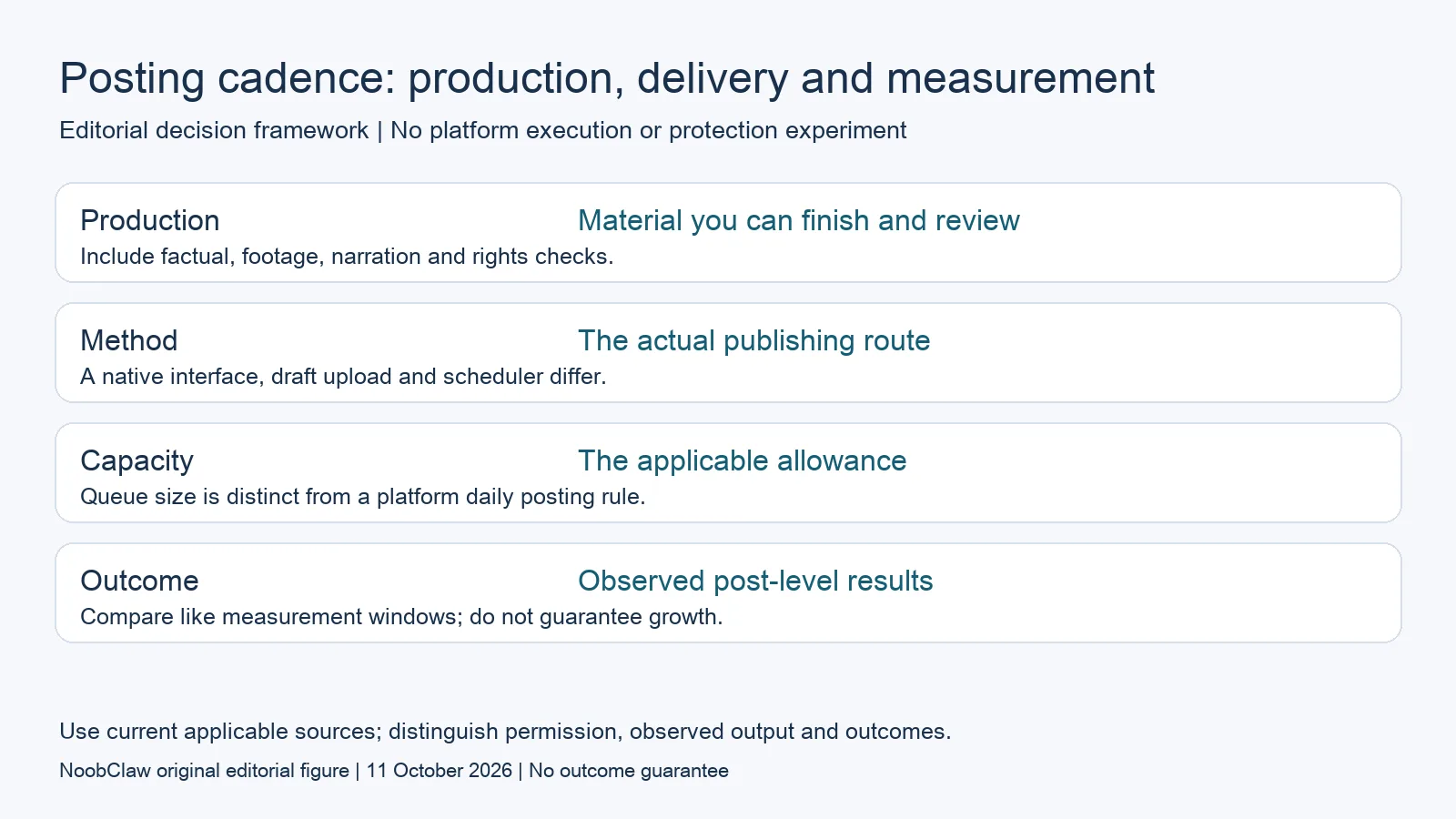
- Production: Material you can finish and review. Include factual, footage, narration and rights checks.
- Method: The actual publishing route. A native interface, draft upload and scheduler differ.
- Capacity: The applicable allowance. Queue size is distinct from a platform daily posting rule.
- Outcome: Observed post-level results. Compare like measurement windows; do not guarantee growth.
Read recommendation advice with its date and scope
TikTok’s July 2020 creator advice encouraged experimentation and said view counts vary from video to video. It also advised considering broader analytics rather than a single engagement measure. This is dated guidance. It should not be represented as a current universal exception from all frequency, spam, content or account conditions in 2026.
The June 2025 Malaysian announcement describes personalized discovery and viewer controls such as topic preferences and keyword filtering. These controls are part of the documented viewer experience, not a numeric posting quota for a creator. Neither source establishes that posting three, five or eleven times in a week is a universal optimum for your account.
A comparison between accounts that publish at different frequencies can reveal an association, but it does not automatically isolate the effect of frequency. Their topics, resources, audience sizes and creative choices can differ too. This review does not reproduce numerical study results without the original method and scope, or turn a difference in typical views into a forecast for your own next post.
Your publishing method has its own conditions
TikTok’s current Content Posting API Upload guide describes sending material for a user to review and complete in TikTok. It requires an approved video.upload scope and the user’s authorization. The documented draft-upload result is therefore distinct from a completed public post. Do not report an upload acknowledgment as successful audience-facing publication.
The Upload guide applies to that API workflow. It does not establish the permissions or limits for every third-party product, a native app composer or a local browser workflow. When using a scheduler, ask which action its integration actually performs and how it reports the final result. Do not assume that every scheduler shares one architecture or that all its plan limits come from TikTok.
For example, Buffer’s current Free plan lists ten waiting posts per connected channel. That is queue depth, with a slot becoming available as an item leaves the queue, rather than a ten-post monthly production budget or TikTok daily allowance. Its current paid fair-use wording has a separate qualification. The counting period was not established here, so this review does not convert that qualification into an annual posting budget.
Plan a small schedule around reviewable material
For a hypothetical small team, begin by listing a few distinct questions you can answer with material you actually have. One might need a demonstration, another a comparison and another a response to a common question. Assign time for checking each answer and the final creative file. The proposed quantity is an operating choice for that team, not a platform recommendation or a safe daily threshold.
If the backlog is thin, improving the brief can be more useful than filling additional queue slots. Check whether the opening makes a promise the video delivers, whether narration contains unsupported product claims and whether the chosen footage is relevant. Repetition should be evaluated as a content and audience question, without claiming a specific automated detection result from superficial wording differences.
NoobClaw’s text tools can supply candidate descriptions, openings or narration from a brief, under the current allowance conditions on their pages. The public text record shows returned drafts. A separate public desktop record shows a local video file with narration and subtitles. These records support a bounded creative use; they do not prove external posting, a platform permission exemption or a cadence that survives enforcement. In the October 10 public local-only execution record, a supplied English script contained 441 characters and produced one 32.6-second video at 1080 × 1920 pixels and 30 frames per second. These are observed input and export specifications from one creative sample. The record also notes generic or off-topic stock footage requiring scene-by-scene review; voice quality and stock licensing were not independently approved. It contains no external TikTok publication, follower growth, recommendation or retention measurement.
Measure the schedule without assigning a single cause
Record the post, topic, publication time and age at which you read its metrics. Use the fields actually available in your interface, and keep views, comments and traffic sources separate. If you compare a new schedule with an earlier period, preserve changes in the content, language and production method as well. A before-and-after result alone cannot isolate the effect of cadence.
Look at the sample size and the range of outcomes, rather than only the most successful clip. Choosing an observation window before reading results can reduce selective comparisons, but it does not turn ordinary posting into a controlled test. If the interface lacks a field, record the gap instead of inventing a reason for it. A low-view post is not by itself a diagnosis of an account restriction.
When a publishing action fails, separate the issue from creative performance. A queue error, an unfinished draft-upload flow, an account notice and a post that received few views require different evidence. Keep the exact returned state and use the appropriate current help for the selected method. This review offers no fixed recovery time, safe volume exemption or promise that spacing posts restores distribution.
Choose the output you need: post-caption drafts, opening-line drafts or spoken-script drafts. These text tools have a limited anonymous allowance; they do not transcribe or publish a video.
For the related content and workflow decisions, read Do TikTok Followers Matter? Audience, Reach and Testing and Buffer Free Plan Limits: Queue Slots, Users and Upgrades. Each review has its own evidence and scope.
A reviewable week instead of an algorithm formula
Suppose you can finish a few distinct product clips during a week. Reserve time for inspecting the footage, narration and captions, and use the intended publishing method only after its applicable conditions are checked. Keep a record of whether each post actually went live and compare available results at the same post age. If the next week changes both cadence and content, report both changes instead of attributing the outcome to frequency alone. This is a hypothetical planning exercise, not an executed TikTok test, a growth forecast or a verified delivery sequence from NoobClaw.
NoobClaw publishes this article. Its script-to-video guide and public creative execution record document a local video result, not external-platform publication. Check the current product offer against the supported action you need.
Frequently asked questions
Is five posts a day guaranteed to be safe?
No universal safe native daily threshold was verified here. The actual account, content, method and applicable conditions still matter. A planning example or queue allowance is not an enforcement exemption.
Does a successful API draft upload mean the post is public?
The current Upload guide describes material the user reviews and completes through TikTok. An upload acknowledgment is distinct from verifying the final public post. Check the actual result for the route you use.
Will increasing frequency raise my typical views?
This review establishes no guaranteed relationship for your account. Compare a sufficient set of actual posts using consistent observation windows, record other changes and avoid assigning a single cause to a before-and-after difference.
Sources
Official material reviewed on October 11, 2026. Document conditions apply to their stated service and scope; the editorial examples are explicitly hypothetical.