No-Code Social Media Workflows for Small Teams
- Specify the missing task before choosing a creation, publishing or reporting product.
- Assign an approval owner and keep account identity visible at the handoff.
- Compare cost using the same output, billing period and required capabilities.
- No 30-account campaign, zero-ban result or automatic replacement for a social team is established here.
A small team can evaluate a no-code social media workflow without starting a 30-account operation. Define the content job, approved output, destination and person responsible for the result. Then inspect what the product actually completes. No-code describes how a user configures software; it does not establish permission for platform activity, eliminate setup work or guarantee account protection. There is no preserved startup campaign or 30-account survival record supporting such claims on this page.
Begin with one useful job and an inspectable result. Account count and an activity dashboard are not substitutes for a content brief, approval or publishing evidence.
Describe the work your team is missing
Write a requirement that starts with an input your team already has. A product brief can lead to an editable caption or script; an approved script and owned assets can lead to a video draft; an approved video can enter a separate publishing process. If the missing work is content creation, adding more connected accounts does not solve it. If the missing work is release coordination, generating another draft may not help either.
Choose a reviewable acceptance condition. An editable script should preserve confirmed facts and the intended explanation. A media draft should be relevant and legible. A publishing result should identify the destination and observed state. A report should state its metric definition, period and source. These tasks may appear in one product, but completion of one does not establish completion of the others.
A no-code interface can reduce the need to write an integration yourself, while still requiring installation, account setup, network access, content review or usage credits. Inspect those conditions in the actual scenario you plan to use. The old assertion that a team replaced all social work with zero engineering effort has no retained supporting campaign. Evaluate the current demonstration instead of turning a configuration method into an outcome guarantee.
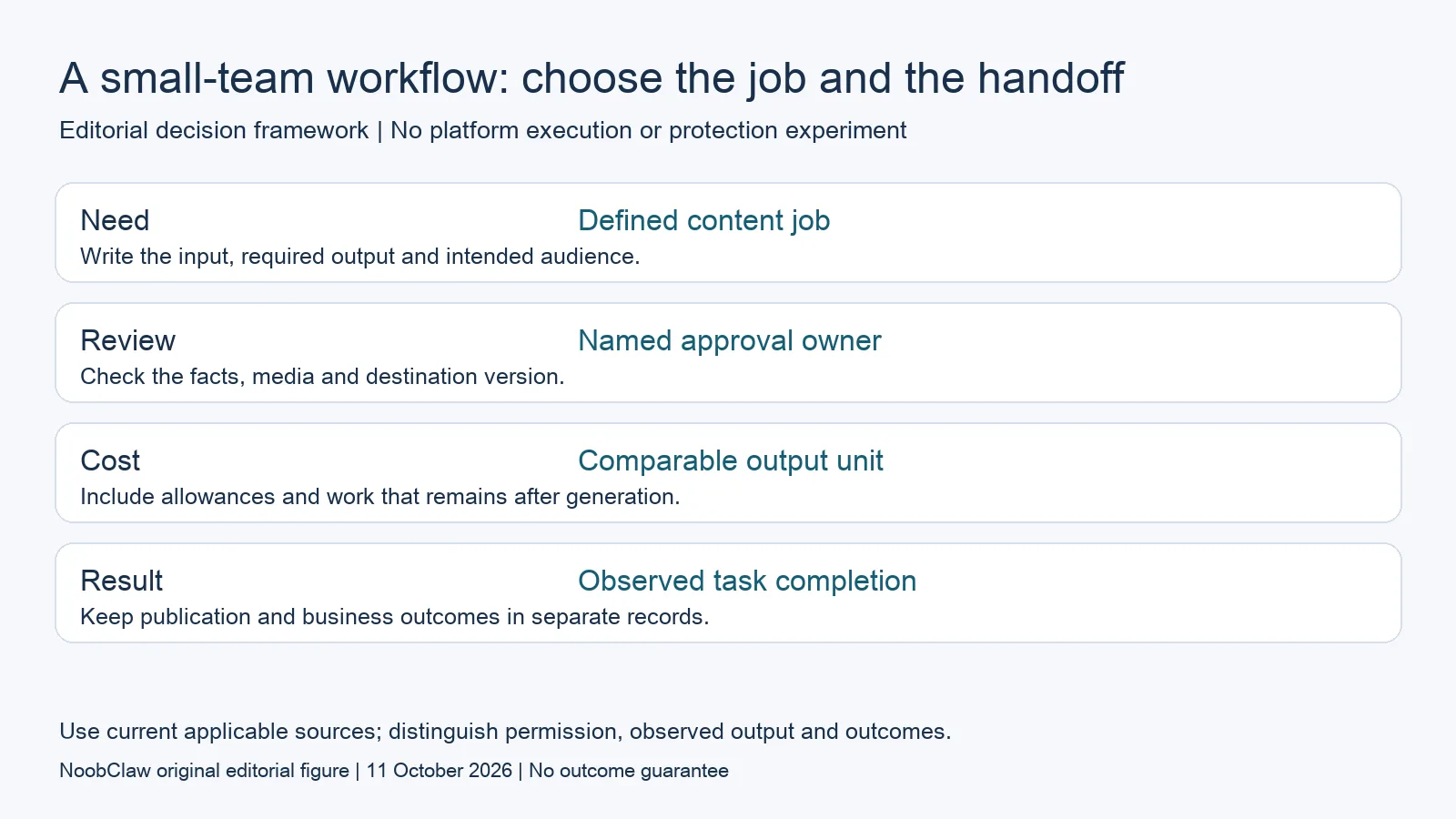
- Need: Defined content job. Write the input, required output and intended audience.
- Review: Named approval owner. Check the facts, media and destination version.
- Cost: Comparable output unit. Include allowances and work that remains after generation.
- Result: Observed task completion. Keep publication and business outcomes in separate records.
Assign responsibilities before adding destinations
Identify who approves the brief, creative output and release. One person may own several steps, but each decision should remain attributable. Keep account credentials out of the editorial handoff. Use public account identities and content-version labels so the intended destination can be checked. If the owner or destination is unclear, launching a batch simply repeats that uncertainty across more tasks.
Google describes Chrome profiles as separating browser information, including bookmarks, history, passwords and settings. That helps explain an organizational capability; it does not establish that different profiles appear to a platform as unrelated people or guarantee that restrictions cannot affect another account. Verify the actual logged-in destination rather than relying on a profile's internal label alone.
Platform conditions also remain specific. X's current automation rules prohibit non-API automation of its website. An existing browser login therefore cannot be treated as blanket permission for X actions. Check the exact method and the current requirements for every selected destination; do not transfer one platform's conditions to another. This review does not document a live multi-platform publishing test or certify a NoobClaw integration for every network.
Budget for the accepted output, not the largest account count
Compare products using the same job and observation unit. A monthly subscription, a connected-account allowance, a seat and a generation credit are different units. List the capabilities you actually need and the work still required after the demonstration. A plan that includes many accounts may provide little value if your team cannot produce an approved file. A creation tool may fit even when another supported method handles publishing.
Use a proposed cost worksheet with the billing period, required seats or destinations, included allowances, usage-dependent charges and review work. Do not subtract hypothetical token rewards or follower income from what you will pay. A vendor's starting price is not a complete estimate of your workflow. Check the current product offer and your actual intended output rather than selecting a plan from a generic account-count comparison.
Record what the evaluation demonstrated and what remains unverified. If the test produced a usable draft but did not cover release, budget for release separately. If the media needed substantial corrections, include that work when comparing useful output. This proposed method does not establish a measured time saving, a fixed cost per published post or a financial return for the team.
Use a bounded creation example to decide product fit
NoobClaw publishes this article and sells content software. Its public creative record documents a 441-character English script producing a local 32.6-second, 1080 by 1920 MP4 at 30 frames per second, with voiceover and subtitles. The result is evidence for that creation step. It is not a startup customer case, a 30-account rollout or proof that the software replaced a social team.
Some sampled stock material needed further relevance review. A local export is therefore a draft to inspect, not automatic proof of a completed audiovisual or asset-license review. If you need a different length, language, media source or publishing destination, evaluate that requirement directly. Do not infer clipping, translation, dubbing, platform publication or sales attribution from the observed short video.
Consider a hypothetical small team explaining a newly released feature. The brief contains confirmed behavior, available screenshots and the intended audience. An assistant returns a script and local video draft. The team corrects a subtitle, removes an invented testimonial and approves the final version before a separately supported release. This example explains a handoff the team can evaluate, not a campaign we ran or evidence of a particular growth result.
For the related content and workflow decisions, read Human-Like Automation: Execution Is Not Account Approval and AI Tools for Content Creators: Choose the Missing Stage. Each review has its own evidence and scope.
A small-team decision record
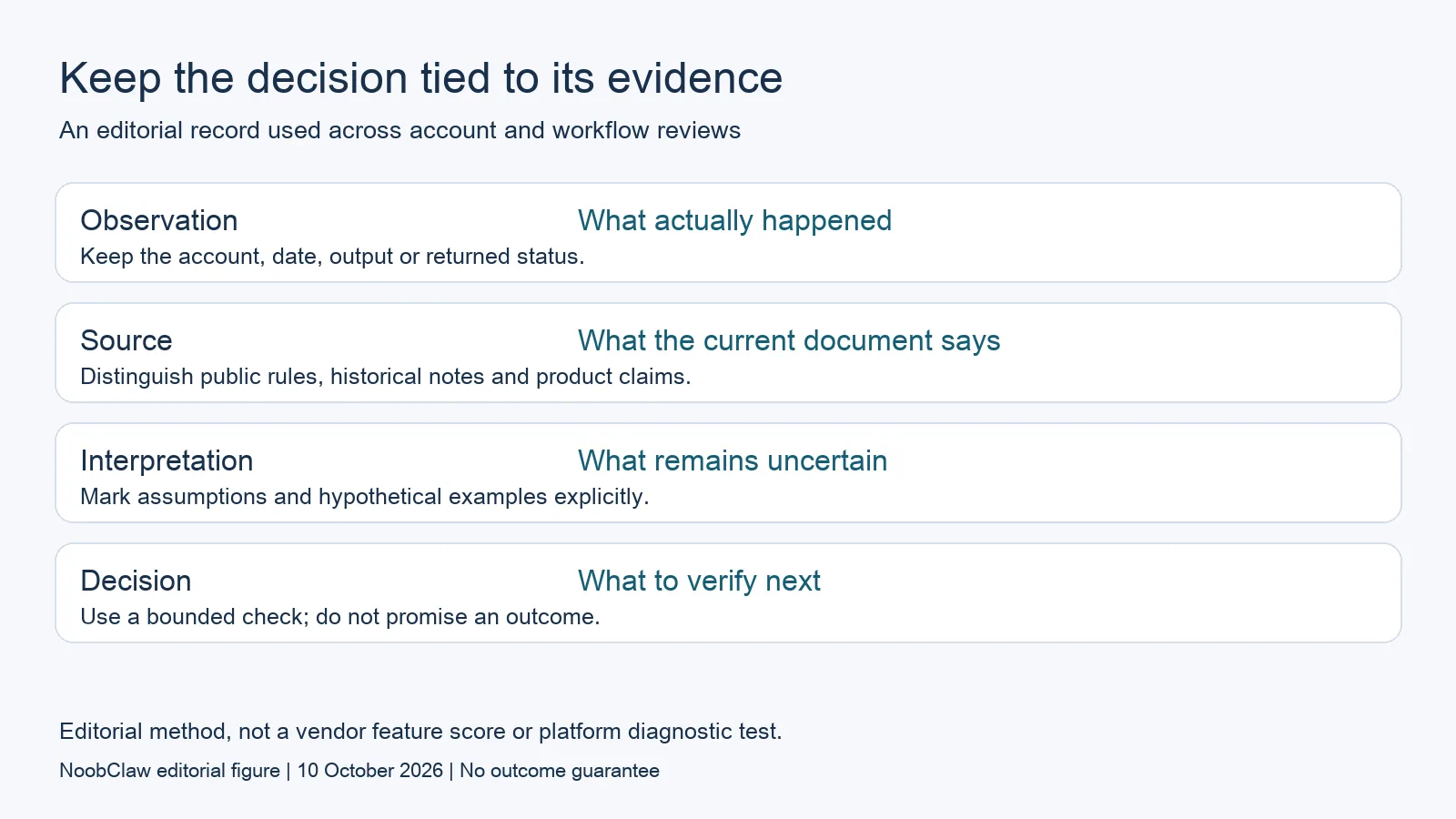
Retain the need, input brief, accepted output, review owner, destination, method, cost unit and unresolved work. A product that completes the content job can be recorded as useful at that scope even when publishing remains separate. After release, observe audience response in a defined window and record inquiries or purchases independently. Software activity is not a customer, a click is not a paid order and a new account is not a growth result. This proposed record avoids scaling an unverified workflow simply because a plan offers more account slots. It supplies no one-account-per-week protection rule, safety quota or forecast of how many accounts your hardware can run.
NoobClaw publishes this article. Its script-to-video guide and public creative execution record document a local video result, not external-platform publication. Check the current product offer against the supported action you need.
Frequently asked questions
Does no-code mean zero setup or review?
Check the actual installation, account, network, credit and content-review conditions. A configuration interface does not eliminate those requirements.
Does operating more accounts establish product value?
Account count is a capacity measure. Evaluate the accepted output and required work before treating additional capacity as useful.
Did NoobClaw run the 30-account startup case described here?
No preserved evidence establishes that campaign. The public example documents one bounded local creative output, not a multi-platform growth or sales result.
Sources
Official material reviewed on October 11, 2026. Document conditions apply to their stated service and scope; the editorial examples are explicitly hypothetical.