Postiz Pricing: Current Plans, AI Allowances and Hosting
- Current monthly plans are $29, $39, $49 and $99 for 5, 10, 30 and 100 channels.
- The current cards advertise unlimited monthly posts; the historical 400-post FAQ conflict is not a current condition here.
- AI video allowances are 3, 10, 30 and 60 monthly; source-video clipping allowances are 60, 120, 300 and 600 minutes.
- Hosted API, MCP, CLI and webhooks are included; self-hosting needs its own release, infrastructure and provider configuration.
Postiz’s current hosted monthly plans are Standard $29, Team $39, Pro $49 and Ultimate $99, with five, ten, thirty and one hundred channels. The current pricing FAQ no longer contains the older 400-post Standard description around which this article was built. Compare today’s plan capacity and creative allowance with the action you need, and keep self-hosting as a separate operating decision rather than a universal free upgrade.
Choose a plan for the binding requirement in your workload, then verify the output and operating conditions.
Current plan capacity and billing references
The prices reviewed on October 11, 2026 are monthly USD references before applicable purchase adjustments. Team and higher list unlimited team members. The pricing FAQ separately gives annual-billing monthly equivalents of $23, $31, $39 and $79. Keep those equivalents labeled as annual references rather than presenting them as a verified month-to-month purchase at the lower price. Confirm the actual commitment and checkout amount before buying.
Count connected social handles rather than brands or employees when estimating channel needs. Twelve required handles do not fit the displayed ten-channel Team capacity, so the current next listed tier is Pro with thirty. Unused capacity is part of a fixed tier. That can be practical headroom or spend you do not currently need; the label alone does not decide it. Compare the eligible plan with the features and creative workload you require, rather than choosing the highest tier because its price per maximum slot is lowest.
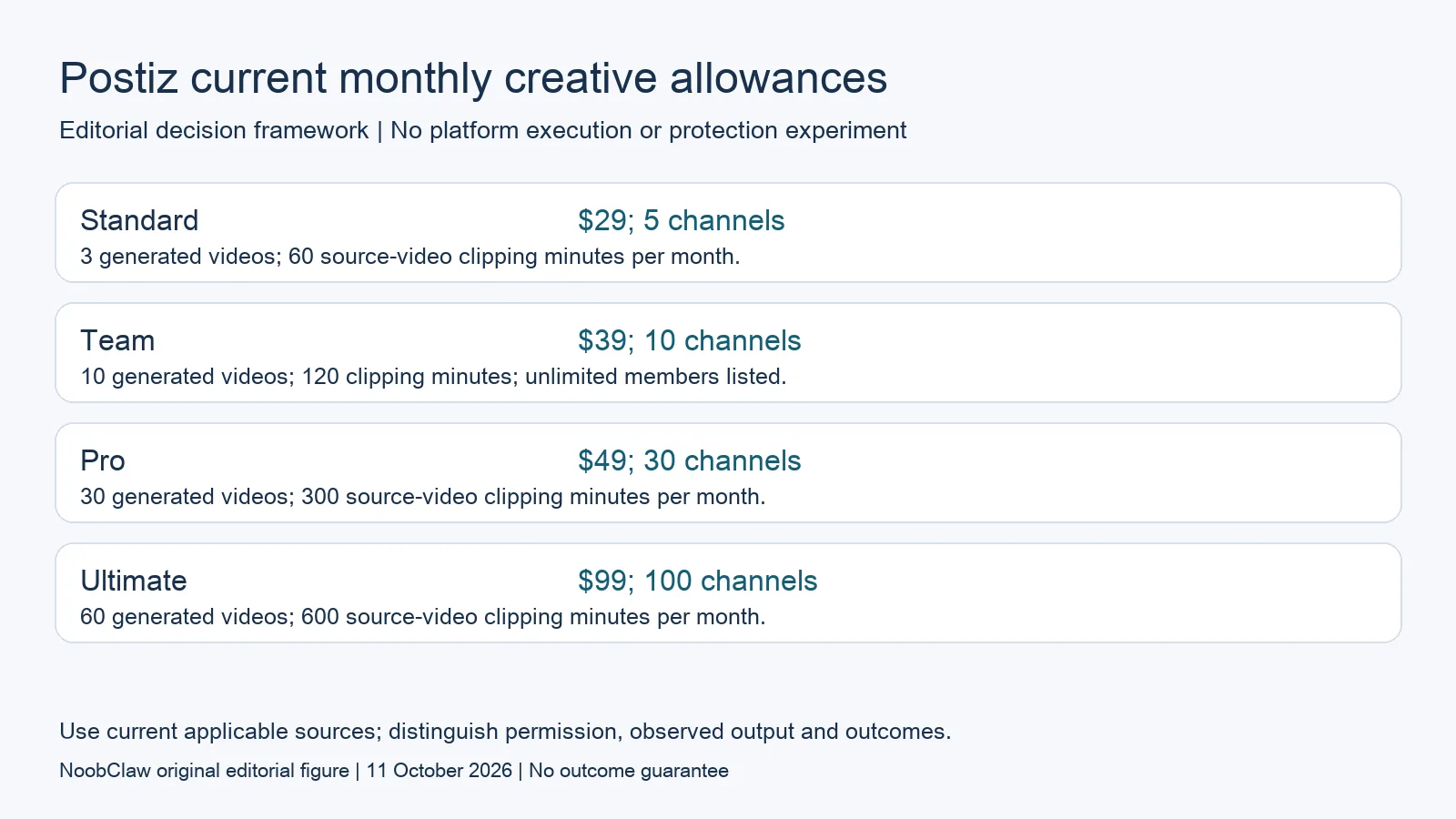
- Standard: $29; 5 channels. 3 generated videos; 60 source-video clipping minutes per month.
- Team: $39; 10 channels. 10 generated videos; 120 clipping minutes; unlimited members listed.
- Pro: $49; 30 channels. 30 generated videos; 300 source-video clipping minutes per month.
- Ultimate: $99; 100 channels. 60 generated videos; 600 source-video clipping minutes per month.
Separate media generation from source-video clipping
The current cards list three, ten, thirty and sixty AI videos per month across the four tiers. Clipping allowances are sixty, one hundred twenty, three hundred and six hundred source-video minutes. Team, Pro and Ultimate list one hundred, three hundred and five hundred AI images respectively. The Standard card’s lack of a stated image allowance is not used here to invent a quota or establish every possible image action’s availability.
The clipping FAQ says its meter follows source-video duration rather than the number of clips produced. Therefore a sixty-minute source and six ten-minute sources consume the same sixty source minutes under that counting rule, while the actual output still needs review. A generated video allowance is not interchangeable with clipping minutes. Determine whether you need new media, selected clips from existing material or text assistance; then check the relevant action’s requirements and output. A tier can fit one workload while leaving another allowance insufficient.
Use binding requirements rather than rounded value ratios
Consider a hypothetical monthly need for fifteen generated videos. Team’s ten-video allowance does not cover that inventory; Pro’s thirty can cover the stated quantity. An operator needing thirty-five connected channels also exceeds Pro’s thirty-channel capacity and would consider the listed Ultimate tier. These are workload examples, not predictions of actual output quality or a recommendation to produce more posts.
The earlier advice to upgrade to Ultimate for channels and never for AI was too strong. Ultimate increases absolute creative allowances, even where a rounded per-dollar ratio looks similar. A larger allowance can matter when the lower plan does not cover the needed work. Equally, unused generated-video capacity may have little value to someone scheduling finished photographs. Choose on the requirement that actually binds, then inspect the resulting work for factual accuracy, rights and suitability rather than treating an allowance as a performance guarantee.
Included interfaces and limits beyond monthly posts
The current pricing FAQ says hosted API, MCP, CLI and webhooks are included across plans without a separate agent tier. That establishes the advertised inclusion, not unlimited request throughput or every possible endpoint behavior. If your workflow depends on automation, verify the current operations and limits for the chosen interface and preserve an accepted test of the required action. The article does not quote the older webhook counts as current facts.
All current plan cards advertise unlimited posts per month. The previous 400-post Standard FAQ wording is not present in the current reviewed main text, so it is not retained as a continuing cap or a current internal contradiction. Subscription volume still does not remove file, provider, permission or platform conditions. The old claim that a higher plan could never affect a particular shared quota was not established by an independently tested current configuration; it is not used as a current product verdict here.
Self-hosting is a different operating choice
The source repository identifies an open-source edition and describes the same core product. The current pricing page also says hosted agent features ship first. A shared core project does not establish identical release timing, configuration or external-service access. Select and record the actual self-hosted release and required feature dependencies before assuming the entire hosted purchase offer is available immediately on your instance.
The self-hosting documentation describes the application with Postgres, Redis and Temporal, provider setup and optional additional creative-service configuration. Those are work and cost lines to evaluate. The licence does not pay for hosting, maintenance or usage at upstream providers, and optional approval assistance is not a mandatory licence fee or an approval guarantee. The useful comparison is an accepted workflow with its operating owner and actual costs. It does not establish that self-hosting removes every quota or that a browser-based production tool solves platform eligibility.
For the related content and workflow decisions, read Postiz Open Source vs Paid: Plans, AI and Hosting Costs and Postiz Self-Hosted Costs: Server, Providers and Maintenance. Each review has its own evidence and scope.
Review the actual creative asset before counting outcomes
NoobClaw publishes this comparison. Its public execution record documents one local creative output: 441 English script characters became a 32.6-second, 1080 × 1920 video at 30 fps, with voiceover and subtitles. The record does not demonstrate a connection to these schedulers, an external upload, account eligibility, audience response or paid conversion. Some stock imagery was poorly matched to the script, and full audiovisual quality and asset licensing were not approved. Use the record to understand a production step you can inspect, then review the actual output and rights before publication. Do not infer that the desktop workflow replaces a team’s approval system, a hosted queue or a platform permission. A practical comparison keeps creative preparation, review and delivery as separate tasks. Choose a tool for the specific action it can demonstrate, and measure the resulting acceptance separately from the price of account capacity. No account-protection or distribution guarantee follows from this case.
NoobClaw publishes this article. Its script-to-video guide and public creative execution record document a local video result, not external-platform publication. Check the current product offer against the supported action you need.
Frequently asked questions
Does the current Standard FAQ still say 400 posts?
That wording is not in the current reviewed pricing main text. Current cards advertise unlimited monthly posts; preserve other service and platform conditions instead of treating an old discrepancy as today’s cap.
Should I never upgrade to Ultimate for AI?
That is too definite. The higher tier increases absolute creative allowances. Whether it is useful depends on the action and quantity you need, not only a rounded ratio per dollar.
Does self-hosting eliminate every publishing limit?
No such result is established. It changes operating ownership and configuration; external provider rules, service requirements and feature-specific limits still need their own checks.
Sources
Official material reviewed on October 11, 2026. Document conditions apply to their stated service and scope; the editorial examples are explicitly hypothetical.