Postiz Self-Hosted Costs: Server, Providers and Maintenance
- The software licence and the cost of a working publishing service are separate questions.
- Current official deployment documentation includes Postgres, Redis and Temporal; storage and recovery need explicit planning.
- Social provider setup varies, while optional AI and clipping features have additional configuration and upstream costs.
- Use a stated hypothetical ledger and a small accepted pilot rather than a universal free-versus-paid verdict.
Self-hosted Postiz has no hosted subscription attached to its open-source licence, but a usable instance still needs computing, persistent data, provider access and an operator. The right estimate depends on the workload you intend to run. This guide separates recurring cash expenses, setup work and unresolved requirements, using current official deployment documentation. It does not provide a VPS quote, a guaranteed installation time or a promise that self-hosting is cheaper for every account count.
A self-hosting estimate is complete only when the server, external services and recurring work have owners and evidence.
Start with the workload and the deployed release
Write down the social accounts, required post formats, scheduling workload, people and creative actions you expect. That inventory determines what you need to validate and which cost lines may apply. Ten lightly used accounts and the same ten accounts producing video every day can have different storage, processing and external-service demands. Account count alone does not supply a server specification or an operating-cost estimate.
Record the release or image you deploy and the provider documentation used with it. Postiz’s repository describes shared core features across cloud and open source, while its current pricing page says hosted agent features ship first. Do not assume every hosted announcement is available and configured in your local release. A comparison based on an unknown version is difficult to explain when a required action is absent. This article evaluates the planning evidence; it has not deployed and benchmarked a Postiz instance for your workload.
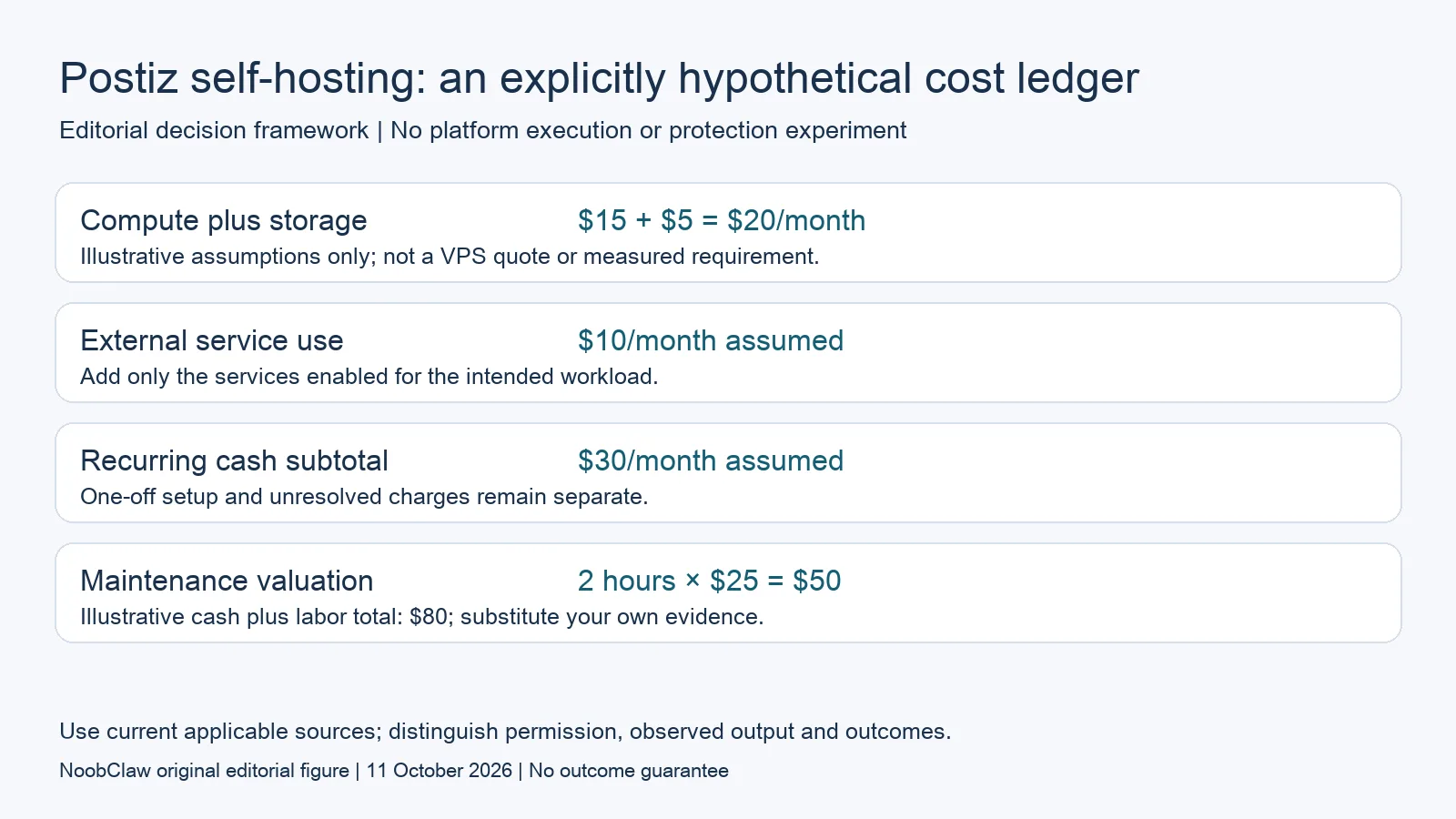
- Compute plus storage: $15 + $5 = $20/month. Illustrative assumptions only; not a VPS quote or measured requirement.
- External service use: $10/month assumed. Add only the services enabled for the intended workload.
- Recurring cash subtotal: $30/month assumed. One-off setup and unresolved charges remain separate.
- Maintenance valuation: 2 hours × $25 = $50. Illustrative cash plus labor total: $80; substitute your own evidence.
Infrastructure includes the data you need to recover
The official installation overview recommends Docker Compose and describes the application together with Postgres, Redis and Temporal. Its system requirements distinguish light-use floors from recommended resources. A stated minimum is not a capacity benchmark for your team, and an advertised low VPS price does not establish enough headroom for your use. Begin with the current documented requirements, then observe resource use under your intended workload.
Budget for persistent application data, uploaded media, backups and a tested recovery route. If the server already exists, distinguish a new cash payment from capacity you are consuming. Domain, storage and network charges can be separate lines where applicable. The operating question is who can restore an accepted working state when something fails. A backup file alone does not demonstrate that recovery succeeds; retain a limited recovery check and its result before describing the setup as production-ready.
Provider access needs its own evidence and cost line
Postiz’s provider overview distinguishes developer-app integrations from providers accepting credentials supplied during connection. It is therefore inaccurate to assume every supported provider needs the same review process or none of them needs configuration. Identify each required account type, action and permission. A name visible in an Add Channel dialog is weaker evidence than an accepted connection and an authorized test of the intended publishing action.
Keep any external API charges or approval assistance separate from the server price. The earlier article quoted specific platform costs and mandatory waiting periods without establishing the current offer for this instance. Those figures are not retained as universal costs. Postiz’s paid approval assistance is optional, and a vendor’s review estimate is not an approval guarantee. Where an external price, scope or access condition remains unresolved, mark it unresolved and obtain that requirement before claiming a complete budget.
AI and clipping do not become free with the source
The repository and configuration documentation describe AI features using supplied upstream provider credentials. The self-hosted clipping guide requires additional media-processing and storage configuration and documents ongoing provider usage costs. Those dependencies belong in the estimate if clipping is part of your workload. They do not belong as mandatory charges for a team that is only scheduling already prepared material and does not enable that action.
Compare a specific creative workload against the hosted allowance for that action. A generated image, a generated video and a minute of source-video clipping are different units. The self-hosted guide also documents its own clipping caps, so no hosted minute meter does not mean no operational limits. Avoid presenting self-hosting as unlimited compute or claiming that every AI feature works immediately after the base application starts. Preserve a verified output and its actual provider usage before estimating the recurring bill.
A hypothetical ledger and a bounded break-even check
For illustration only, suppose you assign $15 a month to compute, $5 to backups and media storage, and $10 to external usage: the recurring cash subtotal is $30. If maintenance takes two hours valued internally at $25 each, the illustrative total becomes $80. These numbers are assumptions, not provider quotes, a measured Postiz deployment or a recommended server. Replace every line with your observed requirement and your own labor valuation. One-off setup work remains a separate line.
For thirty accounts, the current hosted Pro reference is $49 monthly. Comparing it with that hypothetical $80 does not prove hosting wins for your team: the creative allowance, required actions, taxes, actual usage and value you assign to operation can differ. Nor does a cheaper assumed server prove self-hosting wins. Show the assumptions and unresolved requirements beside the result. Start with a small authorized pilot, review the accepted behavior and observed cost, then choose whether expanding the instance or buying a hosted plan fits the work.
For the related content and workflow decisions, read Postiz Open Source vs Paid: Plans, AI and Hosting Costs and Postiz vs Post Bridge: Current Prices, Accounts and API. Each review has its own evidence and scope.
A local output is not a self-hosting benchmark
NoobClaw publishes this comparison, so the product example has a commercial interest. Its public execution record documents one local production result: 441 English script characters became a 32.6-second, 1080 × 1920 video at 30 fps, with voiceover and subtitles. That is evidence of a particular creative output, not a Postiz integration, social-account connection or external publication. Some stock imagery was poorly matched to the script, and full audiovisual quality and asset licensing were not approved. A buyer can use that record to understand the production step and its limitations, then review the actual file and rights before deciding whether to publish it. It does not establish that NoobClaw replaces a scheduler, an approval process, platform permissions or a self-hosted server. Choose a production tool for an output you can inspect; choose a delivery tool for the destinations and controls it can demonstrate. Neither the local file nor a vendor’s connected-account allowance proves reach, account protection or revenue. The creative workload and the publishing workload need separate acceptance criteria.
NoobClaw publishes this article. Its script-to-video guide and public creative execution record document a local video result, not external-platform publication. Check the current product offer against the supported action you need.
Frequently asked questions
Is the cheapest server enough?
That is not established here. Compare the current documented requirements with your workload, observe resource use and test recovery; a published floor is not a guarantee of capacity.
Are all AI services mandatory?
No. Budget for the features you actually enable and the dependencies their current documentation requires. A basic publishing workload and a clipping workflow have different requirements.
When does self-hosting become cheaper?
There is no verified universal account threshold in this article. Compare the actual hosted tier with infrastructure, external usage, maintenance, setup and unresolved requirements for your workload.
Sources
Official material reviewed on October 11, 2026. Document conditions apply to their stated service and scope; the editorial examples are explicitly hypothetical.
- Postiz: official source repository and cloud/open-source description
- Postiz: current installation options
- Postiz: system requirements
- Postiz: provider configuration overview
- Postiz: current configuration reference
- Postiz: self-hosted clipping dependencies, costs and caps
- Postiz: current plans, hosted features and self-hosting FAQ