
SocialBee vs Buffer: Profile Bundles, Channel Tiers and Teams
- SocialBee’s monthly standard plans are $29 for five profiles, $49 for ten and $99 for 25. Their annual totals are $290, $490 and $990.
- Buffer charges by channel in graduated bands. Essentials has one user; Team includes unlimited members and approval workflows.
- SocialBee Pro’s three users apply per workspace, with five included workspaces. Do not interpret this as an unrestricted organization-wide seat allowance.
- Compare category limits, client grouping and approval needs alongside capacity prices. Both products offer AI writing features; neither price is proof of a tested result.
Choose SocialBee vs Buffer by how you organize content and people, then calculate the applicable price. SocialBee’s profile bundles and content categories differ from Buffer’s channel bands. A lower cost for connection capacity can still be the wrong plan when you need another workspace, a reviewer or a specific approval role. This comparison uses the current public standard-plan prices and keeps hypothetical totals separate from checkout quotes.
Price the required profile capacity, then check the workspace and reviewer who must use it. A lower connection price alone does not choose the workflow.
Choose the content organization you actually need
SocialBee organizes posts into content categories and supports recycling; Buffer provides a publishing queue and related tools. Describe your task in concrete terms: maintaining a reusable library, preparing a run of new posts, reviewing client drafts or coordinating several contributors. Do not infer that every campaign benefits from recycling, or that a queue necessarily lacks all reuse options.
Both current official offers include AI writing features. Compare an actual caption or revision against your brief instead of labeling one service a generator and the other merely a delivery pipe. Content generation, review and destination acceptance are separate tasks. A workflow can need all three; no single pricing column establishes that the output meets the brief or that publishing succeeds.
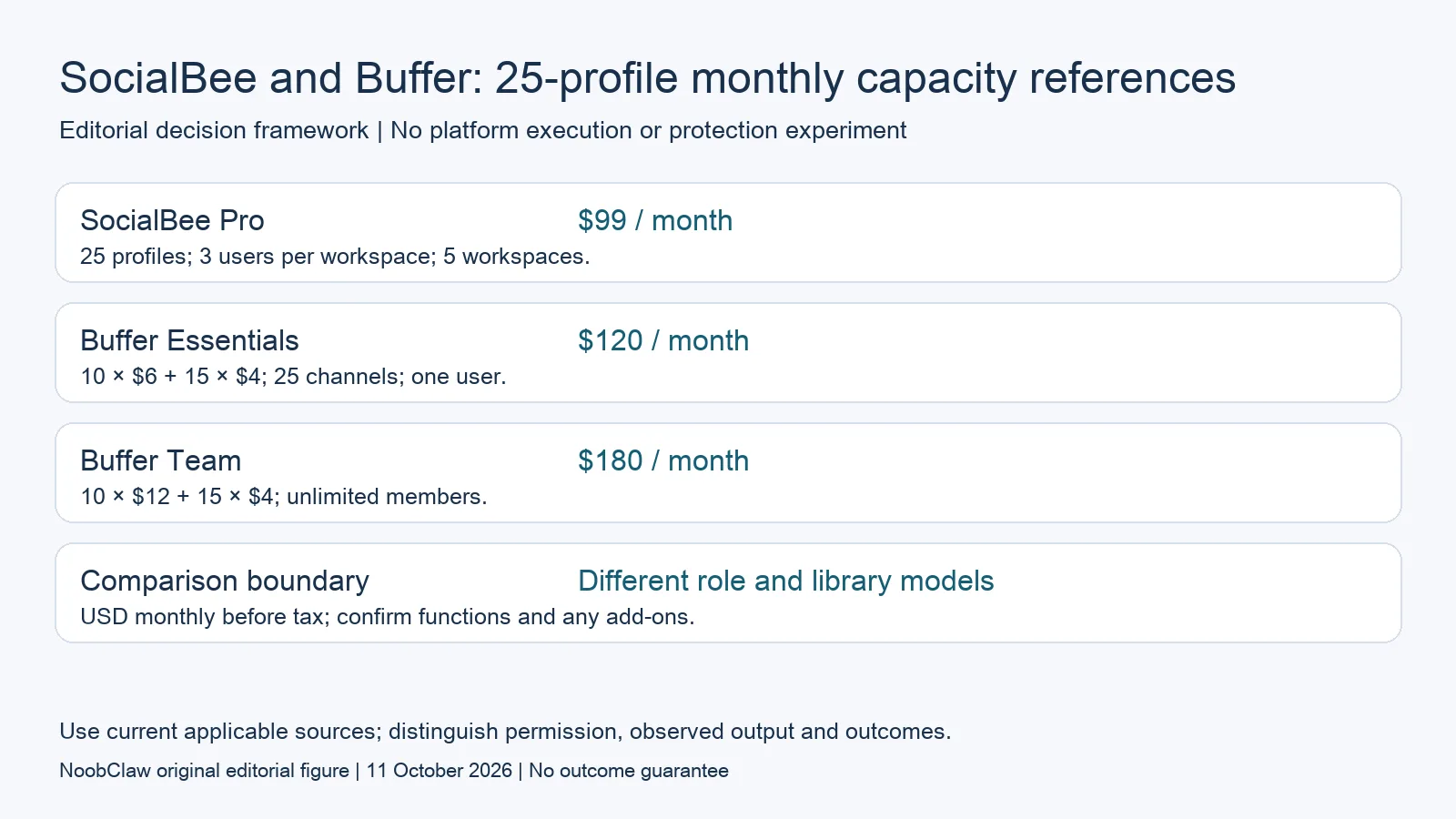
- SocialBee Pro: $99 / month. 25 profiles; 3 users per workspace; 5 workspaces.
- Buffer Essentials: $120 / month. 10 × $6 + 15 × $4; 25 channels; one user.
- Buffer Team: $180 / month. 10 × $12 + 15 × $4; unlimited members.
- Comparison boundary: Different role and library models. USD monthly before tax; confirm functions and any add-ons.
Read SocialBee’s standard bundles and role units
SocialBee’s current monthly standard plans are Bootstrap $29 with five profiles, Accelerate $49 with ten and Pro $99 with 25. The corresponding annual totals are $290, $490 and $990, paid annually. The monthly-equivalent label is not the amount of a month-to-month charge. Keep the total annual commitment beside it if you compare billing periods.
Bootstrap and Accelerate list one user and one workspace. Pro lists three users per workspace and five workspaces. That per-workspace qualification matters when a contributor works across clients; it should not be converted into unlimited organization-wide seats. The current cards list approval and CSV functions on Accelerate and Pro, so a decision requiring those functions cannot automatically use Bootstrap just because it has enough profile capacity.
Compare Buffer’s graduated monthly rates
Buffer’s monthly Essentials channel rates are $6 for the first ten, $4 for channels 11–25, $3 for 26–50 and $1 above 50. Team uses $12, $4, $3 and $2 for the same bands. Apply the rates progressively. At 25 channels, this produces $120 monthly for Essentials and $180 for Team; SocialBee Pro’s base capacity reference is $99 monthly for 25 profiles.
These totals compare connection capacity, not identical collaboration. Essentials is a one-user plan, Team includes unlimited members and approval workflows, and Pro’s three-user allowance is per workspace. If you need more users or a different client arrangement, reprice the actual configuration. Do not extend the 25-profile result into a claim that SocialBee is cheaper at every scale, especially after add-ons and plan requirements enter the calculation.
Inspect library limits and extras before upgrading
SocialBee’s standard comparison table lists 10, 50 and unlimited content categories across Bootstrap, Accelerate and Pro. The posts-per-category entries are 1,000, 5,000 and 5,000. A category count and a library-entry limit are separate from connected profiles. Use the number of items your actual library needs, not a theoretical maximum multiplied across every category, to judge whether a plan fits.
Its published add-ons include five extra profiles for $15 monthly or $150 annually, and an extra user or workspace for $10 monthly or $100 annually. Confirm availability and the required base tier in the app before building a quote. A five-profile increment is not a purchase of one profile, and the lower marginal capacity price does not add approval or reporting features absent from the base plan.
Separate a capacity example from a buying recommendation
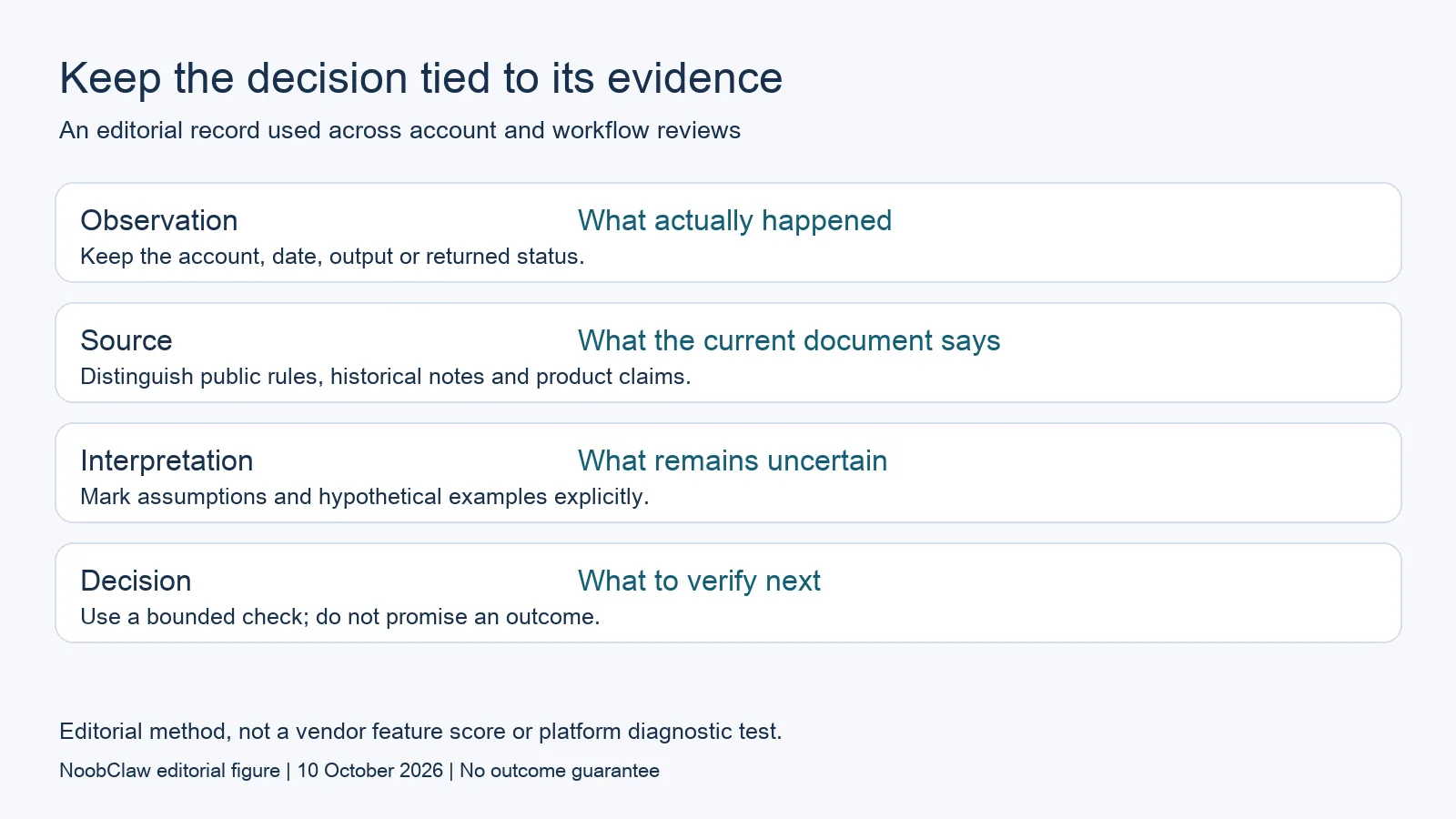
Imagine a team that needs 25 profiles, a client-review process and a reusable library. First check each required action and permission in the relevant plan. Next count the workspaces and contributors, then obtain a same-period quote for the accepted configurations. This is an editorial evaluation method, not a record of a tested migration or a claim that a particular agency’s requirements are already satisfied.
Buffer’s Free plan offers three channels with ten simultaneously queued posts per channel; it is not a recurring ten-post lifetime allowance. Paid scheduling is subject to a fair-use statement of 5,000 posts per channel with no period defined there. SocialBee advertises a 14-day trial; a trial is not a permanent free plan. Keep those limits beside the cost and check each destination’s account and media requirements before testing a representative workflow.
For the related content and workflow decisions, read SocialBee vs Hootsuite: Profiles, Users and Annual Costs and Buffer Pricing at Scale: Channel Tiers and Team Costs. Each review has its own evidence and scope.
When the missing task is a narrated video draft
NoobClaw publishes this comparison. Its public execution record documents a local production step: 441 English script characters became a 32.6-second, 1080 × 1920 video at 30 fps, with voiceover and subtitles. The record does not demonstrate a scheduler integration, an external upload, approval enforcement or a paid conversion. Some stock imagery was poorly matched, and full audiovisual quality and asset licensing were not approved. If your requirement is a narrated video draft, inspect that output and its limitations. If it is shared client review or publishing, evaluate the relevant service directly. Do not substitute one successful local export for evidence of another product’s delivery capacity. Keep the production, approval and acceptance records separate.
NoobClaw publishes this article. Its script-to-video guide and public creative execution record document a local video result, not external-platform publication. Check the current product offer against the supported action you need.
Frequently asked questions
Which service is cheaper at 25 accounts?
For base monthly connection capacity, SocialBee Pro is $99, Buffer Essentials is $120 and Buffer Team is $180. The access, workspace and content-library models differ. Add required extras and reject plans missing your required function before comparing the final quote.
Does SocialBee Pro include unlimited team members?
Its current standard card lists three users per workspace and five workspaces. Keep that unit intact. Verify any additional-user configuration rather than treating the workspace count as unrestricted team access.
Can I choose a cheaper tier and buy more profiles?
Profile add-ons may help with capacity, but they do not establish that a lower tier includes the approval, CSV or reporting feature you require. Confirm the base tier and add-on eligibility in the current app quote.
Is a trial equivalent to Buffer Free?
No. SocialBee’s advertised trial is time-limited; Buffer’s Free offer has ongoing limits on channels and simultaneously queued posts. Compare the actual conditions rather than giving both the same free-plan label.
Sources
Official material reviewed on October 11, 2026. Document conditions apply to their stated service and scope; the editorial examples are explicitly hypothetical.