Threads API Rate Limits: Post Caps and the Call-Budget Floor
- The general call allowance belongs to an app-and-app-user pair; publishing caps have a different scope.
- The documented minimum of ten impressions gives a 48,000-call arithmetic floor, not a near-zero allowance.
- A quota figure does not identify the cause of an actual error or authorize another publishing method.
Threads API limits need an action and an owner before the numbers make sense. A profile publishing allowance and an application's general call budget are separate controls. A new profile is not documented as having almost no calls just because few people saw its posts. Use the current official overview and the actual response from your integration to decide whether to wait, correct a request or investigate another part of the workflow.
Identify the exact action, counting unit and available evidence before choosing a workflow.
Read the two scopes before interpreting a number
The inspected official overview specifies 250 API-published posts, 1,000 replies, 100 deletions and 500 location searches in moving twenty-four-hour windows. General calls are counted for each app-and-app-user pair at 4,800 times impressions, with impressions set to at least ten. Thus the stated formula has a 48,000-call floor. The retrieved body was the German-language official variant; the source link identifies the overview.
A useful inventory has separate rows for the intended action, the affected profile, the calling app and the time window. Do not combine two controls just because they both concern one profile. When comparing two connected tools, identify which operation each performs and which documented scope applies. A different integration does not create a new profile publishing allowance merely because its dashboard is separate.
The ten-impression minimum matters when discussing a quiet account. It contradicts a claim that negligible reach creates negligible call capacity under this formula. That does not prove a particular workflow is below every limit. A sufficiently busy integration, another relevant control, an invalid request or a service problem can still require investigation. Reach alone is not an error diagnosis, and a capacity figure is not a promise that every attempted action succeeds.
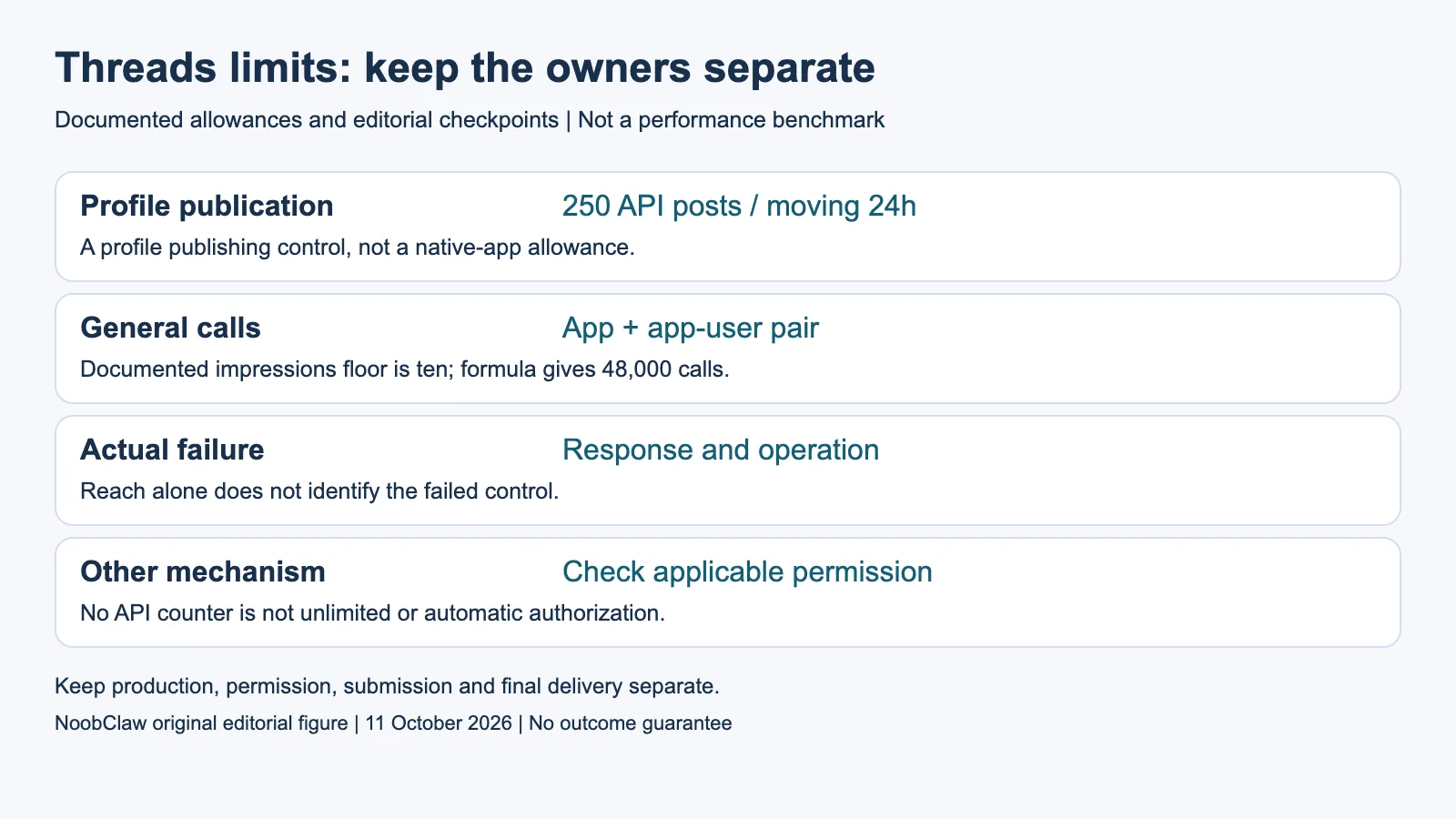
- Actual failure: Response and operation. Reach alone does not identify the failed control.
- Other mechanism: Check applicable permission. No API counter is not unlimited or automatic authorization.
Use the rolling window and actual usage together
A moving window is not a daily calendar reset. In an illustrative publishing ledger, keep the completion time of each relevant operation and the time at which you inspect usage. Earlier activity leaves a moving window as it ages out. Avoid promising an exact retry time from a summary total when you do not have the underlying timestamps or the integration's current response.
The overview provides a publishing-usage endpoint with fields for the relevant operations and configuration. Inspect the applicable permissions before using it, and keep the returned configuration beside the observed usage. An example shown in documentation is an explanation of the response shape, not your own remaining allowance. This article does not execute that endpoint or measure an authenticated profile's quota.
For a hypothetical brief of twelve approved originals in a week, the headline post count alone does not explain an error on the first attempt. Record the operation that actually failed rather than inferring from the editorial calendar. The publishing integration may perform other actions around the post, and those actions need their own scope and evidence. Keep the desired twelve posts separate from the number of underlying requests.
Investigate the failure without a reach-based diagnosis
Start with a compact incident record: timestamp and time zone, operation, calling integration, destination profile, returned status and available request identifier. Retain the relevant response while removing secrets from any shared report. Record whether the item was prepared, submitted, accepted or actually visible. A single green workflow row is weaker evidence than a verified published item with the intended content and audience.
Quota, access, payload, media handling and transport are useful investigation categories, not an exhaustive list or a verdict. Choose the next check from the actual response. If access has changed, verify the grant before resubmitting. If a limit is reported, inspect that limit's scope and window. If the response is unavailable, mark the outcome unknown instead of manufacturing a successful publication or a platform penalty.
Before repeating a write action after a transport interruption, determine whether the first request may already have succeeded. In this illustrative procedure, reconcile the known item or status before creating another copy. An automatic retry policy should specify its maximum attempts and the conditions under which it stops. Waiting can help some temporary problems, but it is not a universal repair for every missing permission, rejected asset or unresolved outcome.
Choose a workflow for the missing task
API publishing, a person using native controls and a tool operating a browser are different mechanisms. A document about one API's counting rules does not certify permission for another mechanism. Ask what the proposed tool actually does, which account controls it uses and what the platform permits. Removing an API token from a workflow is not evidence that all other conditions disappear or that publication becomes unlimited.
NoobClaw's public creative record documents a 441-character English script and a local 32.6-second export at 1080 by 1920 pixels and 30 fps. Audio and subtitles were observed, while footage relevance, voice quality and rights were not approved for release. That is evidence about a production step, not a Threads publication, a measured API allowance, account protection or a quota workaround. Check the needed action against the documented workflow.
Complete the decision with the current source, the applicable counting scope, actual account evidence and an acceptance condition. If your missing task is preparing a video, inspect that stage separately. If it is publishing, require the supported route and an observed final result. If it is understanding an error, investigate the recorded operation. A source-backed limit can improve planning without becoming a claim about guaranteed reach or the cause of every failed request.
For the related content and workflow decisions, read Free Threads Schedulers: Native Options and Queue Limits and Free Social Media Posting API: Access, Limits and Costs. Each review has its own evidence and scope.
NoobClaw publishes this article. Its script-to-video guide and public creative execution record document a local video result, not external-platform publication. Check the current product offer against the supported action you need.
Frequently asked questions
Does a new quiet profile have almost no API calls?
The overview explicitly sets an impressions minimum. The formula therefore does not support a near-zero call allowance from near-zero reach. An actual error still needs its own evidence.
Do all limits reset at midnight?
The cited API controls use moving windows. Inspect the relevant usage and configuration rather than planning around an assumed calendar reset.
Does this prove the API or my workflow is free?
No. The overview establishes technical controls. A vendor subscription, model usage and other workflow costs require their own current terms.
Sources
Sources inspected on October 11, 2026. Current technical and pricing documents retain their operation, account scope, billing units and eligibility conditions. The Threads API overview was read in its retrieved German-language official variant. Native scheduling announcements are dated product records, not authenticated current-account tests. Reused same-day primary copies retain their original retrieval records; they are not new GETs. Worked workloads and costs are hypothetical. The public local-production example does not establish platform publication, account protection or a paid conversion.