Free Threads Schedulers: Native Options and Queue Limits
- Inspect the native scheduling controls before buying a separate tool; an unstated cap is not infinite capacity.
- Buffer Free queue depth and Metricool Free monthly completed-publication counts measure different things.
- An API-dependent integration also needs its actual platform conditions; low reach alone is not a failure diagnosis.
Choose a free Threads scheduler by the work you need to complete. One account with approved original posts is different from several destinations, team review or a reusable combined report. Start by inspecting native controls and then compare the eligible free-plan conditions. A queue of waiting posts, a monthly publication allowance and a connected-account count are different units; a free price alone does not tell you whether the requested week fits.
Identify the exact action, counting unit and available evidence before choosing a workflow.
Inspect native controls without inventing unlimited capacity
Meta's August 15, 2024 announcement describes native scheduling as an upcoming test for web, alongside drafts and insights. Mosseri's later public post announces that posts can be scheduled; his earlier test post excludes replies. These are dated product records, not an authenticated check of every current account or build. Inspect the controls actually available to you before planning the work around a feature.
For a hypothetical week of seven original posts on one Threads account, prepare the approved content and examine the composer, available dates and saved items. Check the time zone and what happens when an item is edited or cancelled. These are acceptance checks, not a certified current menu or a claim about an unlimited queue. A feature announcement that omits a maximum does not prove that there is nothing to outgrow.
Do not apply the native reply exclusion to every third-party feature or every API operation. A scheduled original, a live response and a supported automated reply are different tasks. Choose the actual needed action and inspect the applicable tool and platform conditions. If a current control cannot be confirmed, keep that uncertainty visible rather than promising that all interfaces can complete the same brief.
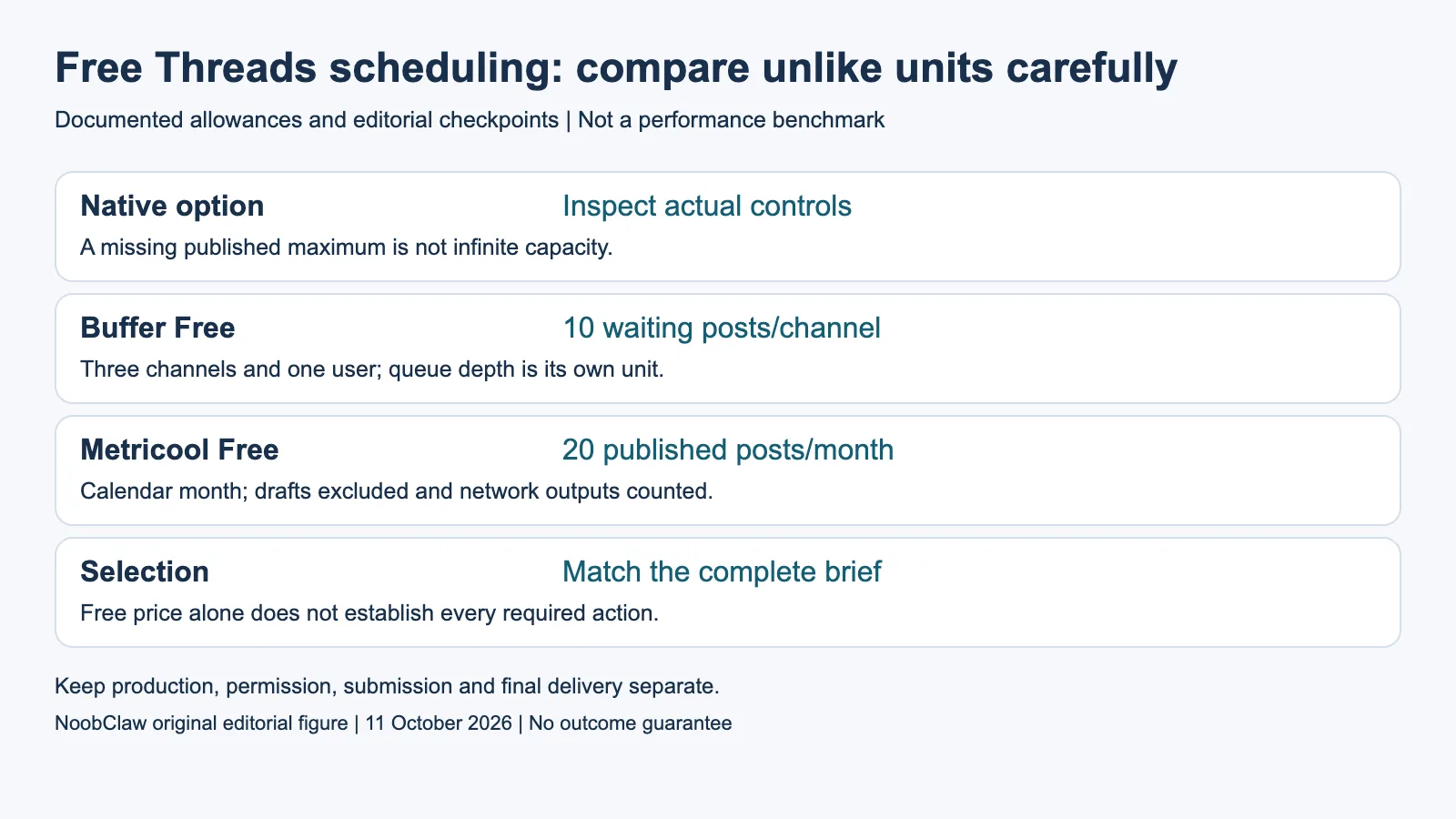
- Native option: Inspect actual controls. A missing published maximum is not infinite capacity.
- Buffer Free: 10 waiting posts/channel. Three channels and one user; queue depth is its own unit.
- Metricool Free: 20 published posts/month. Calendar month; drafts excluded and network outputs counted.
- Selection: Match the complete brief. Free price alone does not establish every required action.
Compare the free-plan units using a small inventory
Buffer's current Free offer lists three channels, one user and ten queued posts per channel. A ten-item queue counts waiting items rather than a general promise of ten completed posts each month. If your brief involves several destinations, map the actual connected channels and queue needs. A multi-network label does not prove the plan fits several profiles on a particular network or includes team approvals.
Metricool's specific Free guide counts twenty actually published posts per calendar month, resetting on the first; drafts and merely scheduled items do not count, and publication on each network counts separately. It includes one brand and thirty days of analytics history, while excluding LinkedIn and X. Use the specific counting conditions instead of treating a scheduling label as a limit on how many drafts can wait.
In an illustrative thirty-day plan of one published original a day, the desired thirty outputs exceed a twenty-publication allowance by ten. That arithmetic is a planning comparison, not a verified month of results or advice to create accounts to evade a condition. If the same brief also publishes on another destination, count the intended network outputs explicitly. A queue-depth plan needs a separate refill schedule and an acceptance check for the supported formats.
Separate the tool plan from the actual publishing mechanism
Ask how the selected integration performs its requested action. Do not state that every third-party scheduler necessarily uses the same API or that a native route has no other limits. For an API-dependent route, inspect the relevant source and current account evidence. A free vendor subscription, an interface control and a platform operation can each have conditions that need to be matched to the brief.
The current Threads overview distinguishes profile publishing controls from general calls counted for each app-and-app-user pair. Its impressions formula has an explicit minimum. Low reach alone therefore does not establish negligible call room or explain an actual publishing error. Check the failed operation and available usage evidence rather than diagnosing a quiet profile from a headline quota or assuming one shared counter for every connected app.
For the hypothetical seven-post week, keep a record of each intended destination and the route responsible for publishing it. Check the final item after the planned time. If the outcome is unknown, inspect the existing task before resubmitting. Multiple tools and cross-post settings can produce a confusing inventory, but a duplicate needs actual evidence; do not assume that connecting any scheduler automatically creates two copies.
Pay for the requirement that remains unmet
A free candidate can be sufficient when its eligible controls complete the actual brief. A paid candidate needs a practical reason: additional inventory, the requested approval workflow, a supported format or the required report. Define that reason before comparing monthly prices. A plan can include unused capacity without being the cheapest suitable option, and a lower entry price can omit the action that makes the tool useful.
NoobClaw's public creative example documents a 441-character script and a local 32.6-second vertical export at 1080 by 1920 pixels and 30 fps. Audio and subtitles were observed; footage match, voice and rights were not approved for release. That result concerns preparation, not native Threads scheduling, a completed public item or a free publishing allowance. Inspect the documented production stage only if that is the missing part of your brief.
Complete the selection with the desired inventory, eligible controls, known counting units and the observed result of a bounded trial. Keep the current source date with the comparison. This article does not predict that scheduled posts receive more or less reach, certify a universal native capacity or promise that a free plan will fit forever. The useful outcome is a verified workflow for the actual week, with unresolved requirements clear before a purchase.
For the related content and workflow decisions, read Threads API Rate Limits: Post Caps and the Call-Budget Floor and Free Social Media Schedulers: Queue Limits and Plan Fit. Each review has its own evidence and scope.
NoobClaw publishes this article. Its script-to-video guide and public creative execution record document a local video result, not external-platform publication. Check the current product offer against the supported action you need.
Frequently asked questions
Does an unpublished native queue limit mean unlimited scheduling?
No. Inspect the actual controls and the requested workload. The cited announcements do not certify an unlimited current queue.
Are a ten-item queue and twenty monthly publications equivalent?
No. Waiting inventory and completed output measure different things. Plan refills or total network publications according to the actual offer.
Does a quiet account prove the call budget caused a failure?
No. The current API overview includes an impressions minimum, and the actual failed operation needs its own response and scope checks.
Sources
Sources inspected on October 11, 2026. Current technical and pricing documents retain their operation, account scope, billing units and eligibility conditions. The Threads API overview was read in its retrieved German-language official variant. Native scheduling announcements are dated product records, not authenticated current-account tests. Reused same-day primary copies retain their original retrieval records; they are not new GETs. Worked workloads and costs are hypothetical. The public local-production example does not establish platform publication, account protection or a paid conversion.