
TikTok Symphony Creative Studio Is Free — And Its Output Pipe Goes to Ads Manager, Not Your Profile
- Symphony Creative Studio is open to all logged-in TikTok for Business users and generates video from a product URL, a prompt, an image, or an example video.
- TikTok states that qualifying output is automatically labelled AI-generated in the video file. Using the platform own tool does not exempt you from disclosure — it guarantees it.
- The documented export paths are download and export to TikTok Ads Manager. The product page does not describe publishing to an organic account.
- It is powered by the same Seedance model family that third-party AI video tools use. The model is not the differentiator. The distribution pipe is.
Free AI video generation from the platform itself sounds like the end of the argument. Why pay a third-party tool when TikTok will make the video for you at no cost?
Because the question is not who generates the file. It is where the file is allowed to go. And on that question TikTok's own product page is quietly specific.
What it is, in TikTok's words
TikTok describes Symphony Creative Studio as "an AI-powered video-generation tool that can generate a video in minutes from minimal user input," aimed at advertisers and content creators, with particular emphasis on those "with limited time and resources."
Access is stated as "all logged-in TikTok for Business users." That is the first fact worth pausing on: the door is a business account, not a creator account. Capabilities include turning a product URL into a video, adding a digital avatar to narrate a script, dubbing and translating existing videos into other languages, and a full editor with AI captions and royalty-free music.

The pipe: download, or export to Ads Manager
TikTok documents two things you can do with the output — download it, or "export ... to TikTok Ads Manager," with direct sync into Ads Manager as the headline workflow. The page does not describe posting the result to an organic account.
That is not a loophole to exploit, it is a statement of intent. Symphony Creative Studio is a creative production line for paid media. The reason it is free is the same reason ad platforms give away creative tooling generally: the tool is not the product, the ad spend is.
A free generator that outputs into an ad account is not a cheaper version of your content workflow. It is a cheaper on-ramp to buying media.
You can, of course, download a file and upload it yourself. But then you have a manual step at the exact point where volume matters, and you have given up the one thing the integration was offering.
The part almost nobody expects: it labels itself
Here is the line that changes how people think about this tool. TikTok states: "All content generated by Symphony Creative Studio that meets the requirements for disclosing the use of AI from ad policy is automatically labeled as 'AI-generated' in the video output."
The platform's own generator stamps the platform's own AI label onto the file. A surprising number of people assume the opposite — that using first-party tooling is the safe way to avoid the label. It is the most certain way to get it.
Whether that matters depends entirely on your category. For a product ad, an AI-generated label is close to irrelevant. For a personality-led account where the whole proposition is that a human is behind it, it is not a small detail. Disclosure rules now differ meaningfully by platform, which is worth reading in one place — see how the disclosure rules compare across platforms before you standardise a workflow across several.
Same model, different plumbing
Symphony Creative Studio's own page credits Dreamina Seedance 2.0 as the engine. If that name looks familiar it is because the Seedance family is what a number of third-party AI video products build on too. So when people frame this as "TikTok's AI versus the tools," the model layer is largely the same conversation.
What differs is everything around it:
- Account type. Symphony needs TikTok for Business. Your organic accounts are a different login.
- Destination. Ads Manager versus a profile feed.
- Multiplicity. One ad account producing many creatives is a different problem from many accounts each producing their own content. Symphony solves the first.
- Cross-platform. A TikTok-owned pipeline outputs into TikTok. Everything else is your problem.
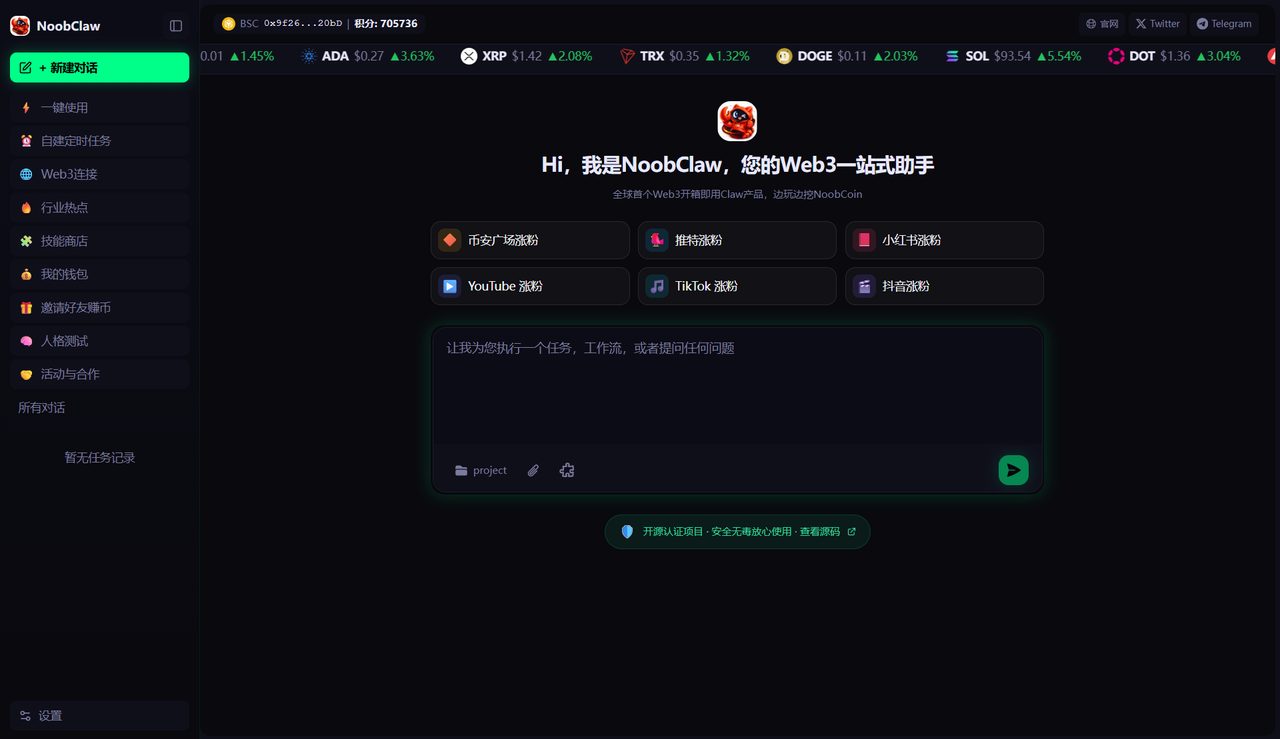
This is where a tool like NoobClaw is answering a different question rather than competing on generation quality. It runs on your own machine against your own logged-in accounts, generates something different for each account from that account's own niche and persona, and posts on a randomised human-looking schedule across a dozen platforms. Symphony makes one excellent ad creative fast. That is genuinely useful, and it is not the same job.
If you are choosing between AI video products more generally, the category is messier than it looks — four quite different products compete under the same name, and the watermark is usually the paywall.
Where a free first-party generator genuinely wins
None of the above means the tool is not worth using. It means being clear about the job. Three situations where Symphony Creative Studio is straightforwardly the right answer:
- You are testing ad creative and need variation volume. Ten variants of a product video, generated from a URL, synced straight into Ads Manager, is a workflow that used to require an agency. The AI label is irrelevant on a paid placement.
- You need the same video in six languages. The dubbing and translation path is first-party, which means the lip and audio handling is tuned for the format the platform serves. That is a hard thing to match with a general-purpose tool.
- You have a product and no footage. Turning a product page into something watchable is a genuine cold-start solution, and it costs nothing to try.
Where it is the wrong answer is anything where the value proposition is that a person is behind the account. An automatically applied AI-generated label on a personality-led post is not a neutral piece of metadata — it is a claim about authorship, applied by the platform, that you did not get to phrase yourself.
The label is not a penalty. It is a disclosure you no longer control the wording of. Decide whether your format survives that before you standardise on the tool.
There is also a quieter operational point. A pipeline that terminates in Ads Manager is a pipeline that terminates on one platform. If your plan involves the same idea landing on several platforms with different framing, captions and rhythm, the generation step was never the hard part — the fan-out was. Any tool that solves generation brilliantly and stops at one destination leaves the expensive half of the work on your desk.
FAQ
Do I need to run ads to use Symphony Creative Studio?
TikTok states access is for all logged-in TikTok for Business users, so creating an account is the gate rather than active spend. But the documented export path runs into Ads Manager, so the tool is built on the assumption that spend is where the output is going.
Can I post Symphony videos to my normal TikTok account?
You can download the file and upload it yourself like any other video. TikTok's product page does not describe a direct publish-to-organic path, and the AI-generated label applied at generation time travels with the file.
Does the AI-generated label hurt reach?
TikTok does not publish a reach penalty for labelled content, and anyone quoting a percentage is guessing. What is documented is that the label exists and that Symphony applies it automatically to qualifying output. Plan around the label being visible, not around a number nobody can source.