
The X Lead Generation API Is Documented Now. It Will Not Help Organic Accounts.
- X documented the Lead Generation API on 15 September 2026: create native lead forms, attach them to a card with a LEAD_FORM destination, export leads as JSON, CSV or XLSX.
- It sits under the Ads API, needs the Campaign user permission, and limits exports to account administrators. It is not a route to automated DMs or organic lead capture.
- What organic automation works with, verified today: POST /2/tweets allows 100 requests per 15 min per user and 10,000 per 24 hrs per app, plus policy rules on duplicate content and bot labelling.
- Two more changelog lines that week: REGIONS segmentation for async analytics (16 Sep, country parameter required) and a Google Tag Manager server-side template for the Conversion API (17 Sep).
When a platform documents something called a Lead Generation API, the first reaction in any growth channel is a small jolt of hope: maybe this is the one that finally lets us capture leads automatically. We had that reaction on Monday. We are writing this on Friday, and the honest answer is no.
That is a disappointing thing to publish. It is also the most useful thing we can publish about it, because the alternative — implying a capability that does not exist — is how people end up building three weeks of pipeline against a door that was never open.
What the X Lead Generation API actually shipped on 15 September
The X API changelog entry for 15 September 2026 records that documentation for the Lead Generation API became available. Read in the docs rather than in the summary, it is three concrete things:
- POST /12/accounts/:account_id/lead_forms creates a native lead form. A form carries an introduction, the fields you want collected, a privacy-policy reference and an optional thank-you page.
- POST /12/accounts/:account_id/cards accepts a destination type of LEAD_FORM, which is how the form gets attached to something a user can actually see.
- POST /12/accounts/:account_id/ad-export/api/v1/exports with entity_type=leads exports the submissions, in JSON, CSV or XLSX.
Two access details matter more than the endpoints. The Leads API requires the Campaign user permission, and lead exports are restricted to account administrators. Those are not incidental. They tell you who this was built for before you write a line of code.
Why the /12/accounts/ prefix is the whole story
Look at the path shape. Every one of those endpoints begins /12/accounts/:account_id/ — that is the Ads API, versioned separately from the v2 API you use to read and write posts, and scoped to an advertising account. The word "lead" in the name refers to a lead generated by a Lead Gen campaign: paid placement, a native form attached to a card, submissions collected by X and handed back to the advertiser.
So here is the part we would rather not write, stated plainly rather than buried:
This is an Ads API surface. It is not a route to automating direct messages, and it is not a way to capture leads from organic posts. If you are not running paid campaigns, the Lead Generation API is not a tool you can pick up.
It is worth being precise about what is and is not being claimed here. The API is real, it is documented, and for a team already running Lead Gen campaigns it genuinely removes work — exporting submissions on a schedule instead of downloading them by hand is a meaningful improvement, and the XLSX option suggests X knows who is actually doing that downloading. None of that becomes untrue because it does not help organic operators. It just does not help organic operators.
What organic automation actually has to work with
If you run accounts rather than campaigns, the interesting numbers this week were never in the Lead Gen docs. They are in the boring parts of the fundamentals. We re-checked both today:
- POST /2/tweets: 100 requests per 15 minutes per user, and 10,000 per 24 hours per app. The per-user window is the one that bites individual operators; the per-app ceiling is the one that bites anyone building a tool other people use.
- Automation rules in the developer policy. Two principles matter far more than the rest: do not post identical or substantially similar content across multiple accounts, and automated accounts must be identifiable as such. Honest caveat: X's automation-rules page would not load for us today — it returned a payment-required error on one path and a 404 on another — so we are describing the policy rather than quoting it, and you should read it yourself before you rely on our summary.
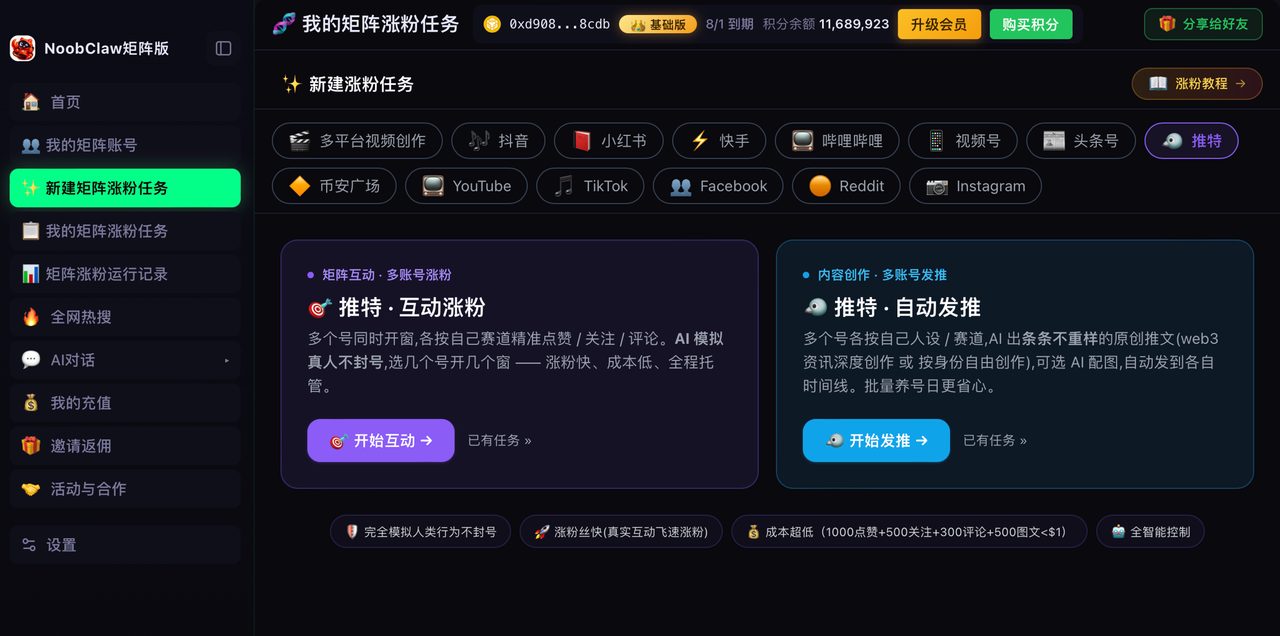
Those two rules are usually read as restrictions. Read them as design constraints instead and they tell you what a workable organic setup looks like: many accounts, each producing genuinely different content, at a pace no single window has to absorb. That is a content-generation problem, not a capture problem — which is why this is where a tool has something to offer. An AI matrix growth engine like NoobClaw is built around exactly that constraint: each account writes to its own niche, persona and keyword set so the output differs by account rather than being one post fanned out, and it signs in through a local browser on your own machine instead of taking your credentials. Whether that produces leads depends entirely on your niche and your material. What it changes is the mechanics — the per-account differentiation stops being a thing you do by hand.
For the actual lead-finding step, the organic playbook has not moved this week and does not run through any API. It runs through the comment sections where people have already raised their hands, and the platform-specific version of that is covered in finding warm leads without ads. The rate limits and labelling requirements above are the guardrails on how fast you can work that seam, and X's automation rules for agents goes deeper on where the line sits.
Two more changelog lines from the same week
Since you are in the changelog anyway, two smaller entries are worth a line each — both Ads API, both from this week:
- 16 September: asynchronous analytics jobs now support REGIONS as a segmentation type. When you request a regional breakdown, the country parameter becomes mandatory. If you have a nightly analytics job, that is a small schema change with a hard failure mode.
- 17 September: the official X Ads Conversion API tag is now available as a server-side template in Google Tag Manager, so advertisers can send website conversions without hand-writing the request code.
Both confirm the direction of travel. The energy this month is on the paid side of the platform. That is not a conspiracy, it is a business, and the correct response is to stop waiting for an organic equivalent and go work the surfaces that are already open.
FAQ
Can I use the X Lead Generation API without running ads?
No. The endpoints live under /12/accounts/:account_id/, which is the Ads API scoped to an advertising account, and the Leads API requires the Campaign user permission. Lead exports go further and are restricted to account administrators. Without a campaign and the right role on the account, there is nothing for these calls to operate on.
Does it let me automate direct messages to people who engage with my posts?
No, and this is the misreading most worth heading off. A lead form is a form the user fills in, not a conversation you start. Nothing in the 15 September documentation touches DMs, and there is no organic equivalent hiding behind it. If your plan depended on that, change the plan now rather than after the integration work.
What limits should an organic X automation respect?
Two hard numbers and two rules. The numbers: 100 post-creation requests per 15 minutes per user and 10,000 per 24 hours per app. The rules: no identical or substantially similar content across multiple accounts, and automated accounts must be identifiable. The rate limits are also the ceiling any third-party scheduler is working inside, which is why who pays for X API access shows up in tool pricing whether the tool mentions it or not.
The takeaway is a small one, held honestly: a new API is only good news if it is on your surface. Check the path prefix and the required permission before you let yourself get excited. It takes thirty seconds and it saves the three weeks.