Blotato API Alternatives: Access, Channels and Status Checks
- Blotato documents API access on paid plans, beginning with Starter; its free trial excludes API access.
- Buffer lists API access on Free and paid plans, with separate request allowances.
- Zernio bills graduated connected-account bands; profiles and additional usage have different definitions.
- Inspect the required action and final publication state before treating any provider as an equivalent replacement.
Looking for a Blotato API alternative starts with the operation you need to replace. A connection subscription, a generated video and a confirmed publication are different deliverables. Blotato currently documents paid API access, so this comparison does not assume its API is unavailable. It compares current official access and billing conditions for Blotato, Buffer and Zernio, checked October 11, 2026, then explains how to evaluate the required workflow without treating a request receipt as a published post. No competing API was activated or benchmarked for this review.
Select an eligible service for the required account and action, then verify the resulting status. A lower connection bill alone does not establish a working replacement.
Define the replacement before comparing subscriptions
Write down the intended account type, input asset, operation and required output. For example, an agency might need to submit an approved short video to a named client account, schedule it for a specific time and return the public URL. Another buyer might need the short video itself created from a brief. These buyers can have different shortlists even when both search for an API alternative. Include the approval owner and the person responsible for investigating failures in the same brief.
Keep your evaluation contract narrow enough to check. A service describing publishing does not establish every supported format or destination combination you require. Likewise, an AI feature name does not demonstrate that the resulting copy or video is suitable for a client. Ask for documentation of the specific operation and prepare a representative asset. This review compares documented access and cost conditions; it does not certify endpoint parity or observed publishing reliability.
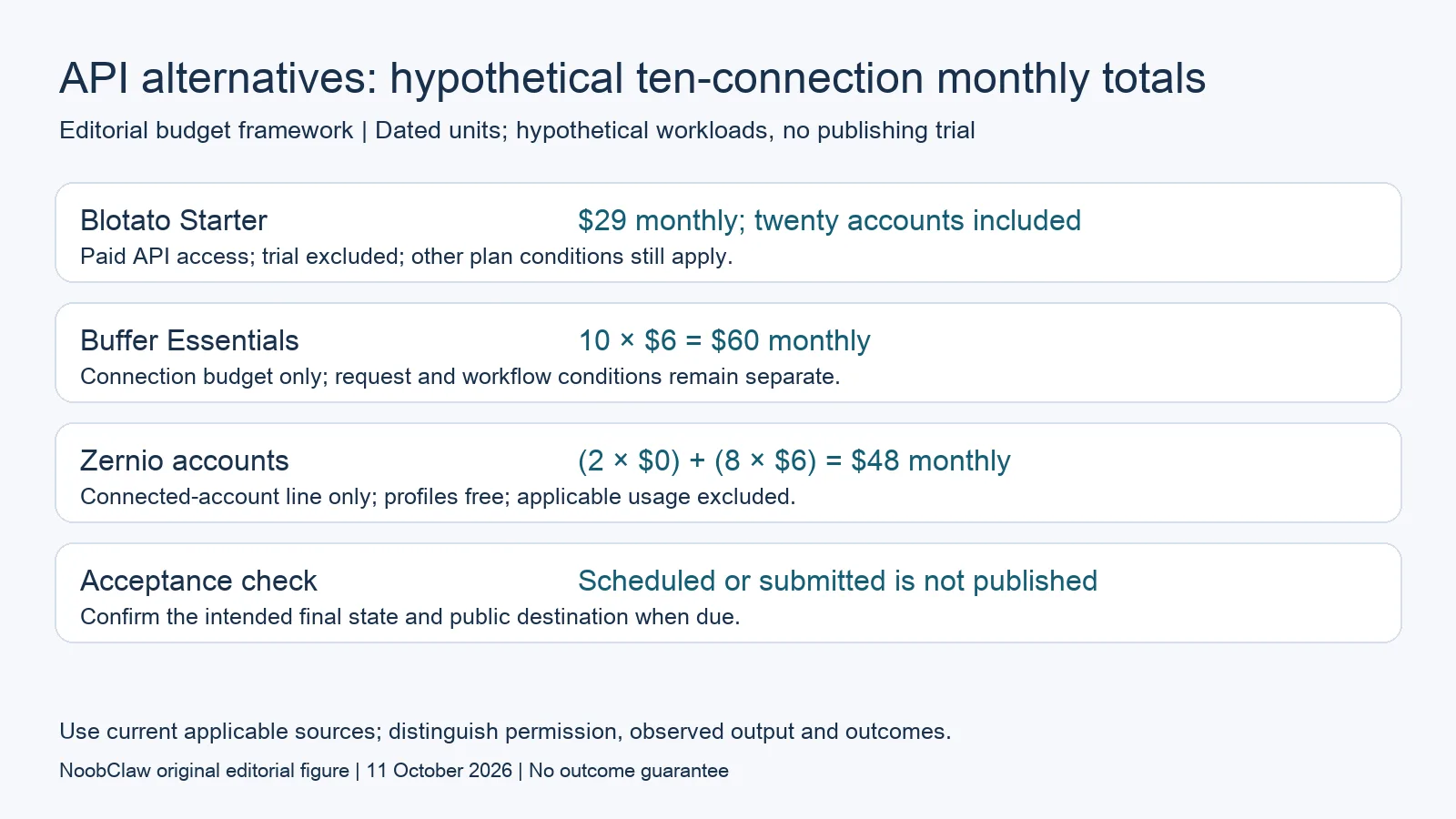
- Blotato Starter: $29 monthly; twenty accounts included. Paid API access; trial excluded; other plan conditions still apply.
- Buffer Essentials: 10 × $6 = $60 monthly. Connection budget only; request and workflow conditions remain separate.
- Zernio accounts: (2 × $0) + (8 × $6) = $48 monthly. Connected-account line only; profiles free; applicable usage excluded.
- Acceptance check: Scheduled or submitted is not published. Confirm the intended final state and public destination when due.
Compare documented access and connection costs
Blotato’s current API page includes access on paid plans starting with Starter at $29 monthly, with twenty connected accounts. It excludes API access from the free trial. Its listed higher tiers increase account capacity, scheduled-queue capacity and other limits. The pricing and API documents should therefore be read together. An included API does not mean every workload fits the starting plan, and a web trial does not demonstrate paid API behavior.
Buffer lists API access even on Free: one key and 3,000 requests monthly. Free connects up to three channels, with ten scheduled posts per channel at a time. Paid Essentials starts at $6 per channel monthly, using graduated bands beyond ten; Team has different collaboration conditions. Zernio’s current account bands make the first two connected accounts free, then charge $6 each for accounts three through ten and $3 each for eleven through one hundred. Profiles are grouping containers rather than the billable connection unit. Additional usage is separate.
A hypothetical ten-connection month is $29 for Blotato Starter, $60 for Buffer Essentials and $48 for Zernio’s connected-account line. The figure below shows that arithmetic under the stated monthly conditions. These are different service packages: the totals exclude taxes and applicable extra usage, and do not establish feature parity. A trial or free allowance can reduce the cost of examining eligibility, but it cannot substitute for verifying the required action and account permissions.
Separate a submitted request from the final result
Blotato’s current documentation distinguishes a submission identifier from later published, scheduled or failed states. Use that distinction when defining your acceptance check. A future scheduled item is not a failed publication merely because it has not reached its planned time. Conversely, a successful submission response is insufficient evidence that a public post exists. Preserve the provider identifier, intended account, requested timing and final status, then check the public URL when publication is expected.
For an alternative service, ask how its documented status model represents the same stages. Does the workflow expose a scheduled item, a failure reason and the resulting destination URL? Define who checks a delayed or failed item and how duplicates are avoided before moving a client workflow. These are evaluation questions, not claims that every shortlisted provider implements identical endpoints. Do not switch an entire inventory based on a pricing page or a response that merely acknowledges receipt.
Budget requests, generation and account usage separately
Buffer’s pricing document lists multiple API request windows. Free has a monthly allowance, a 24-hour allowance and a fifteen-minute limit; increasing the subscription does not make every short-window condition disappear. A hypothetical integration can spend requests on reads and status checks as well as submissions. Count the operations described by the intended implementation instead of assuming that the number of posts equals the number of billable or limited requests. Confirm any endpoint-specific conditions in the relevant API documentation.
Blotato’s publishing API and AI generation credits are separate concepts. Zernio also separates its connected-account line from applicable usage, including X API pass-through charges. Consequently, neither an account allowance nor a word such as unlimited proves a zero-cost complete workflow. Start with the required inventory, then list expected operations, creation work and additional charges. Do not label a connection-only calculation an actual invoice or a measured cost per successful publication.
Choose the service that covers the missing deliverable
Consider the documented Blotato paid workflow when its supported action, generation needs and account conditions fit. Consider Buffer when its supported channels, request budget and relevant team conditions fit. Consider Zernio when its account definition, API workflow and additional usage conditions fit. These are shortlist criteria rather than a universal ranking. For a concrete client brief, compare eligible plans after confirming the action; discard an ineligible cheaper package before calculating the final budget.
If the missing deliverable is a narrated vertical video, evaluate production independently of distribution. The local NoobClaw record below documents one export with explicit quality limitations. It does not establish a direct integration with these services. Inspect the actual scenes, wording and rights before preparing a publication request. Browser operation or agent assistance also does not establish account authorization, exemption from platform rules or guaranteed reach. Track audience clicks only after an observed publication, under a defined destination and time window.
Choose the output you need: post-caption drafts, opening-line drafts or spoken-script drafts. These text tools have a limited anonymous allowance; they do not transcribe or publish a video.
For the related content and workflow decisions, read Blotato Free Trial: API Access, Credits and Billing Triggers and Blotato vs n8n: Credits, Workflow Runs and Integration Costs. Each review has its own evidence and scope.
A bounded production example, separate from publishing
NoobClaw publishes this article. Its public October 10, 2026 execution record documents one local creative run: 441 English input characters became a 32.6-second video at 1080 × 1920 pixels and 30 frames per second. This establishes an input and exported file, not scheduler integration, client approval, external publication or audience response. Generic or off-topic footage needs scene-by-scene review; voice quality and footage rights were not independently approved. Use this bounded record to evaluate a production deliverable independently of an API subscription.
The script-to-video guide and public creative execution record document a local video result, not external-platform publication. Check the current product offer against the supported action you need.
Frequently asked questions
Does Blotato currently offer an API?
Yes. Its current official API page documents access on paid plans, starting with Starter. The free trial excludes API access. This review has not activated a key or tested those endpoints.
Does free API access mean a free unlimited publishing workflow?
No. Check connected accounts, queue capacity, request windows, supported actions and additional usage. A free key or connection allowance does not establish unlimited output or every required feature.
How should I compare a video-production tool with a publishing API?
Specify each deliverable separately: an approved asset, a submission or schedule, and the final publication. Evaluate the missing step using its actual output rather than assuming every product replaces the whole workflow.
Sources
Official material reviewed on October 11, 2026. Document conditions apply to their stated service and scope; the editorial examples are explicitly hypothetical.