Multi-Platform Content Scheduling: Check Each Destination
- Check the actual account, action and method for every destination.
- A local file or subscription capacity is not publishing permission.
- No zero-ban, follower-growth or financial-return result is established.
A multi-platform content schedule is a plan for different destinations, not one universal permission to automate them. X, Binance Square and OKX Orbit describe different methods, account conditions and features in their official materials. A shared brief or local video does not make those conditions interchangeable. This review has no documented six-account, ninety-day experiment or account-protection result. It addresses the content and handoff decision for a community team: what each audience needs, which native or approved route actually exists, and what evidence would confirm the attempted publication. It does not recommend a trading strategy or forecast financial results.
A shared calendar does not make destination permissions identical.
Turn a shared topic into destination-specific requirements
A hypothetical software team explaining a public release might use one source document for several community updates. The source should identify the implemented change, evidence, remaining limitations and date. Each destination may need a different explanation or format, but the facts should remain consistent. Do not copy an unsupported performance claim into every version merely because a generator can produce several drafts. A content calendar organizes intended work; it does not establish the suitability or permission of every item.
Write the account and action next to each version. Preparing text offline, publishing a post, replying to another participant and collecting community information are different operations. One account's approved purpose does not settle another service's conditions. A hypothetical team can accept an accurate draft while deciding that a proposed connected method has not been verified. The review should preserve that distinction instead of presenting the schedule as a completed deployment.
Record the actual destination feature. A trading API is not evidence of a community publishing interface; a native scheduling button is not proof that every third-party method is allowed. Look for a current official description of the specific service and its account conditions. If no relevant interface or permission has been verified, mark that step unresolved. Do not fill the gap with a browser-session claim or an arbitrary daily quota. The workflow can still have useful editorial outputs without a universal connection.
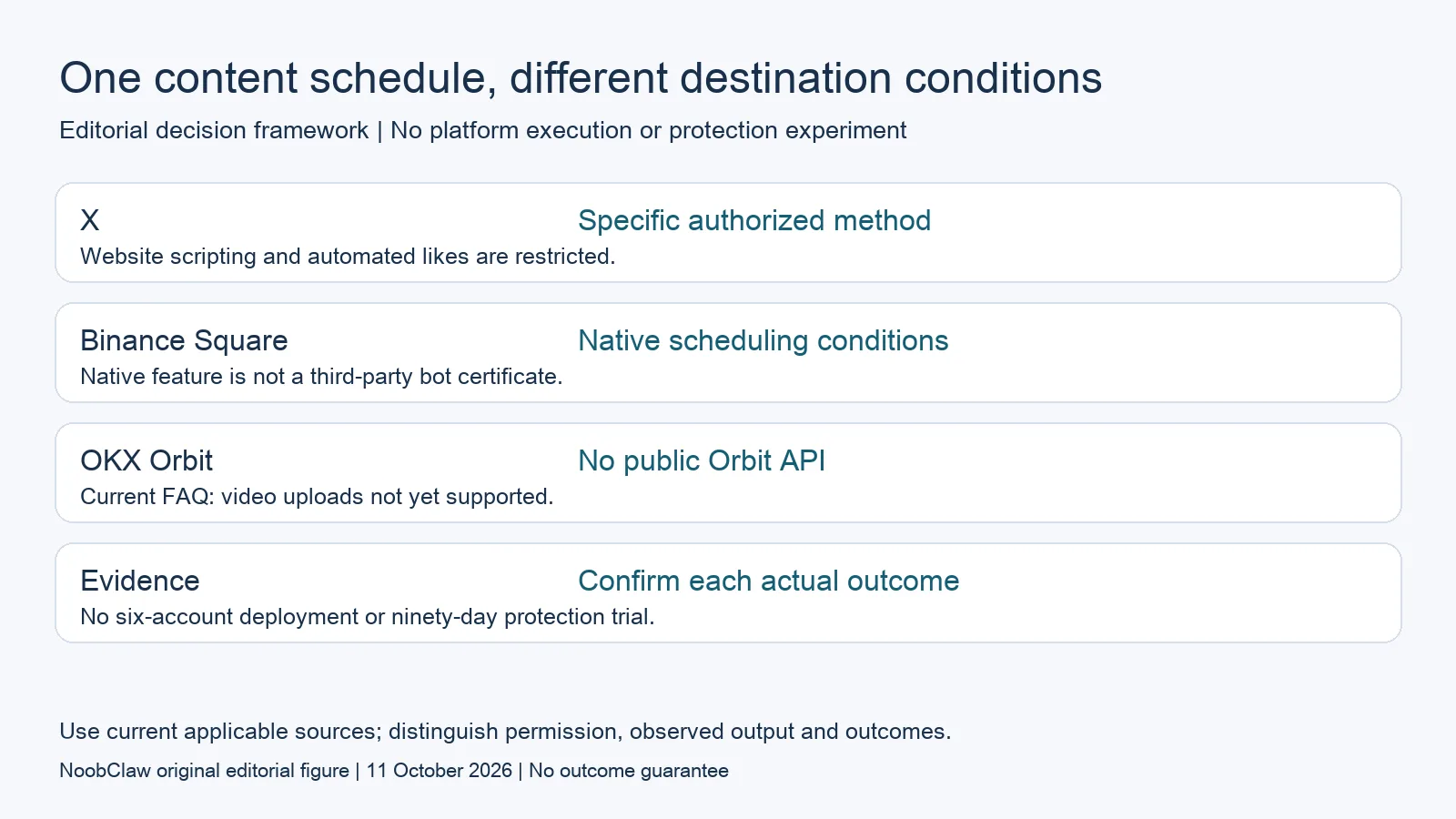
- X: Specific authorized method. Website scripting and automated likes are restricted.
- Binance Square: Native scheduling conditions. Native feature is not a third-party bot certificate.
- OKX Orbit: No public Orbit API. Current FAQ: video uploads not yet supported.
- Evidence: Confirm each actual outcome. No six-account deployment or ninety-day protection trial.
Compare the official conditions, not the account-survival story
X's current automation rules, updated April 2026, prohibit non-API website scripting and automated likes. They also specify additional conditions for automated replies, including prior written explicit approval for AI reply bots. The existence of useful drafting software does not supply those permissions. A local session and randomized delay are descriptions of a method, not an exception to the destination's rules. This review has not deployed or tested an X publishing or reply integration.
Binance Square's current official FAQ describes a native Schedule Post feature and account, terms and regional conditions. Its community guidelines address repeated or similar content, coordinated activity and bot or bulk interaction concerns. These documents have a Square community scope. A hypothetical team should check the actual native feature and eligibility rather than infer that a general exchange API or an X source post authorizes third-party automated distribution. No Square publishing result is present in the product case below.
The current OKX Orbit FAQ states that there is no public Orbit API and video uploads are not yet supported. It also describes restrictions for sub-accounts and conditions for its X synchronization feature. Do not present a local MP4 as a ready Orbit upload or a trading interface as an Orbit content method. Account or regional differences still need the relevant official checks. These feature conditions narrow the actual schedule; they do not predict a ban, account recovery or a safe number of operations.
Budget the handoff and keep later outcomes separate
A hypothetical schedule should allocate work for factual review, rights, format preparation and the actual authorized handoff. A date in a spreadsheet is not a confirmed post. If an item cannot use its proposed destination method, preserve the unresolved requirement instead of marking it sent. Someone should be responsible for checking the actual destination result and any notice. This approach gives the team a useful completion record without inventing an account-protection or visibility outcome.
Subscription units need their own interpretation. NoobClaw's current offer advertises account capacity and usage credits; that capacity does not establish platform authorization or continuous production throughput. A content team should check the current in-app units for the task and retain review work in its budget. This article has no measured cost per accepted draft, no ninety-day workload record and no timed comparison with a manual schedule. A base price alone cannot support a quantified weekly saving.
Define the metric that answers the question. An accepted script describes preparation; confirmed publication describes a handoff; genuine questions describe a response; a completed product task or paid customer needs separate evidence. The content and automation analyses linked below address narrower decisions before those later measurements. A different audience response across destinations cannot isolate one scheduling tool's effect. Keep the sample, dates and limitations with any report rather than renaming clicks or posts as commercial conversions.
For the related content and workflow decisions, read AI Content Generation for Social Media: Drafts to Video and Blotato Alternatives: Choose by the Workflow You Need. Each review has its own evidence and scope.
The documented case ends before all three destinations
NoobClaw publishes this article and sells content tools. Its public record documents one supplied script producing one local MP4 draft with stated duration, resolution, frame rate and sampled subtitle checks. Some stock imagery needed closer relevance, and full audio review remained necessary. No X, Binance Square or OKX Orbit publication took place in that record. It is therefore not evidence of a six-account deployment, zero-ban performance, native-feature eligibility or audience growth. The output also cannot demonstrate an Orbit video feature that the current FAQ says is not yet supported. An editor can inspect the creation task through the record and separate guide, then identify the remaining production and destination requirements. That bounded observation is more useful than expanding one exported file into a promise about every service on a schedule.
Inspect the public script-to-video execution record and the script-to-video operating guide. Check the current product offer against the task you need.
Frequently asked questions
Does a browser session authorize every destination?
No such universal approval is established. Check the actual service, action and method; X’s current rules specifically restrict non-API website scripting.
Can the local MP4 be uploaded to OKX Orbit?
The current Orbit FAQ says video uploads are not yet supported. The case includes no Orbit publication and cannot establish a workaround or permission.
Does native Square scheduling certify another tool?
The FAQ describes the native feature and its conditions. It does not establish a blanket permission or verified integration for third-party automation.
Sources
Official material reviewed on October 11, 2026. Document conditions apply to their stated service and scope; the editorial examples are explicitly hypothetical.