Planoly vs Preview: Social Sets, Devices and Free Plans
- Planoly offers a mobile Free plan with ten uploads monthly; its paid bundles count social sets and users.
- Preview Free and Premium have different feature access; Premium includes auto-post and unlimited team/device wording.
- Confirm actual account support before calculating utilization costs or declaring a winner.
Planoly and Preview can both be considered for visual planning, but their prices do not buy identical configurations. Define the accounts, devices, collaborators and publishing formats before deciding which eligible plan costs less. This comparison uses current official pages; it does not certify a successful connected-account deployment or assume an unpublished account ceiling is unlimited.
Compare the eligible configuration for the task, then verify the actual result.
Current offers and the free-plan distinction
Planoly's displayed annual paid bases are $14, $24 and $47 per month equivalent for Starter, Growth and Pro, with one, two and six social sets and the same included user counts. A social set permits up to one of each listed social channel. Growth adds a set for $10 and a user for $5 monthly; Pro's add-ons are $8 and $3. Starter requires an upgrade to add sets or users. Its current FAQ separately lists mobile Free with ten uploads monthly and a fourteen-day paid-plan trial.
Preview displays annual USD equivalents of $6.67 for Pro and $12.50 for Premium, and says monthly plans are available. Free lists one user and one device with unlimited planning posts. Premium lists auto-post for Instagram, Facebook and TikTok, a desktop planner and unlimited device and team-member wording. The public page does not supply an account-count guarantee for every intended deployment; verify account and format support before interpreting its capacity.
These are different documented offers, not proof that one always replaces the other. A planning allowance is not the same as unattended delivery. A mobile free offer is not the same as a trial of a paid desktop workflow. Keep the term and the actual feature gate beside every price. Where a needed count is not stated, leave it unresolved rather than treating the gap as a reason to declare either product incapable or limitless.
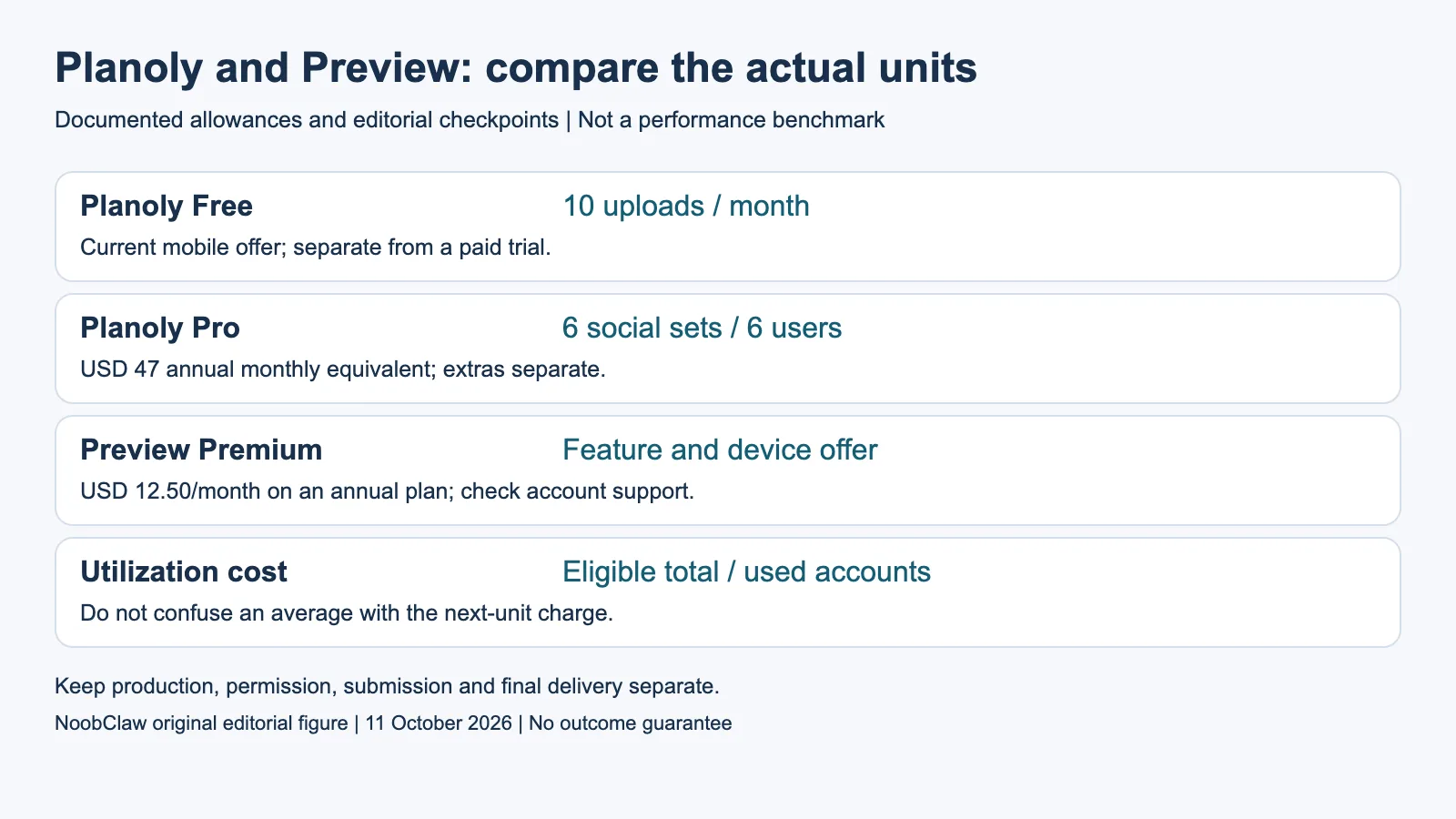
- Planoly Free: 10 uploads / month. Current mobile offer; separate from a paid trial.
- Planoly Pro: 6 social sets / 6 users. USD 47 annual monthly equivalent; extras separate.
- Preview Premium: Feature and device offer. USD 12.50/month on an annual plan; check account support.
- Utilization cost: Eligible total / used accounts. Do not confuse an average with the next-unit charge.
Worked examples: six sets and a seventh set
For an illustrative inventory of six separate client social sets, Planoly Pro's displayed annual base is $47 per month equivalent, before tax and extras. Its included-set average is $47 divided by six, approximately $7.83. Adding a seventh set at the documented $8 charge gives a $55 monthly-equivalent subtotal using that base and add-on convention. The $8 next-unit charge and the $7.83 included average answer different questions.
That arithmetic does not establish a vendor's intention to discourage larger agencies. Nor does it mean an add-on is always preferable to a higher tier. A higher tier can change included users and features as well as the set count. Count the staff who need access, check whether the add-on retains the required workflow, and confirm the total and billing term at purchase. The example is a documented-price calculation, not an observed invoice.
Preview can be included in an actual-account utilization comparison once the eligible account inventory is confirmed. A vendor billing devices or features does not make cost per used account mathematically impossible. Divide the eligible total by the verified accounts actually used, then label that result as your utilization average. Do not publish an assumed sixty-account average just because the pricing page does not state the account ceiling.
Choose by the supported creative and delivery task
For one owner who plans content and completes publication manually, inspect the relevant free offer's actual controls. For a desktop workflow or an automatic destination result, inspect the required paid feature and supported profile type. Do not choose only by the word unlimited: identify whether it refers to planning items, uploads, devices, users or successful external publication.
Both current pages describe creative features. Planoly includes AI ideas, keyword and caption suggestions and templates; Preview describes caption ideas and creative tools. This is not evidence that either generates every required finished asset, but it contradicts a blanket assertion that visual planners cannot help create anything. Request the specific deliverable you need and inspect the output rather than treating a category label as a complete feature description.
For each destination, record the approved media, caption, audience and actual submission result. An automatic-publishing option on a card does not certify every possible account type or media setting. A reminder still includes a manual handoff. Repeated captions across accounts are an editorial and platform-rule question; this article has no controlled test establishing that all similar publications are necessarily linked or that profile separation prevents any action.
Use a small acceptance test before committing a roster
Specify a bounded trial: the intended device, authorized account, supported format, collaborator permission and result you need to observe. A successful planner preview can complete a planning check without completing publication. A successful upload response can still need a destination-state check. Keep those acceptance stages separate so a client knows exactly which part of the workflow was tested.
NoobClaw's public example demonstrates a different task. A 441-character English script produced a local 32.6-second export at 1080 by 1920 pixels and 30 fps, with observed audio and subtitles. The generic footage was partly off-topic, and voice quality and asset rights were not approved for release. That is not a Planoly or Preview trial, proof of account isolation, an external post or a growth measurement.
If you already have approved media, select a planner or publisher for the remaining coordination task. If you need a script or a new asset, inspect that production workflow and its price separately. Keep the eligible plan, actual account support, unresolved conditions and observed trial result in the decision record. A modest plan that performs the required task is a better-supported purchase than a larger allowance justified by an invented universal winner.
For the related content and workflow decisions, read Buffer vs Metricool vs RecurPost: Plans and Limits and Free Social Media Schedulers: Queue Limits and Plan Fit. Each review has its own evidence and scope.
NoobClaw publishes this article. Its script-to-video guide and public creative execution record document a local video result, not external-platform publication. Check the current product offer against the supported action you need.
Frequently asked questions
Does Planoly have a free plan?
Its current FAQ lists a mobile Free offer with ten uploads per month, separately from the fourteen-day trial of paid plans. Check the current account and format controls.
Can I calculate Preview’s cost per account?
Yes, after confirming the eligible inventory. A utilization average is different from the vendor’s billed device or feature unit; an unknown account cap must stay unresolved.
Does an unlimited planning allowance mean unlimited auto-posting?
No. Identify the unit, feature gate, account support and destination conditions. This comparison does not certify unlimited successful platform delivery.
Sources
Official material read on October 11, 2026. Current vendor prices identify monthly payment or annual commitment, currency and counting unit. Meta product announcements retain their historical dates; they do not verify every current interface feature. Prices identify their billing term; vendor allowances are not measured publishing results. Hypothetical inventory and cost examples are labeled; the public local-production record has its own limitations.