
Postiz vs Ayrshare (2026): Both Are "For Developers" — They Disagree About What You Own
- Postiz: $29 / 5 channels up to $99 / 100, unlimited posts, and a self-host option with no licence fee.
- Ayrshare: $149 for one profile spanning up to 14 networks, scaling to $599 for 30 profiles.
- The decisive difference is app approvals. Postiz says outright that Facebook, Instagram, Threads and YouTube are the complicated ones.
- Self-hosting converts a subscription into credential work and waiting. Whether that is cheaper depends on whether someone owns it.
Both of these get recommended to the same person: someone technical enough to want an API, who is tired of dashboards. The recommendations are not interchangeable, because the two products disagree about a basic question — who holds the platform credentials.
Pricing below was pulled on 16 September 2026. Verify before acting.
The two pages
Postiz (postiz.com/pricing):
| Plan | Monthly | Channels | Posts | AI images / videos per month | Team |
|---|---|---|---|---|---|
| Standard | $29 | 5 | unlimited | — / 3 | no team members |
| Team | $39 | 10 | unlimited | 100 / 10 | unlimited |
| Pro | $49 | 30 | unlimited | 300 / 30 | unlimited |
| Ultimate | $99 | 100 | unlimited | 500 / 60 | unlimited |
Every tier includes the API, webhooks, custom integrations, cross posting, RSS auto-post and analytics. Per channel: $5.80 / $3.90 / $1.63 / $0.99.
Ayrshare (ayrshare.com/pricing): Premium $149 (1 profile, up to 14 accounts across 14 networks), Launch $299 (10 profiles, up to 140 accounts), Business $599 (30 profiles included, expandable to 300, up to 420 accounts). Add-ons at Business: Max Pack $300/mo, Facebook Ads $100/mo.
The unit mismatch, stated once
Postiz counts channels — one connected account on one network. Ayrshare counts profiles — an identity that spans up to 14 networks.
So "one brand posting to 14 networks" is 14 channels on Postiz (Pro tier, $49) and 1 profile on Ayrshare ($149). Postiz wins that comparison on price by 3×.
But "10 brands each on 14 networks" is 140 channels on Postiz — above the Ultimate tier's 100 — and 10 profiles on Ayrshare (Launch, $299). Now the comparison inverts.
Neither is cheaper in general. The crossover is somewhere between one brand and ten, and it depends entirely on how many networks each brand touches.
The difference that actually decides it: app approvals
This is the part most comparisons omit, and it is the expensive part.
To publish to a platform programmatically, someone needs an approved application with that platform. On a hosted API, the vendor has already done this — you inherit their approvals. On self-hosted software, you do it yourself.
Postiz is unusually honest about this on its own FAQ. Self-hosting is supported and documented, app approvals are described as optional paid services rather than mandatory, and the reason given is direct: "Facebook, Instagram, Threads and YouTube are more complicated." Earlier wording on the same page put the typical wait at more than a month.
That is a vendor telling you that the subscription you save by self-hosting converts into two other costs:
- Credential work — creating apps, submitting review materials, responding to rejections, per platform.
- Waiting — potentially over a month per complicated platform, during which you publish nothing programmatically there.
Ayrshare's $149 entry price looks very different once you price a month of waiting.
What you inherit versus what you own
Underneath the pricing, these two products answer one question differently: whose relationship with the platform are you using?
With Ayrshare, you use theirs. The approved applications, the rate-limit allocations, the maintenance when a platform changes something — all of that sits with the vendor. You get speed and you accept dependency. If they have an outage, you have an outage. If a platform restricts their application, your publishing is affected by a decision you were not part of.
With self-hosted Postiz, you use your own. Nothing between you and the platform, no shared fate with other customers, and complete control over how you handle changes. You also carry every piece of that work yourself, indefinitely — platform APIs change, approvals get re-reviewed, and none of it announces itself in advance.
Hosted is renting someone's standing with the platform. Self-hosted is building your own. The subscription fee is the visible part of that trade; the invisible part is who wakes up when it breaks.
Postiz's managed tiers sit in the middle and are frequently the sensible answer: you get their approvals and hosting, at per-channel pricing that stays reasonable up to 100 channels. Most people who think they want self-hosting actually want the $49 tier.
Which one, by situation
| Situation | Pick | Reason |
|---|---|---|
| One brand, ≤30 channels, want a hosted dashboard + API | Postiz | $49 covers it; per channel $1.63 |
| Agency, 10+ client identities, each multi-network | Ayrshare | Profiles map to clients; $29.90 per client at Launch |
| You have infra people and want to own the stack | Postiz self-hosted | No licence fee — budget the approvals instead |
| You need to ship this quarter | Ayrshare | Inherited approvals; no review queue |
| Many accounts on one platform | Neither, cleanly | Postiz counts each as a channel; Ayrshare counts each as a profile |
That last row, expanded
Both tools assume your accounts are different brands on different networks. When they are instead many accounts on the same network, two things break at once.
First, the pricing unit stops being generous — 20 accounts on one platform is 20 channels or 20 profiles, with none of the multi-network bundling either product is designed around.
Second, and more seriously, the API route makes the accounts look related. Same client application, same infrastructure, often the same posting rhythm. A scheduler that is an asset for one brand becomes a correlation signal for twenty.
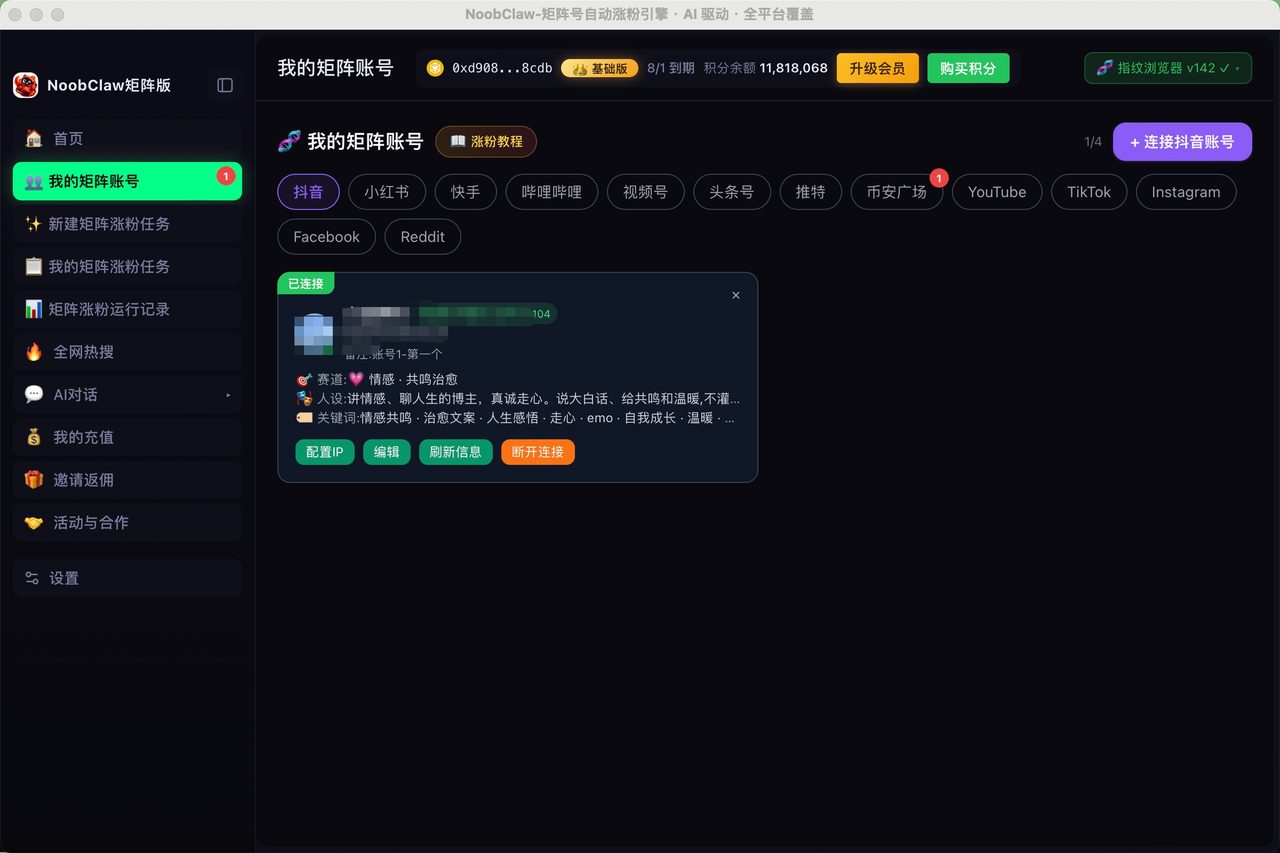
That shape needs different machinery: separation per account (distinct browser fingerprint and exit IP, bound and stable rather than rotating), randomised timing rather than fixed intervals, and content that differs per account by construction rather than by editing. NoobClaw is built for exactly that and runs locally on your own machine rather than as an API. It is not a developer endpoint and should not be compared to one on those terms — if you want a programmatic pipe for one brand, both products above beat it at that job.
FAQ
Which is better if I am not a developer?
Postiz, without much hesitation. It has a dashboard, a calendar and a picture editor, so you can use it entirely through an interface and treat the API as an option you may never touch. Ayrshare has no equivalent surface — it assumes something on your side is making the calls. Paying $149 for an API you will drive by hand is the wrong purchase regardless of how good the API is.
Is self-hosted Postiz really free?
The software has no licence fee, but a self-hosted deployment costs server time, maintenance, and the platform app approvals described above. The vendor's own FAQ lists approvals as a separate paid service precisely because they are work. Whether the total is below $29/month depends on how you value your own hours — for most solo operators it is not.
Does Ayrshare have a cheaper entry tier?
Premium at $149/mo was the lowest published tier when we pulled the page on 16 September 2026. The reason it looks steep is the unit — one profile spans up to 14 networks — not that it is a premium product. For a single-network creator it is simply the wrong shape.
Can Postiz's API do everything the dashboard does?
The pricing page lists API, webhooks and custom integrations as features on every tier including Standard, which is unusual — many competitors gate API access behind higher tiers. For exact endpoint coverage, check the vendor documentation rather than a comparison article. See also Postiz open source vs paid.