Postiz vs Buffer: Current Plans, Channel Costs and Approvals
- Postiz’s monthly tiers are $29/5, $39/10, $49/30 and $99/100 channels.
- Buffer Essentials and Team use graduated per-channel rates, with different starting rates and collaboration controls.
- At thirty channels the published monthly arithmetic is Postiz Pro $49, Buffer Essentials $135 and Buffer Team $195.
- Postiz preview feedback is not an enforced approval state; self-hosting requires its own release and configuration checks.
Postiz and Buffer use different pricing shapes. Postiz’s current hosted monthly tiers buy fixed channel capacities; Buffer’s paid channel rates fall in graduated bands. At five paid channels, the displayed references are $29 for Postiz Standard and $30 for Buffer Essentials; at six, Postiz Team is $39 and Buffer Essentials is $36. That small crossover does not decide the whole purchase. Team permissions, creative work, formats and operating responsibility can matter more than a one-dollar difference.
Price the channels you will use and the review controls you require before choosing a headline winner.
The channel-cost comparison at useful counts
Monthly USD references were checked on October 11, 2026. Buffer Essentials charges $6 each for the first ten channels, $4 each for eleven through twenty-five, $3 each for twenty-six through fifty, and $1 each above fifty. Team starts at $12 for the first ten, then $4, $3 and $2 in those bands. The lower rate applies to channels in that band, rather than repricing all earlier channels.
Ten channels therefore cost $60 on Essentials or $120 on Team, compared with Postiz Team at $39. At thirty channels, Essentials is 10 × $6 + 15 × $4 + 5 × $3 = $135; Team is $195, compared with Postiz Pro at $49. These figures compare current account capacity, not complete feature equivalence. Annual rates, taxes and your actual checkout offer need their own comparison. Keep a required handle inventory beside the table so the denominator is explicit.
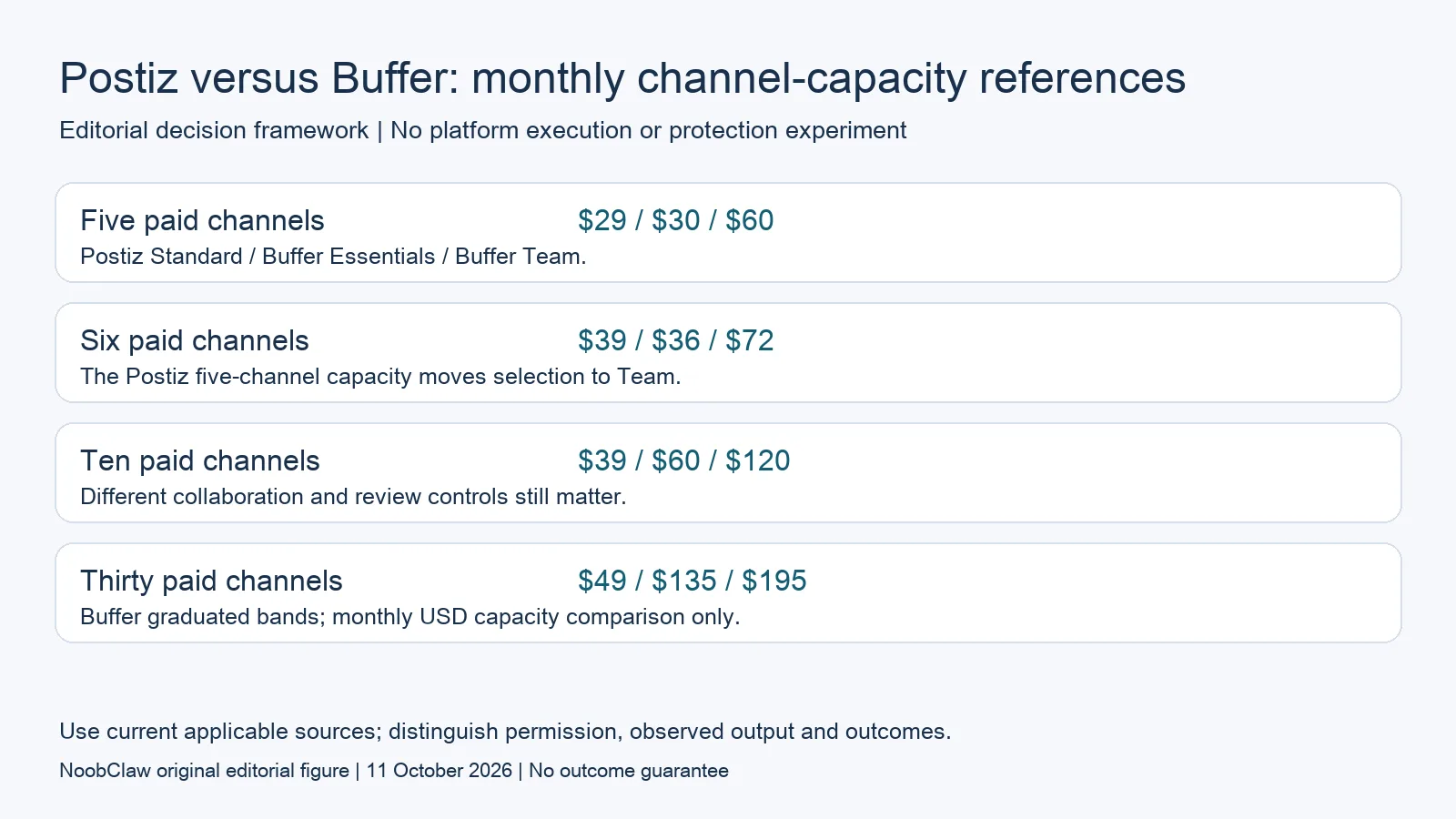
- Five paid channels: $29 / $30 / $60. Postiz Standard / Buffer Essentials / Buffer Team.
- Six paid channels: $39 / $36 / $72. The Postiz five-channel capacity moves selection to Team.
- Ten paid channels: $39 / $60 / $120. Different collaboration and review controls still matter.
- Thirty paid channels: $49 / $135 / $195. Buffer graduated bands; monthly USD capacity comparison only.
Why the five-versus-six crossover is not a buying rule
Postiz Standard holds five channels, so a sixth required channel moves the current hosted selection to Team. That is why the small-count ranking briefly changes: five is $29 versus $30 on paid Essentials, six is $39 versus $36, and seven is $39 versus $42. These are selected arithmetic examples, not a claim that a tier name changes what your team is allowed to do.
Buffer’s Free offer can fit up to three channels with its stated queue and single-user conditions. A reader who fits that workload is not choosing between the two paid totals at all. Conversely, a reader needing multiple collaborators or formal approvals cannot use the Essentials price as if it included Team’s controls. Compare the lowest eligible offer for the actual work. A universal recommendation beginning at seven accounts would omit those requirements and any required network or format that the selected service cannot deliver.
Approval workflow and preview feedback have different effects
Buffer’s current Team offer lists unlimited members, approval workflows and access controls. Postiz’s official approval documentation describes sending a public preview link and collecting comments without requiring the recipient to have an account. It also says the preview is not password protected and that approval is a conversation rather than a blocking approved state. The operator moves the draft to scheduled.
Neither absence of a formal blocking flag nor the presence of a Team approval feature settles every team’s needs. A solo creator may need no extra sign-off. A client team may require enforced separation between a drafter and a publisher. Write that requirement explicitly, then test the relevant role and state transitions. Do not call Postiz incapable of all review work, and do not describe a preview comment as a technical lock that prevents publication. Sharing draft previews also needs the appropriate content and audience choice.
Unlimited scheduling does not remove every limit
Buffer’s pricing states that paid unlimited scheduling is subject to a 5,000-post-per-channel fair-use cap. Its Free queue holds ten scheduled posts per channel at one time, with a slot available again after publication. The paid fair-use wording does not establish an annual published-output budget here. Avoid declaring the limit irrelevant for every reader or pricing a yearly output ceiling from an unstated window.
Postiz’s current cards advertise unlimited monthly posts while separately describing creative allowances and channel capacity. That does not remove platform rules, format conditions or request limits. Both products also advertise API access, so inclusion alone is not a decisive distinction. If automation is part of the purchase, check the current interface’s actual operations and limits with your intended workload. The present comparison does not claim that an upgrade buys unlimited requests or changes an external platform’s permissions.
Creative production and the self-hosting alternative
Both products list AI assistance, and Postiz also lists AI media and clipping features. It is inaccurate to claim neither can help create content or that every scheduler merely delivers files. Compare the actual kind of output and allowance you need, then review a sample for accuracy, rights and suitability. A cheaper account-capacity figure says little about the cost of preparing that material.
Postiz’s self-hosted path is a separate operating choice. Its repository describes shared core features, while its current pricing page says hosted agent features ship first. Verify the release, provider setup and external services before assuming immediate feature parity or zero operating cost. The older article’s repository counts and security-release frequency are not retained as a current deployment assessment. A useful selection ends with a small accepted workflow test and a clear owner for maintenance, rather than a category-wide guarantee.
For the related content and workflow decisions, read Postiz Open Source vs Paid: Plans, AI and Hosting Costs and Buffer Pricing at Scale: Channel Tiers and Team Costs. Each review has its own evidence and scope.
Inspect the creative output separately from the queue
NoobClaw publishes this comparison. Its public execution record documents one local creative output: 441 English script characters became a 32.6-second, 1080 × 1920 video at 30 fps, with voiceover and subtitles. The record does not demonstrate a connection to these schedulers, an external upload, account eligibility, audience response or paid conversion. Some stock imagery was poorly matched to the script, and full audiovisual quality and asset licensing were not approved. Use the record to understand a production step you can inspect, then review the actual output and rights before publication. Do not infer that the desktop workflow replaces a team’s approval system, a hosted queue or a platform permission. A practical comparison keeps creative preparation, review and delivery as separate tasks. Choose a tool for the specific action it can demonstrate, and measure the resulting acceptance separately from the price of account capacity. No account-protection or distribution guarantee follows from this case.
NoobClaw publishes this article. Its script-to-video guide and public creative execution record document a local video result, not external-platform publication. Check the current product offer against the supported action you need.
Frequently asked questions
Is Postiz always cheaper than Buffer?
No universal purchase verdict follows. The paid monthly capacity comparison changes at small counts, Buffer has a limited Free offer, and features such as formal approvals can require a different plan.
Does Postiz provide an enforced approval flag?
Its current approval documentation describes preview comments and manual movement from draft to scheduled. It explicitly distinguishes that conversation from a blocking approved state.
Does Buffer’s 5,000 fair-use number mean 5,000 posts per year?
The quoted pricing wording does not establish that annual window. Keep the stated fair-use condition and verify the relevant counting rules before budgeting output.
Sources
Official material reviewed on October 11, 2026. Document conditions apply to their stated service and scope; the editorial examples are explicitly hypothetical.