Social Media Schedulers for X: Current Support and Costs
- The inspected vendors list X support under specific plan and feature conditions.
- Account connection, publishing, analytics and engagement are separate capabilities.
- Compare the whole workload and verify a final X URL before reporting publication.
Several schedulers currently document support for X, formerly Twitter. The useful comparison is which plan supports your account and intended action, what the whole workload costs, and how a failed or delayed submission is reported. A network logo alone does not answer those questions. This review compares inspected official descriptions rather than claiming authenticated publication through every vendor. It also keeps the platform’s automation conditions separate from a scheduler subscription.
Choose the documented action, count its actual units and verify the final result.
What the inspected vendors actually document
Buffer’s current pricing specification lists automatic publishing for both free and Premium X profiles. The feature matrix distinguishes analytics by profile type; connection does not imply identical analytics everywhere. Buffer Free includes three connected channels, one user and ten waiting posts per channel, with slots becoming available after publication. These are account and queue allowances, not a universal daily publishing entitlement.
SocialPilot’s current specification lists X publishing and scheduling. Its US Essentials offer is USD 30 per month on monthly billing, or USD 25.50 per month billed annually, for seven social accounts and one team member. The specification excludes analytics, Social Inbox, approval workflows and bulk scheduling from that tier. A buyer needing those actions should compare their appropriate plan rather than labeling the entry subscription a full team workflow.
Metricool’s inspected pricing excludes X from Free and lists an X add-on on paid plans at USD 10 per connected account per month. Its USD Starter option for five brands is USD 25 on monthly billing, or USD 20 per month billed annually. A brand can hold one profile per network. For one required X connection, a hypothetical monthly-billed Starter five-brand comparison therefore begins at USD 35 before tax, not the base price alone.
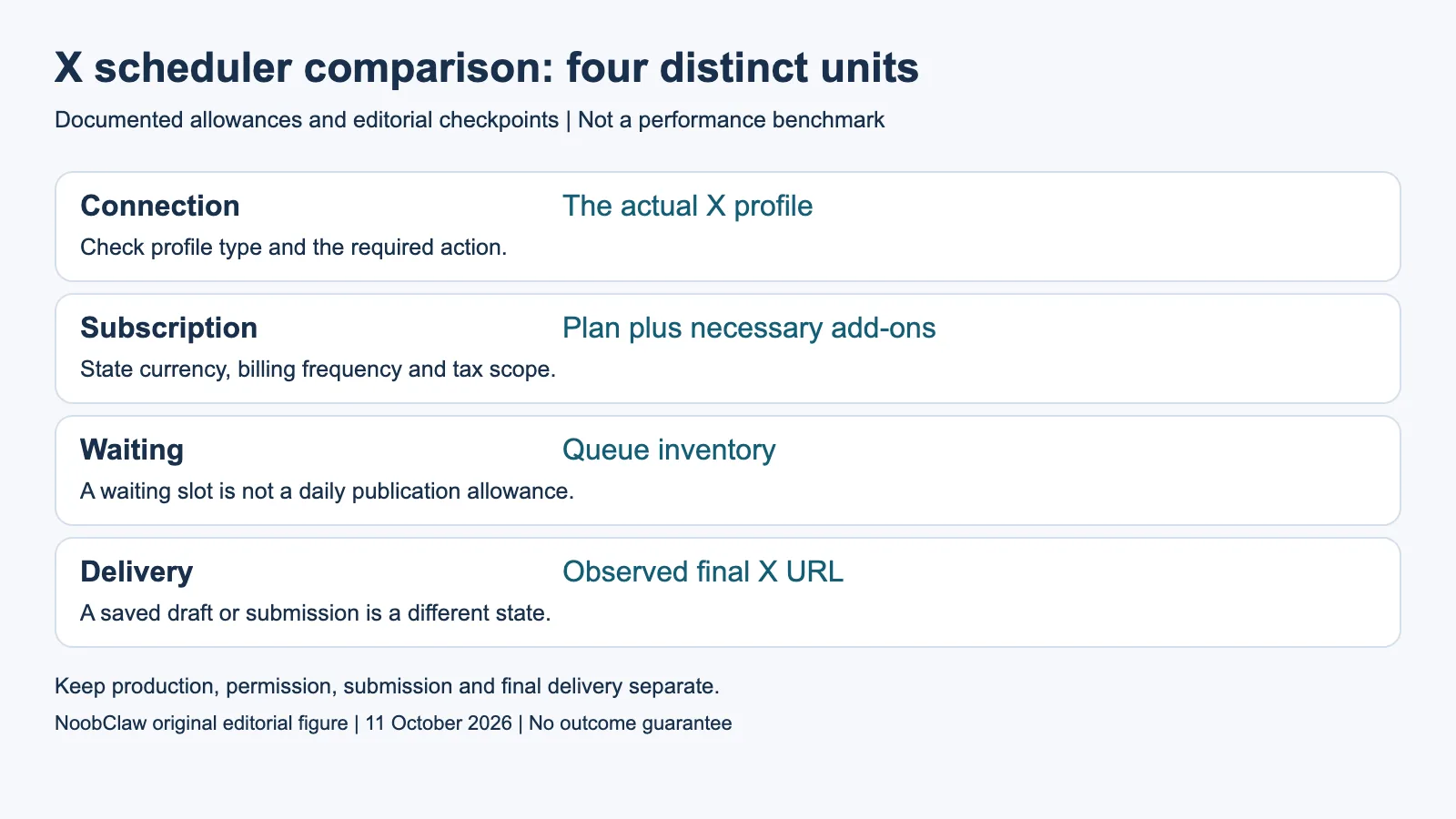
- Connection: The actual X profile. Check profile type and the required action.
- Subscription: Plan plus necessary add-ons. State currency, billing frequency and tax scope.
- Waiting: Queue inventory. A waiting slot is not a daily publication allowance.
- Delivery: Observed final X URL. A saved draft or submission is a different state.
Write the X job before choosing a plan
Name the actual profile, intended post format and required follow-up. A plain text announcement, a threaded explanation and a media post are different acceptance checks. Decide whether the person operating the queue also needs another person to approve the draft. If your workflow includes answering comments or exporting a report, list those actions explicitly. Do not let a publishing connection silently become evidence for every adjacent feature.
Build a comparison sheet with separate rows for connected profiles, people with access, required approvals, waiting inventory, analytics and any add-on. Attach the relevant plan and billing frequency to each row. If documentation does not establish a particular format, mark it unverified and ask for a bounded demonstration. Absence from a card is not proof that an integration was removed, and an old screenshot cannot certify its present behavior.
Use a realistic draft from your own brief when assessing the workflow. Preserve its text, media, destination and scheduled time zone, then check how an edit or cancellation is handled. This article supplies no measured vendor success rate, X impressions forecast or team time saving. The point of the exercise is to expose a task that a cheap-looking tier cannot satisfy before it becomes an operational dependency.
A subscription does not replace platform conditions
X’s inspected automation rules prohibit non-API automation such as scripting the website. They also require prior written approval for AI-generated reply bots. When automating another user’s account, express consent and an explanation of the intended actions are required. Those are platform conditions, not optional extras that disappear because a third-party plan includes a browser extension, a large queue or an AI assistant.
Separate an API-based publishing claim from a proposed browser action and from automated replies. Ask which mechanism performs the intended write, what authority it has and where the owner can stop it. An installed connection demonstrates neither a universal exemption nor permission for unrelated actions. If the documented route does not cover your task, prepare the content separately and choose an appropriate available route rather than interpreting technical capability as authorization.
NoobClaw’s public example documents a 441-character English script exported locally as a 32.6-second video at 1080×1920 pixels and 30 fps. Footage relevance, listening quality and stock rights still require review. That result can inform asset-production evaluation; it does not demonstrate X publication or approved reply automation. A local creative product belongs in your shortlist only when that documented production step is the missing part of the job.
Record delivery and the useful business observation
Treat a saved draft, a queued item, an accepted submission and a published X URL as separate states. Retain the actual error if the interface reports a failure. Before resending after an interruption, determine whether the first attempt created an item. A missing public result does not, by itself, identify whether credentials, media, timing or another condition caused the problem. Diagnose from the evidence for that specific attempt.
For an illustrative campaign ledger, keep the content version, destination, queue state, submission receipt, final URL and time beside the campaign link. Review edits and cancellations as well as successful submissions. If several people handle the item, record who owns the next action. This is a reporting method, not a claim that any vendor handles duplicate prevention or failures in a particular undocumented way.
Measure relevant visits separately from impressions or completed purchases. A dashboard’s post count cannot establish revenue, and a scheduler’s price cannot predict how much traffic a particular X post will earn. Compare the subscription with the observed effort and capabilities your workflow actually needs. Retain the same brief when revisiting the decision so that a changed account count or reporting requirement is not mistaken for a vendor price increase.
For the related content and workflow decisions, read Threads API Rate Limits: Post Caps and the Call-Budget Floor and X API Free Tier: Current Credits, Costs and Posting Rules. Each review has its own evidence and scope.
NoobClaw publishes this article. Its script-to-video guide and public creative execution record document a local video result, not external-platform publication. Check the current product offer against the supported action you need.
Frequently asked questions
Which of these tools currently lists X publishing?
The inspected Buffer and SocialPilot specifications list it; Metricool lists X through its paid-plan add-on. This is documentation evidence, not an authenticated trial of each integration.
Does a connected X profile include all analytics?
No. Compare the documented profile type, tier and analytics feature separately from publishing.
Can I bypass an API requirement with a browser script?
Do not interpret a browser capability as permission. X’s inspected automation rules prohibit non-API website automation; assess the actual method and action.
Sources
Sources inspected on October 11, 2026. Prices retain the specified currency, billing frequency and counting unit. Same-day reused copies retain their original retrieval receipts. Instagram Help was read in its Chinese-language rendered body. The Fast Track application returned an unavailable-region notice in the anonymous retrieval; no individual eligibility or current complete program terms are certified. The Sprout Help body was read through public web retrieval after native HTTP403. Survey fieldwork dates and populations are separate from retrieval dates. Workloads are illustrative; one local creative output does not establish publication, account protection, growth or paid conversion.