Buffer vs Metricool: Channels, Brands and Actual Plan Costs
- Buffer bills one connected profile as a channel; Metricool organizes one profile per network inside each brand. Translate your actual inventory into both units.
- Buffer paid channel rates decrease progressively with volume. Do not multiply the first-channel rate forever or apply the final rate retroactively to every channel.
- Free allowances use different counters: Buffer has reusable waiting queue slots, while Metricool counts completed publications during the calendar month.
- Both offer AI creation functions. Compare actual output, approval and reporting needs rather than assuming a scheduler forces identical content across accounts.
Buffer and Metricool can both support publishing and content work, but their pricing units and limits differ. Count the actual connected profiles, how those profiles belong to brands, and which functions the team needs before comparing bills. This review uses current public offers and defined examples. It replaces flat-rate assumptions and broad creation exclusions with a plan-specific comparison you can check against the required workflow.
Translate the same inventory into channels and brands, then choose eligible features. The billing unit starts the calculation; it does not choose the product by itself.
Define channels and brands before pricing them
Buffer defines a channel as one social account connected to the service, such as one Instagram profile or Facebook Page. Metricool defines a brand around a business or client, with one profile per social network within that brand. Five businesses with an Instagram and a Facebook Page each therefore make ten Buffer channels and can make five Metricool brands. Keep the actual network and profile type on the inventory worksheet.
Ten separately managed Instagram profiles cannot all fit into one Metricool brand under the one-profile-per-network definition. That inventory needs a different brand count from one business across several networks, even if both have ten total profiles. Do not divide a brand subscription by every theoretically available network to produce a low average for profiles you do not actually use.
The connection list also needs the intended action. Automatic publishing, reminder workflows, analytics and community functions can differ by profile type and network. A network logo in a vendor’s marketing grid does not verify the precise format, account eligibility or reporting metric you need. Confirm those requirements before treating either price as a comparable solution.
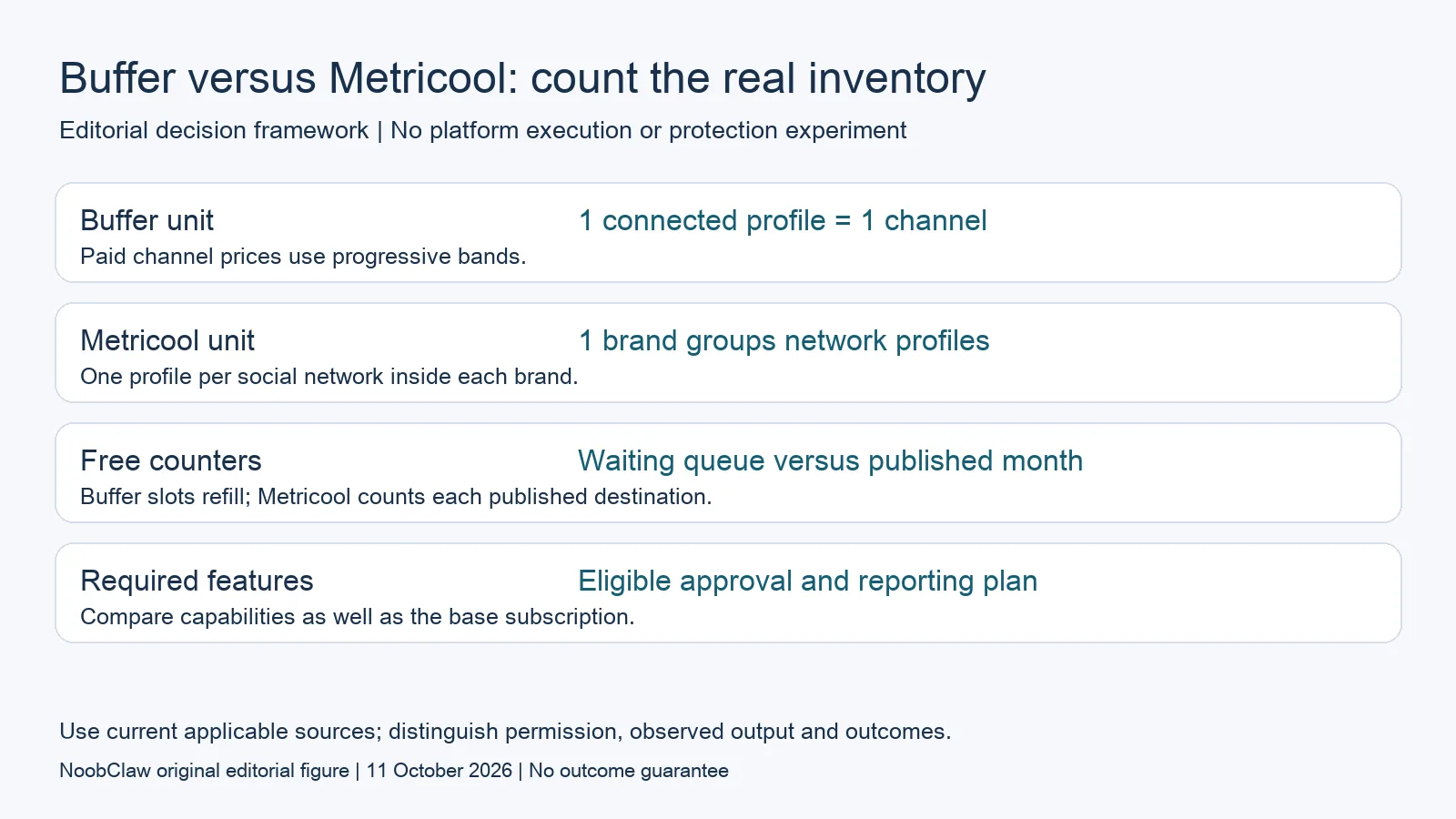
- Buffer unit: 1 connected profile = 1 channel. Paid channel prices use progressive bands.
- Metricool unit: 1 brand groups network profiles. One profile per social network inside each brand.
- Free counters: Waiting queue versus published month. Buffer slots refill; Metricool counts each published destination.
- Required features: Eligible approval and reporting plan. Compare capabilities as well as the base subscription.
Buffer uses progressive rates and an approval gate
The current official pricing markdown lists monthly Essentials rates of $6 per channel for the first ten, $4 for channels eleven through twenty-five, $3 for twenty-six through fifty and $1 thereafter. The published examples include ten channels at $60, twenty-five at $120 and fifty at $195 monthly. These are progressive band totals. The rate for a later channel does not retroactively replace the rates for all earlier channels.
For an illustrative twenty-channel Essentials inventory, ten channels at $6 and the next ten at $4 give $100 monthly before applicable tax. Multiplying twenty by $6 would overstate that base total; multiplying twenty by $4 would understate it. This calculation explains the public tariff, not a completed purchase or a special discounted offer. Use the current calculator and checkout to establish the actual account quote.
Buffer Team provides approval workflows, access controls and unlimited team members. Its first ten channels are $12 monthly each, with separate later bands. The public examples give ten Team channels at $120 and twenty-five at $180 monthly. Essentials includes one user, so a team requiring the documented approval workflow should compare Team with an eligible competitor tier, not silently substitute the cheaper solo plan.
Metricool: match the tier, term and extras
Metricool Starter has five- and ten-brand options. On monthly USD billing those base cards are $25 and $45; their annual monthly equivalents are $20 and $36. Advanced has fifteen, twenty-five and fifty brands, quoted monthly in USD at $67, $107 and $210, or as annual equivalents at $53, $85 and $159. These are different billing terms and exclude applicable VAT. Do not relabel annual equivalents as month-to-month prices.
The official plan overview places team and role management, post approval and API access in Advanced or Custom. Brand count alone is therefore insufficient: an approval requirement can make Advanced the lowest eligible tier even if the team has only five brands. MCP access is a separate route available on any plan, but that access does not remove the underlying plan’s limits or grant API-tier functions.
X connections are separately billed on eligible paid plans, currently €10/$10 monthly or €120/$120 annually per connected account in the official guide. Advanced Analytics also has an account-level add-on quote tied to the selected plan and cycle. Add the extras your real work requires. Do not use observed exclusions to claim that every vendor follows the same supplier-cost rule; no such universal explanation is established by this comparison.
Free queue slots and monthly publications measure different things
Buffer Free includes up to three simultaneous channels and ten waiting scheduled posts per channel. When a post publishes, a queue slot becomes available for another item. This is a capacity limit on what is waiting, not a total of ten publications during the month. Its free plan also includes AI assistance and limited insights; verify the profile-specific functions needed by your connected channels.
Metricool Free includes one brand, twenty actual publications per calendar month, thirty days of analytics history and five monthly AI text credits. Its specific current FAQ says drafts do not count until published and duplicate content counts once for each network where it publishes. Free excludes LinkedIn and X. Four destination publications consume four counts, even when they originate from one creative item.
For a hypothetical five-item plan going to four included networks, twenty completed destinations use the Metricool free monthly count. Buffer’s waiting-slot counter answers a different question about the queue at a particular time. That does not prove which free plan fits the required formats or that every scheduled item will publish. Keep publication receipts and the vendor’s actual counter separate from the planned schedule.
Choose the reporting, collaboration and creative workflow
For five businesses with Instagram and Facebook each, the monthly USD base examples are $60 for ten Buffer Essentials channels and $25 for Metricool Starter five brands. This is a defined solo/base-plan cost comparison before tax and extras, not full capability parity. If approval workflows are required, the eligible examples change to Buffer Team ten at $120 and Metricool Advanced fifteen at $67; other requirements still need their own checks.
Neither service should be described as incapable of generating or adapting content. Buffer explicitly documents its AI drafting, refining and repurposing, while Metricool lists an AI assistant with plan-based credits. A decision to syndicate identical text is a user’s workflow choice, not proof that either product requires it. Assess the actual instructions, output types, review controls and account briefs relevant to your work.
NoobClaw publishes this review and offers a separate bounded creative route. Its public October 10 local-video record used 441 English characters and produced one 32.6-second export at 1080 × 1920 pixels and 30 frames per second. Generic or off-topic stock footage needed further inspection, and voice quality and stock licensing were not independently approved. This evidence does not establish better scheduling, reporting replacement, external publication or an audience result; evaluate the creative job separately.
Choose the output you need: post-caption drafts, opening-line drafts or spoken-script drafts. These text tools have a limited anonymous allowance; they do not transcribe or publish a video.
For the related content and workflow decisions, read Buffer Free Plan Limits: Queue Slots, Users and Upgrades and Buffer Pricing at Scale: Channel Tiers and Team Costs. Each review has its own evidence and scope.
A channel cost example that respects the progressive tariff
For an illustrative solo workload of twenty profiles, calculate Buffer Essentials as ten at $6 plus ten at $4, giving $100 monthly before applicable tax. Then organize those same profiles into the actual Metricool brands and choose a tier that includes the required features. Do not invent the brand count from the profile total alone. If collaboration is required, use eligible team plans and recalculate. This is a planning example based on public offers, not a completed customer migration or measured saving.
NoobClaw publishes this article. Its script-to-video guide and public creative execution record document a local video result, not external-platform publication. Check the current product offer against the supported action you need.
Frequently asked questions
Does Buffer’s bill stay linear at large counts?
No. Its current published paid rates are progressive channel bands. Use the rate in each band and the actual count, rather than extending the first rate to all channels.
Are the free post limits the same?
No. Buffer describes reusable waiting slots per channel; Metricool’s specific Free FAQ describes completed calendar-month publications and counts duplicate network destinations separately.
Which is better for a team needing approvals?
Compare the eligible plans: Buffer Team and Metricool Advanced or Custom document approval functions. Then check actual users, profiles, brand structure, reports and add-ons rather than choosing from a solo starting price.
Sources
Official material reviewed on October 11, 2026. Document conditions apply to their stated service and scope; the editorial examples are explicitly hypothetical.