
Free Social Media Schedulers: Channels, Queues and AI Limits
- Buffer Free’s three channels and ten queued posts per channel are separate limits; ten is not a monthly publishing allowance.
- Free writing assistance exists: Buffer includes AI Assistant, while Archie offers asset-led creation under its own plan conditions.
- YouTube documents native scheduled publishing, with account restrictions that can stop a scheduled video from going public.
- Choose against required output, destinations, queue depth and review controls; measure your own handling time.
A free social media scheduler can fit a small workload, but free does not describe a single set of limits. Connected channels, waiting posts, content creation, people and formats all matter. This review compares concrete current offers, separates queue depth from monthly volume, and shows how to calculate value without inventing a typical time saving.
A queue slot, an AI credit and a connected channel measure different things. Keep them separate.
Buffer Free: channel count and queue depth both matter
Buffer’s current Free card lists three connected channels, ten scheduled posts per channel, one user, one hundred ideas and an AI Assistant. A channel refers to a connected destination, not all of a brand’s networks combined. Three distinct destinations can use the three-channel allowance; five required destinations exceed it even if each posts infrequently. Confirm actual account types and connection requirements before treating the allowance as usable coverage.
The ten-post limit applies to scheduled posts at one time. It is not a ten-post monthly quota. In a hypothetical three-channel portfolio, ten waiting items in each queue give thirty waiting items in total, while unused space on one channel does not establish that another channel can exceed ten. As items publish, slots can be refilled under the service’s conditions. A month with more than ten posts can therefore fit if the waiting queue never exceeds the allowance.
The same feature table describes an AI Assistant for refining and repurposing content, with unlimited writing credits. It separately lists five AI-reply suggestions per week on Free. Writing and reply suggestions are distinct modules. Free is not fairly described as a calendar with no creation support, although its writing assistance does not by itself prove a finished video-generation workflow.
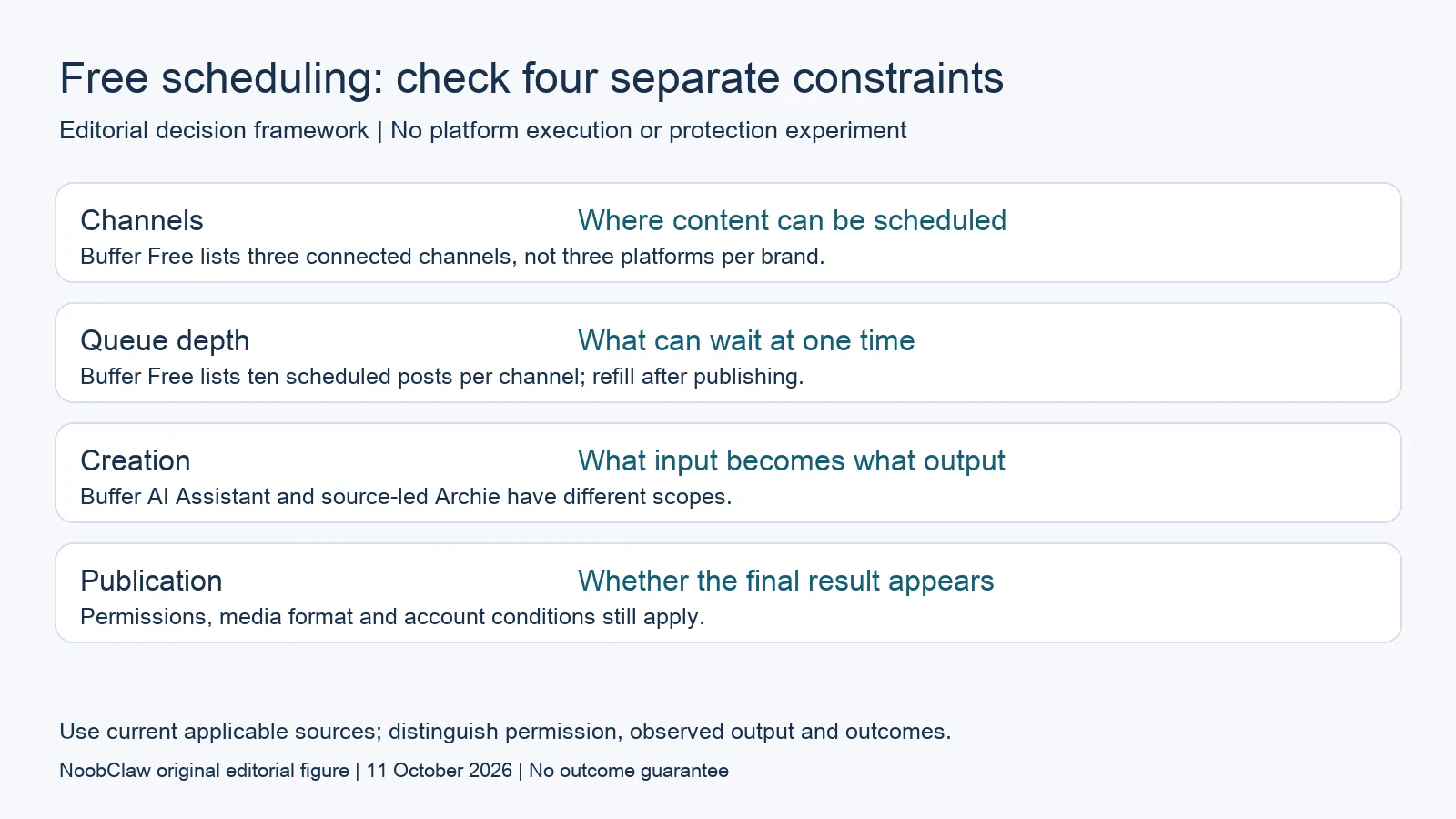
- Channels: Where content can be scheduled. Buffer Free lists three connected channels, not three platforms per brand.
- Queue depth: What can wait at one time. Buffer Free lists ten scheduled posts per channel; refill after publishing.
- Creation: What input becomes what output. Buffer AI Assistant and source-led Archie have different scopes.
- Publication: Whether the final result appears. Permissions, media format and account conditions still apply.
Free Archie and native YouTube solve different jobs
Agorapulse’s former Free plan ended July 6, 2026. Its current free Archie offer lists up to fifty profiles on Facebook, Instagram, LinkedIn and YouTube only, one owner, restricted Archie-only users, calendar and drafts. New posts must be created using Archie. Its stated ten monthly credits and beta note about untracked usage should not be translated into a permanent unlimited allowance.
Archie’s general product article says each workflow starts with an existing source asset, such as a PDF, article, video or audio file. It distinguishes repurposing that material into posts from a Writing Assistant that improves an individual draft in the Composer. An asset-led free creation plan can be useful if you have suitable source material, while still failing a requirement for unrelated management functions or an unsupported destination.
YouTube’s official help explains scheduled publication of a private video at a selected date, time and time zone. It also says a Community Guidelines strike can stop a scheduled video from publishing during the penalty period, leaving it private until it can be rescheduled. Native scheduling is therefore a concrete option for the YouTube task, not proof that every platform offers every format for every account.
Compare the intended result. If you already have a reviewed YouTube video, native scheduling may meet that step. If you need one shared multi-network queue, inspect the scheduler. If you need an existing long asset repurposed, inspect Archie. If you need a narrated local video from a script, test production independently. These routes can be combined without pretending they are identical substitutes.
Evaluate the missing control or deliverable
Create a requirement sheet listing exact destination types, media formats, desired waiting horizon, operators and approvers. Decide whether a reminder followed by a native step is acceptable. A tool can organize scheduled work while leaving a final action to a person; that may fit one workflow and fail another. Check the actual result rather than rejecting or accepting all reminder-based paths in the abstract.
Do not assume every free plan lacks analytics, approvals or creation, or that every paid plan includes the exact controls you need. Read the current selected tier and test the relevant function. Buffer Team’s listed approvals and unlimited members describe a different collaboration offer from its one-user Free plan. Likewise, free Archie permissions do not establish the complete paid Agorapulse management suite.
Distinguish weak content from weak scheduling. An AI assistant may produce different captions, but useful differences require an audience, an accurate brief and human judgment. A populated calendar does not establish originality, rights clearance, audience value or public publishing. Test the required deliverable instead of claiming no scheduler can help create distinct content.
Account access is also part of the decision. An account allowance is not platform authorization. Record how the destination is connected, what permission is needed and how to revoke access. This review offers no claim that scheduling prevents enforcement or that a particular posting rate guarantees a safe account. Keep platform-specific conditions attached to the action.
Calculate value with your own timing
Measure one representative session, including preparation, review, upload, scheduling, checking the result and correcting errors. In a hypothetical week with three channels and four posts per channel, twelve total posts at five minutes of handling each take sixty minutes. Those assumptions illustrate a calculation; they are not evidence that most operators spend one to four hours a week or that a tool saves that amount.
Run the same task through the candidate and include remaining manual steps. If it takes three minutes per post under your conditions, the hypothetical reduction is twenty-four minutes a week, before setup and failure handling. Use your own measured numbers and labor rate. A cheap plan is not automatically worthwhile, and partial coverage is not automatically worthless: both judgments depend on the actual task.
NoobClaw’s current offer permits free entry with sign-up credits, then usage-based top-ups or optional subscriptions. It does not establish a free recurring publishing suite in this review. Evaluate its production output separately from scheduling. Keep the working calendar until a replacement passes your named requirements and account-specific export and cancellation conditions are understood.
For the related content and workflow decisions, read Manage Multiple Social Media Accounts Free: Compare Routes and Blotato Free Alternatives: Compare Trials, Credits and Output. Each review has its own evidence and scope.
One local production example, separately measured
NoobClaw publishes this comparison and has a commercial interest in the recommendation. Its public execution record documents one English script of 441 characters producing a 32.6-second local MP4, 1080 by 1920 pixels at 30 frames per second, with voiceover and subtitles. That supports investigating a local script-to-video production task. It does not establish connected social accounts, approved public publishing, platform protection, audience growth or paid customers. Some stock footage was not closely matched to the script, and the record does not establish a complete audiovisual or licensing review. Inspect a representative finished file, corrections and editing effort before choosing it for production. For public publishing, require a separate destination-specific demonstration and check the current permission requirements. A local output cannot substitute for that evidence.
NoobClaw publishes this article. Its script-to-video guide and public creative execution record document a local video result, not external-platform publication. Check the current product offer against the supported action you need.
Frequently asked questions
Does Buffer Free allow only ten posts a month?
No. Its stated limit is ten scheduled posts per channel at one time. A published item frees a slot, while the connected-channel allowance remains a separate limit.
Can a scheduler help create content?
Some current offers explicitly provide AI writing or asset repurposing. Confirm the output type and allowance rather than excluding creation from the entire scheduling category.
How much time will a free scheduler save?
This review has no universal time-saving result. Measure your own preparation, review, final native steps and error correction. The twelve-post examples are explicitly hypothetical.
Is native YouTube scheduling guaranteed to publish?
No. YouTube describes account conditions, including strikes, that can prevent scheduled publication. Check the actual account status and final result.
Sources
Official material reviewed on October 11, 2026. Document conditions apply to their stated service and scope; the editorial examples are explicitly hypothetical.