Xiaohongshu Auto-Like Tools: Claims and Content Alternatives
- The old three-tool test, 403-follower result and zero-restriction claim have no preserved evidence here.
- Check current community expectations rather than treating delays as permission.
- A separate Chrome profile organizes browser information; it does not certify platform protection.
- For content needs, inspect an editable draft or local output and the human review still required.
An auto-like or auto-comment tool should be evaluated by its intended behavior and available evidence, not a story about invisible browser operation. This page has no preserved three-tool comparison or record showing 403 followers from automated engagement. The current Xiaohongshu covenant rejects fabricated engagement and disguised marketing. A buyer should identify the content work they actually need and distinguish it from a tool promising to manufacture attention.
A browser profile is an account-context tool, not proof of permission or guaranteed invisibility. Ask what useful work the product actually completes.
Separate an engagement claim from a content requirement
Write down the work that is missing. A creator may need a clearer explanation, reviewed script or visual draft. An auto-like product addresses a different action. If the purchase reason is better content, a count of completed likes does not establish that the product improved the explanation. Ask for an output that can be checked against the actual task before discussing a larger account operation.
A hypothetical business receives a question about how its product works. The useful work may be preparing an accurate reply from confirmed instructions and assigning a person to review it. Another tool might promise to find unrelated notes and leave promotional comments. These are different specifications. This example is a proposed buying exercise, not an account campaign or an observed comparison of tool outcomes.
Require clarity about the provider’s evidence. A screen showing activity can establish that an interface recorded events, while a real destination record may establish a completed action. Neither establishes a customer result or universal permission. Keep the action, destination and observed state separate rather than accepting a bundled promise of content, growth and account protection.
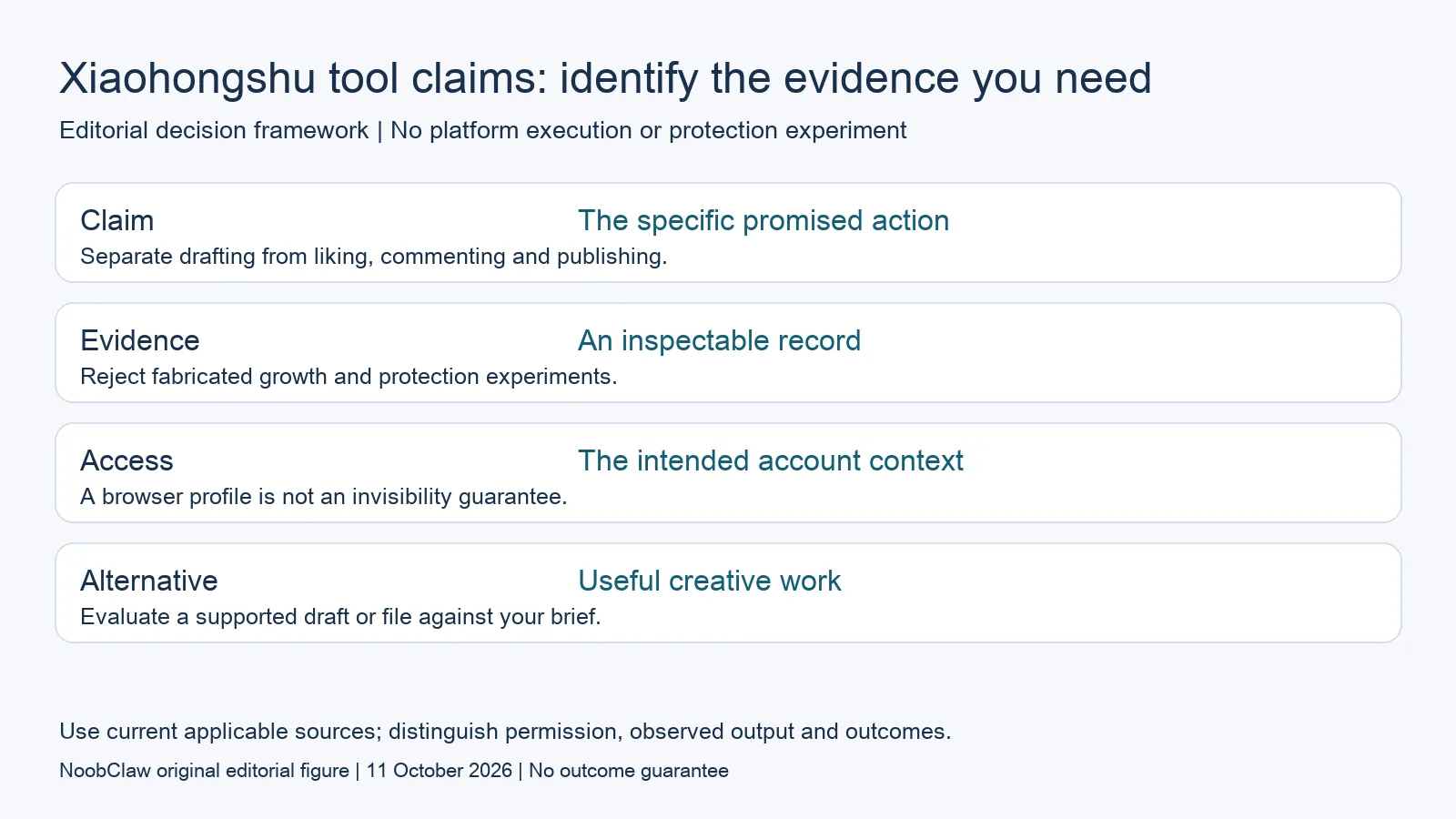
- Claim: The specific promised action. Separate drafting from liking, commenting and publishing.
- Evidence: An inspectable record. Reject fabricated growth and protection experiments.
- Access: The intended account context. A browser profile is not an invisibility guarantee.
- Alternative: Useful creative work. Evaluate a supported draft or file against your brief.
Read community expectations instead of a pacing formula
The current official Community Covenant 2.0 rejects fabricated likes, saves, sales and reviews, including manipulation through technical means. Its commercial guidance opposes pretending to be ordinary users, manufacturing word of mouth and sending unwanted promotional content through comments or messages. The covenant supports transparent business identity and genuine information. A random delay does not establish an exception to these expectations.
There is no preserved evidence for this page’s old three-tool test, 403 new followers in thirty days or claimed zero-restriction rate. Nor is there a verified daily safety threshold of five likes and three comments, a guaranteed captcha cooldown or knowledge of the platform’s private behavioral classifier. Those values cannot remain purchase evidence merely because they are specific.
An account-specific notice should be examined as an actual notice, not reconstructed from a change in reach. This review does not diagnose a hidden restriction or promise recovery. When a provider offers a protection guarantee, ask which behavior and conditions its evidence covered. An undocumented personal anecdote should remain unverified rather than become a technical explanation of why one method supposedly escapes detection.
Use browser profiles for the organization they provide
Google’s Chrome profile documentation describes keeping browser information such as history, passwords and settings separate. It also notes that someone with access to the device can switch profiles. That documentation is about browser organization; it does not establish that Xiaohongshu cannot associate accounts or detect an automated action. Do not turn a profile feature into a platform-permission guarantee.
For a team’s legitimate account work, identify the owner, intended destination and person approving content. A separate browser context can help prevent an accidental switch, but a reviewer still needs to confirm the destination before a consequential action. This is a proposed operating check, not evidence that browser profiles create unique hardware identities or make every automated behavior acceptable.
Ask the provider to describe its actual access and data handling. This article has not performed a complete credential, extension or security audit and does not certify that all data stays local. A logged-in session is an access context, not evidence about every service the product uses. Keep product capability, data-handling claims and platform requirements as separately reviewable questions.
Choose a content alternative when that is the missing work
NoobClaw publishes this review and sells content software. Its public execution record shows a 441-character English script producing one 32.6-second local MP4 at 1080 by 1920 pixels and 30 frames per second, with voiceover and subtitles. These are actual values from one local creation run. The record does not show Xiaohongshu likes, comments, publishing or follower acquisition.
Some sampled stock material needed further relevance review. Inspect the draft against the source explanation, and require a demonstration matching the language and media you intend to use. The English example does not certify Chinese wording or cover quality. A rendered file also does not establish full audiovisual approval or complete asset rights. Keep the remaining review work visible in the purchase comparison.
If your need is drafting, evaluate the accepted text and the corrections it requires. If it is assembling a narrated local file, inspect that actual output and prerequisites. If it is automated platform interaction, ask for separate current capability and permission evidence. No local creative result establishes an engagement-tool winner or guaranteed protection. A useful alternative should solve the missing work, not simply rename an activity count as growth.
For the related content and workflow decisions, read AI Tools for Content Creators: Choose the Missing Stage and Human-Like Automation: Execution Is Not Account Approval. Each review has its own evidence and scope.
A proposed claim-review sheet for a tool purchase
List each promised action, supporting record, account context, intended destination and unresolved requirement. For a claim of follower growth, retain the actual measurement source and observation period; for a protection claim, retain the test conditions and limits. This is a proposed evaluation sheet, not a three-tool trial we ran. Add the content output separately so a buyer can see whether it helps the intended audience. If the only available evidence is a local video, record that scope instead of treating it as an account campaign. Compare price using the same deliverable and billing period, including review work remaining for the team. An empty evidence field is a reason to ask for a bounded demonstration, not to invent a conclusion.
NoobClaw publishes this article. Its script-to-video guide and public creative execution record document a local video result, not external-platform publication. Check the current product offer against the supported action you need.
Frequently asked questions
Does a profile make automatic likes undetectable?
No such protection is established. Chrome’s profile feature concerns browser information and account context, not a guarantee about another platform’s detection.
Did NoobClaw gain 403 followers in the test described here?
No preserved test record supports that old claim. The public record linked here demonstrates a local creation output, without a Xiaohongshu engagement campaign.
What should a content tool demonstrate instead?
An actual output matching your input, language and media requirements, with factual and creative review limits clearly recorded. Platform interaction requires separate evidence.
Sources
Official material reviewed on October 11, 2026. Document conditions apply to their stated service and scope; the editorial examples are explicitly hypothetical.