
YouTube Is Expanding React Live: Reactors Keep Live Revenue, Originals Get Credit. What Changes for Reaction Videos
- On September 23, 2026 YouTube said Watch With ('React live') will expand from livestreams to all eligible long-form videos, rolling out later this year. The reacting creator keeps live ad revenue and
- An uploaded reaction video still has to clear three separate gates: YPP entry thresholds, the channel-level reused content policy, and copyright claims. YouTube's own policy lists 'reaction videos whe
- React Live settles the source creator's permission in advance (eligible livestreams are opted in by default; the source creator can switch it to 'No one'), and Content ID does not claim you for the so
- If you run several channels, having them react to each other to move metrics is the kind of coordinated, artificial engagement YouTube's spam policy covers. Treat React Live as a format for real comme
Every reaction upload carries a lawyer's question: is this commentary, or someone else's video with my face in the corner? On September 23, 2026, at Made on YouTube, the platform answered part of it with a product. "Watch With", which lets a creator go live reacting to another creator's content, is being extended from livestreams to "all eligible long form videos across YouTube, with a roll out starting later this year". The same post spells out who gets paid: "Reacting creators keep the live ad revenue and fan funding they earn, while original creators get clear attribution, added view credit in YouTube Studio, and full control over which of their videos can be reacted to."
That is one of the clearest revenue rules YouTube has written for reaction content, and it leaves the ordinary uploaded reaction video exactly where it was. This piece separates the two.
What exactly did YouTube announce about React Live?
On September 3, 2026, TeamYouTube posted an experiment in its test features and experiments thread: eligible mobile creators in the test group see a "React live" button in the Share panel of an eligible livestream. The camera locks horizontal, and "you can't turn your camera off for the reaction." Reacting creators "will be able to earn revenue as normal." For the source creator, "Revenue from reactions is not shared, however, the concurrent viewership metrics, public views, and watch time from all the reactions will be attributed back to your content." Eligible streams are opted in by default; to opt out you change the "React live" setting in the mobile metadata editor from "Allow eligible channels" to "No one" before going live.
On September 23, the Live post widened the scope to long-form videos and listed plans for 2027 (co-stream matchmaking, Live showdowns). The scale behind the push: in August 2026, more than 600M logged-in viewers watched live content (including archives) each day on average, and today more than 40% of live watch time comes from viewers outside the creator's home country.
Eligibility is narrower than the announcement suggests. YouTube's Watch With help page says the feature is "currently only available to a select number of creators", and a reacting creator "must be eligible to live stream on a mobile device", which requires at least 50 subscribers and no live streaming restrictions in the last 90 days. The source stream must be opted in. YouTube has not said what eligibility will look like for the long-form expansion.
Can you monetize reaction videos on YouTube today?
Yes, but "monetize" hides three separate decisions made by three different systems: YPP entry thresholds for the channel, the reused content review of the whole channel, and copyright claims on each video. Most answers collapse them into one.
The first gate is 1,000 subscribers plus 4,000 qualified watch hours in 12 months or 10M qualified Shorts views in 90 days (YPP eligibility page), rising to 8,000 hours or 20M Shorts views for new applicants from February 1, 2027 (August 10, 2026 announcement).
The second gate is where reaction channels actually live or die. YouTube's channel monetization policies list "Reaction videos where you comment on the original video" among the examples that are allowed to monetize, next to "Using clips for a critical review". The not-allowed list includes "Content that gets views from mostly non-verbal reactions to your videos without added voice commentary" and "Promotion of other people's content (even if you have permission)". The policy "applies to your channel as a whole". When YouTube renamed its repetitious content policy to "inauthentic content" on July 15, 2025, the same page stated: "There is no change to our reused content policy which reviews content like commentary, clips, compilations, and reaction videos."
The third gate is copyright, and it runs on different rules. A copyright claim can block a video, track it, or monetize it for the claimant, and this can differ by country. YouTube's fair use page is blunt that "Automated systems like Content ID can't decide fair use", and that phrases like "all rights go to the author" or "I do not own" "don't automatically mean you're making fair use".
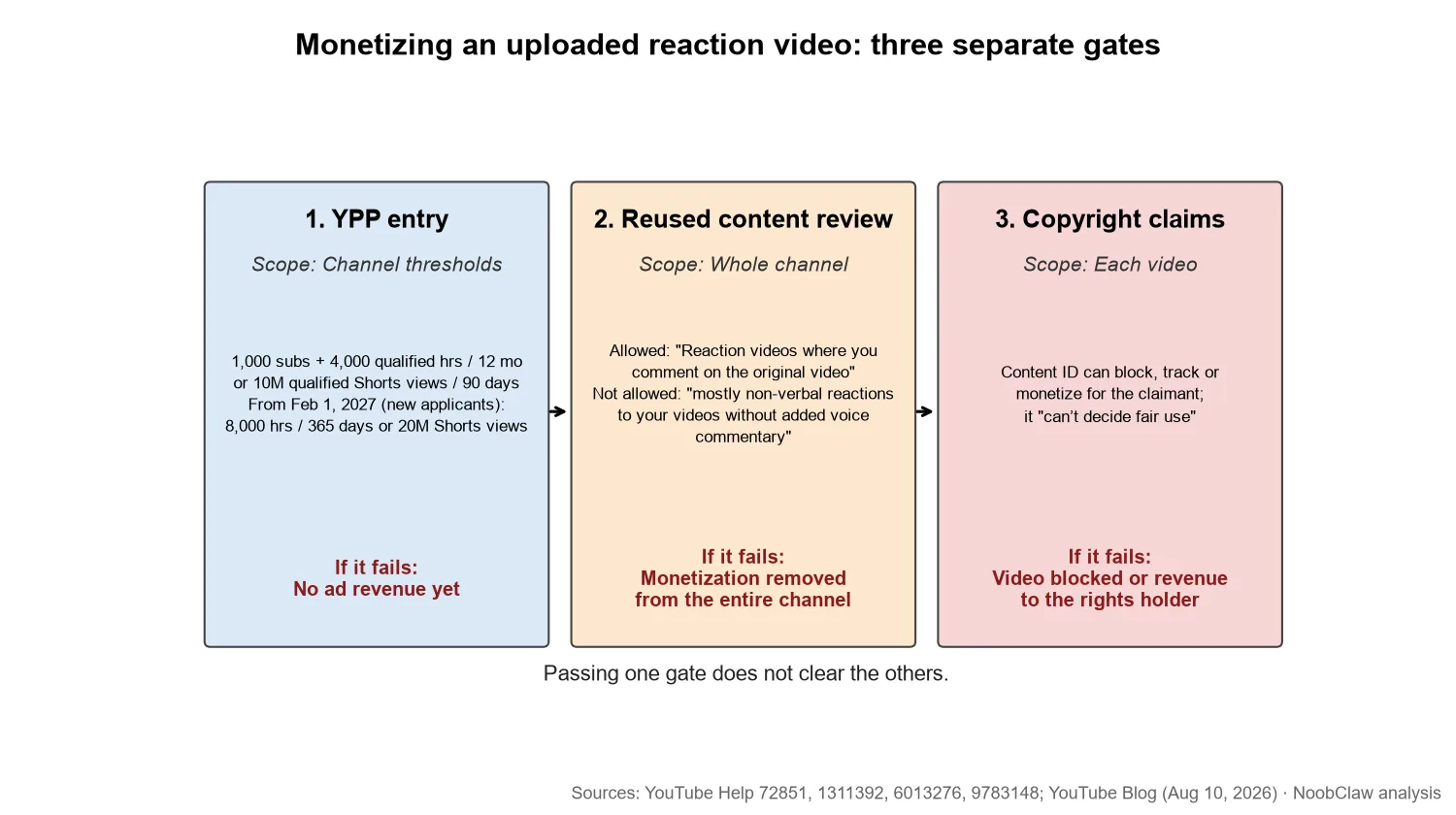
Passing the reused content review does not protect you from a copyright claim, and winning a copyright dispute does not restore channel monetization. They are different systems answering different questions.
Why a React Live stream is a different deal from an uploaded reaction video
Consider what a reaction creator went through before. Filmmaker Matt Hosseinzadeh sued Ethan and Hila Klein (h3h3Productions) in 2016 (No. 16-CV-3081) over a fourteen-minute reaction video that showed about three minutes of his five-minute skit. According to the U.S. Copyright Office's fair use summary of the case, the court ruled on August 23, 2017 that the use was fair as a matter of law, calling the video "quintessential criticism and comment" that "does not serve as a market substitute" for the original. They won, after a takedown, a counter-notification and a federal lawsuit, and even then the court called the amount-used factor neutral because "a great deal of plaintiff's work was copied". Three minutes is not a safe ratio.
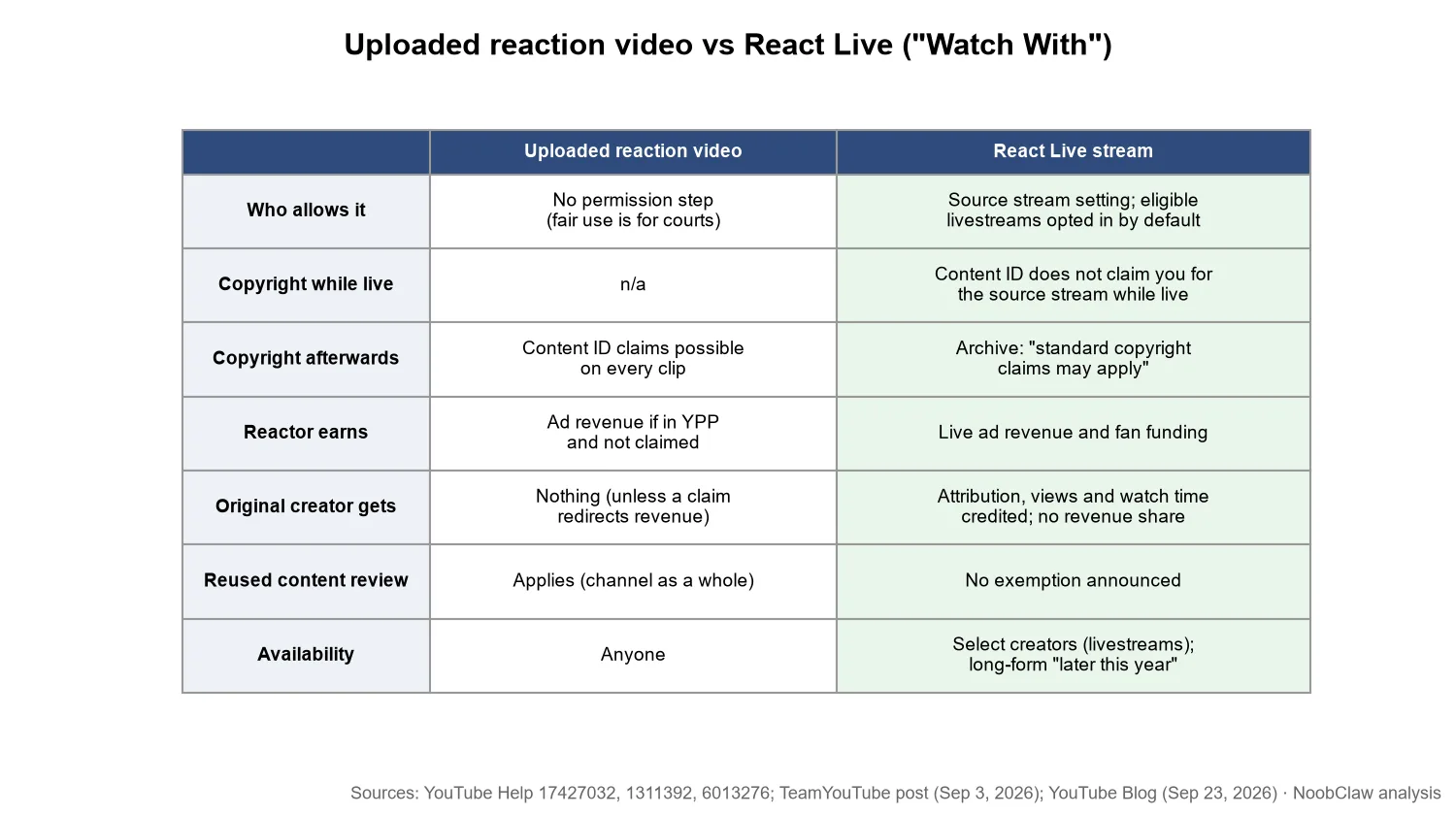
React Live settles permission in advance: the source stream's setting decides whether reactions are allowed, and eligible livestreams allow them unless the creator switches them off. Our reading: YouTube pays the original creator in metrics, not money. Four details mark the limits:
- The camera cannot be turned off. The live format forces the reactor's face and voice on screen, which lines up with the policy line against "mostly non-verbal reactions to your videos without added voice commentary".
- "Earn revenue as normal" means normal monetization rules still apply; nothing says React Live is exempt from the channel-level review.
- Livestreams are opted in by default. If you stream and do not want to be reacted to, you have to change the setting before you go live, per the September 3 post.
- The archive is a different story. The help page says Content ID evaluates your stream independently, "so you will not receive a copyright claim for content broadcasted by the source stream" while you are live. But "once your live stream ends and becomes an archived video, standard copyright claims may apply to any copyrighted material in the archive." YouTube adds: "Avoid playing background music to prevent copyright claims on your archive."
Uploaded reaction videos are untouched. How the channel-level review can go wrong shows in public complaints: on Trustpilot, a creator wrote on September 17, 2026 that their channel "was demonetized for alleged 'Reused Content'" and that "the appeal option disappeared even though the deadline is still today" (Trustpilot, YouTube reviews; one creator's account, not a YouTube finding).
What React Live means if you run more than one channel
The temptation is to point your smaller channels at your main channel's streams and let attributed views flow back. We would not. YouTube's spam, deceptive practices and scams policy applies to "coordinated networks of channels" and tells creators to avoid practices that "rely on artificial engagement", giving coordinated "sub-for-sub" schemes as an example; three strikes within 90 days can end a channel. A cluster of channels owned by one person, all reacting to each other to move metrics, is in our reading exactly what that clause is aimed at, and the reused content review looks at every channel as a whole. Same logic as posting the same video on two YouTube channels.
An open question for anyone chasing YPP: reaction watch time is "attributed back to your content", but YouTube has not said whether it counts as qualified watch hours. Plan as if it does not. The definition YouTube did publish is covered in what qualified watch hours are, and the 2027 thresholds in the YPP requirements breakdown.
A healthier revenue line is commerce. YouTube says more than 1.3 million creators are in the Shopping affiliate program, which will expand to 35 countries by the end of the year, and the entry bar for Shopping is still 500 subscribers plus 3,000 qualified watch hours in the last year or 3M qualified Shorts views in 90 days, per the YPP changes page (details in the Shopping 500-subscriber piece).
Multi-channel tools, NoobClaw among them, generate content per account from its own niche and persona and publish from your own logged-in browser, which can reduce how alike your channels look. It does not make reused material monetizable, and some NoobClaw engines, such as translation reposting, sit squarely in reused-content territory; our inauthentic content explainer goes through where that line is.
Not settled yet: long-form eligibility, timing (the dates come from the Live post; CEO Neal Mohan's keynote gives none), and copyright outside the U.S., where exceptions "can differ". Our judgment: if you already make commentary-heavy reactions, React Live is a cleaner way to react to creators who have not opted out, because permission is settled before you start; just keep background music out of the stream so the archive does not pick up claims. If your reaction format depends on the original doing most of the work, neither the new feature nor the old upload route will carry it.
FAQ
Do I need permission to react to someone's YouTube video?
For an uploaded reaction, U.S. fair use can apply without permission, but YouTube notes that only courts decide fair use, and Content ID can still claim the video. Permission alone does not satisfy the reused content policy either. For React Live, reactions are only possible on streams that allow them, and eligible livestreams allow them by default. That covers the live broadcast; once your reaction becomes an archived video, standard copyright claims may apply.
Does the original creator get paid when someone reacts through React Live?
Not in cash. The September 3 test post says "Revenue from reactions is not shared"; the original creator gets attribution plus views and watch time credited in YouTube Studio.
Will React Live views count toward the original channel's YPP watch hours?
YouTube has not said. It confirms the watch time is attributed to the source content, but eligibility runs on qualified watch hours. Until YouTube says otherwise, do not count reaction credit toward your threshold.
Sources
- New YouTube Live tools for fan funding, dubbing and more · YouTube Official Blog · 2026-09-23 · blog.youtube
- Innovation for the YouTube Era: What's new for viewers and creators (Neal Mohan) · YouTube Official Blog · 2026-09-23 · blog.youtube
- Bringing brands and creators together to help you earn more · YouTube Official Blog · 2026-09-23 · blog.youtube
- YouTube test features and experiments (entry dated September 3, 2026) · YouTube Help Community, TeamYouTube · 2026-09-03 · support.google.com
- YouTube channel monetization policies · YouTube Help · updated 2025-07-15, retrieved 2026-09-24 · support.google.com
- YouTube Partner Program overview and eligibility · YouTube Help · retrieved 2026-09-24 · support.google.com
- YouTube Partner Program updates for 2027 · YouTube Official Blog · 2026-08-10 · blog.youtube
- Fair use on YouTube · YouTube Help · retrieved 2026-09-24 · support.google.com
- Learn about copyright claims · YouTube Help · retrieved 2026-09-24 · support.google.com
- React live to YouTube streams on mobile with "Watch With" · YouTube Help · retrieved 2026-09-24 · support.google.com
- Live stream on mobile: eligibility (50 subscribers) · YouTube Help · retrieved 2026-09-24 · support.google.com
- Changes to the YouTube Partner Program · YouTube Help · retrieved 2026-09-24 · support.google.com
- Spam, deceptive practices, and scams policies · YouTube Help · retrieved 2026-09-24 · support.google.com
- Hosseinzadeh v. Klein, No. 16-CV-3081 (S.D.N.Y. Aug. 23, 2017), Fair Use Index summary · U.S. Copyright Office · copyright.gov
- YouTube reviews (review by Zola Lazic, September 17, 2026) · Trustpilot · trustpilot.com