Blotato vs n8n: Credits, Workflow Runs and Integration Costs
- Blotato Starter’s monthly USD card lists $29, 1,250 AI credits and twenty total connected accounts; network-specific conditions remain separate. API calls are not generation-credit use in its current
- n8n’s displayed annual EUR equivalents are €20 for 2,500 monthly executions and €50 for 10,000. An execution is a workflow run, not each individual node or destination.
- A hypothetical thirty-run workflow reaching twenty destinations has 600 destination attempts; it need not have 600 workflow executions. Design and separately triggered runs matter.
- Use either product or a combination only where it addresses the actual task. NoobClaw’s local creative export is a separate production result, not a managed publishing integration or a measured saving
Blotato and n8n can occupy different stages of a social-content workflow. Blotato combines creative features with a managed publishing API; n8n orchestrates work across integrations. Comparing their headline prices without identifying those stages gives a misleading purchase decision. This review uses current official material read on October 11, 2026 and explicitly hypothetical workload examples. It distinguishes generation, connections, workflow runs and actual publication. No authenticated vendor trial, checkout or completed cross-vendor workflow is claimed.
One destination is not automatically one workflow execution, and one API call is not automatically one generation credit. Describe the actual workflow first.
Keep Blotato’s generation and connection limits separate
Blotato’s current monthly USD cards list Starter at $29, Creator at $97 and Agency at $499. Starter includes 1,250 AI credits and twenty social accounts; Creator includes 5,000 credits and forty accounts. The pricing page advertises unlimited AI writing, while credits cover specified AI media generation. The current API page separately says API calls do not consume generation credits. Do not calculate a publishing bill by treating every caption, request and generated video as one interchangeable credit.
Account capacity is also different from the number of outputs. A hypothetical inventory of twenty distinct connected accounts can fit the stated Starter count, subject to network-specific eligibility and limits. It does not establish that an arbitrary workload fits the generation allowance or that twenty accounts on one network are all eligible under that plan. For example, the current API overview gives Starter a separate three-account TikTok condition. A total connection allowance cannot override that narrower condition.
Blotato’s seven-day web-app trial excludes the API. Its current API overview says creating an API key ends the trial and starts the paid Starter subscription. Treat that as a purchase condition to review before generating a key, not as a free developer test. We have not authenticated a trial, performed a checkout or published a post through either vendor in this comparison. Public feature availability and an account-specific successful operation remain separate evidence.
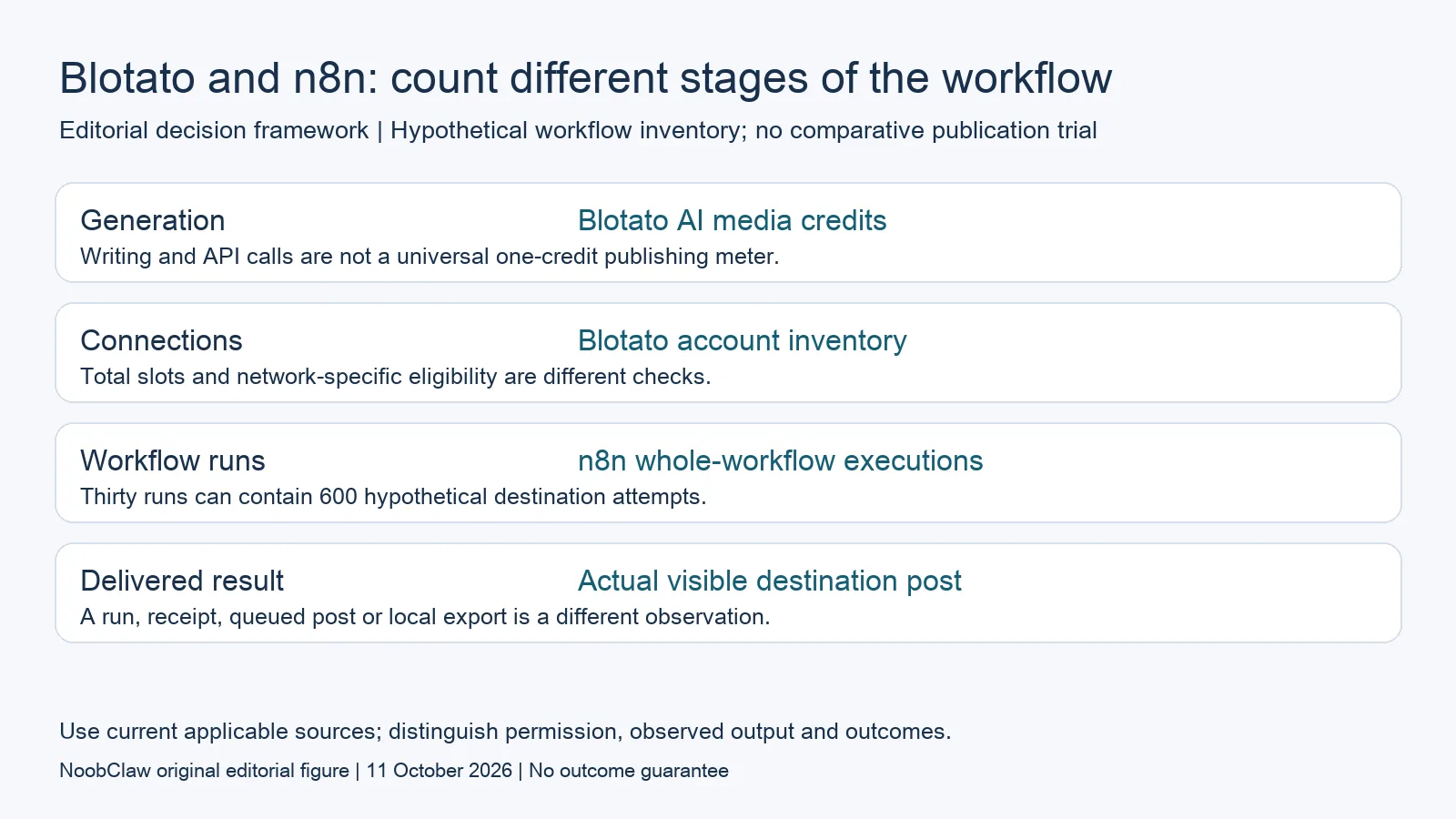
- Generation: Blotato AI media credits. Writing and API calls are not a universal one-credit publishing meter.
- Connections: Blotato account inventory. Total slots and network-specific eligibility are different checks.
- Workflow runs: n8n whole-workflow executions. Thirty runs can contain 600 hypothetical destination attempts.
- Delivered result: Actual visible destination post. A run, receipt, queued post or local export is a different observation.
Read n8n’s billing term and the unit it measures
n8n’s currently displayed annual EUR monthly equivalents are €20 for Starter with 2,500 workflow executions and €50 for Pro with 10,000. The cards include unlimited steps and users. These are annual-commitment references, not verified month-to-month prices and not directly comparable to Blotato’s monthly USD card without matching term and currency. We do not declare a cash saving by subtracting euros from dollars or by comparing unlike subscriptions.
The pricing FAQ defines an execution as a run of the entire workflow rather than charging separately for every step. A graph can contain multiple actions within one run. Separately triggered workflows and the actual production design still matter, so count the runs your intended architecture creates. A visible node count or a connected-account inventory is not enough to calculate that usage. Keep the execution allowance separate from any AI-provider or publishing-provider charges.
n8n also describes a standard self-hosted Community Edition and separately priced self-hosted business offerings. Choosing self-hosting means evaluating hosting, updates, backups, credential administration and the features you need; this review does not establish a universal zero operating cost. Read the applicable edition and terms before selecting it. Neither a community installation nor a paid workflow tier automatically supplies access to every destination’s publishing functions.
Calculate runs without turning every destination into an execution
Consider a hypothetical workflow that starts once per day for thirty days and, within each run, attempts delivery to twenty destinations. That describes thirty initial workflow runs and 600 destination attempts. It does not automatically describe 600 n8n executions. If instead twenty independent workflows start every day, the design has 600 initial runs. These are planning examples, not measured vendor logs or a recommendation to duplicate the same content across accounts.
The two architectures can also differ in review, scheduling and failure handling. An additional independently triggered job can change the run count; an action within an existing run is not thereby a separate execution. Preserve the actual production logs when estimating real usage, and check the documented treatment of the routes you use. Do not add fetch nodes, branches or every loop item to a quota simply because they appear as separate visual elements.
For a pilot, keep three columns: planned workflow starts, destination attempts and confirmed final publications. A retry or failure may affect those observations differently. The design must also prevent unintentional duplicate external actions; a completed orchestration run does not prove every destination succeeded. There is no verified fan-out performance experiment here, and the example does not establish that one arrangement is always cheaper or more reliable.
Plan the connection route and verify the actual delivered result
A workflow needs a defined source, an approved output, an authorized destination and a result that can be inspected. An orchestration tool can call a direct platform integration or a managed publishing provider. Those routes have different application ownership and maintenance responsibilities. Do not assume that every hosted customer must register a separate developer app, or that a managed API removes account authorization, destination eligibility and action-specific requirements.
For a hypothetical pilot, use one eligible account and one reviewed asset. Record who holds the application credentials, what the user authorizes and how you will detect a failed or duplicated attempt. Preserve the returned reference and check the intended final destination. An accepted request or a waiting schedule is not proof that the post is visible. The review here supplies no authenticated comparative trial, fixed setup time, platform-review waiting period or guarantee against account restrictions.
Blotato’s current API overview explicitly distinguishes a submission receipt from a published result and describes checking its subsequent status. This supports keeping the stages separate; it is not an experiment showing every planned publication succeeds. Platform rules and media requirements still apply to the proposed action. Neither a paid subscription nor a successful local script establishes that every destination will accept the same content or that the resulting post will reach a particular audience.
Choose a single product or combination according to the missing work
n8n is a candidate when the problem is coordinating sources, transformations, decisions and external calls in a workflow you can maintain. Blotato is a candidate when its supported creative features or managed publishing surface match the actual task. Its pricing page advertises official n8n nodes, so a combined route is a documented option. That does not establish that most buyers need both or that paying both subscriptions is invariably cheaper than another arrangement.
Write down the acceptance condition before testing: the correct approved asset reaches an eligible destination once, the result is retained and failures remain visible. Then identify which part belongs to the editor, orchestration tool or publishing provider. A simple requirement might need fewer moving parts; a more complex requirement might justify orchestration. This is a buyer evaluation method, not a survey of the most common architecture or a proven reduction in on-call work.
If the blocked step is creating a narrated video from a supplied script, inspect NoobClaw’s bounded local example below. It addresses creative production rather than the n8n execution counter or Blotato’s managed API. The recorded export does not demonstrate an n8n node, automatic vendor handoff or successful external publication. Choose it where the supported output matches the brief and retain the separate review, rights and destination checks.
Choose the output you need: post-caption drafts, opening-line drafts or spoken-script drafts. These text tools have a limited anonymous allowance; they do not transcribe or publish a video.
For the related content and workflow decisions, read Blotato vs Upload-Post: Accounts, Profiles and Usage Meters and Blotato Pricing: Plans, Credits and Account Limits. Each review has its own evidence and scope.
A separate documented creative export, with its limitations
NoobClaw publishes this article. Its public October 10, 2026 execution record documents one local creative run: 441 English input characters became a 32.6-second video at 1080 × 1920 pixels and 30 frames per second. This establishes the input and exported file for that run. It does not establish a client approval, scheduler integration, external publication, copyright clearance, monetization acceptance or audience response. Generic or off-topic stock footage still requires scene-by-scene review, and voice quality and footage rights were not independently approved. Use the bounded example to assess the separate production step. A paid plan or a successful export cannot replace review of the actual asset, the rights available for its intended use and the destination’s requirements.
The script-to-video guide and public creative execution record document a local video result, not external-platform publication. Check the current product offer against the supported action you need.
Frequently asked questions
Does a twenty-destination run necessarily use twenty n8n executions?
No. The cited unit is the whole-workflow run. Separately triggered workflows and the actual production route can change the count; use the design and recorded execution logs.
Is Blotato API access included in the free trial?
The current pricing and API overview exclude it. The overview says generating a key ends the trial and starts paid Starter; review that purchase condition before doing so.
Must I use both products?
No. A combined route is supported, but choose according to the actual missing stage and total requirements. This review proves neither a universal need for both nor a guaranteed saving.
Sources
Official material reviewed on October 11, 2026. Document conditions apply to their stated service and scope; the editorial examples are explicitly hypothetical.