Blotato vs Upload-Post: Accounts, Profiles and Usage Meters
- Blotato’s monthly USD Starter card lists $29, twenty total accounts and 1,250 AI credits; current API calls do not consume generation credits. Network-specific conditions still apply.
- Upload-Post’s observed annual panel shows Basic $192/year for five profiles and Professional $400/year for twenty-five. These are not verified month-to-month charges.
- Upload-Post separately lists uploads, FFmpeg editor minutes and AI Shorts analyses. Its Free card has ten uploads, two profiles, thirty editor minutes and ten analyses monthly.
- Profiles bundle one account per platform for a person or client. A hosted provider’s app approval is distinct from the customer’s authorization, eligibility and intended action.
Blotato vs Upload-Post is a comparison of supported creative and publishing requirements, not simply a choice between AI credits and video minutes. Upload-Post labels its minutes as video-editor API use and separately lists uploads, profiles and AI analyses. Blotato separately limits connections and generation while providing a paid publishing API. Current official material was reviewed on October 11, 2026. This guide uses hypothetical inventories, distinguishes displayed annual equivalents from monthly references and claims no checkout or comparative publishing test.
A finished video’s length is not automatically a charge against an optional editor allowance. Count the action actually used and the destination inventory.
Keep Blotato’s generation and connection limits separate
Blotato’s current monthly USD cards list Starter at $29, Creator at $97 and Agency at $499. Starter includes 1,250 AI credits and twenty social accounts; Creator includes 5,000 credits and forty accounts. The pricing page advertises unlimited AI writing, while credits cover specified AI media generation. The current API page separately says API calls do not consume generation credits. Do not calculate a publishing bill by treating every caption, request and generated video as one interchangeable credit.
Account capacity is also different from the number of outputs. A hypothetical inventory of twenty distinct connected accounts can fit the stated Starter count, subject to network-specific eligibility and limits. It does not establish that an arbitrary workload fits the generation allowance or that twenty accounts on one network are all eligible under that plan. For example, the current API overview gives Starter a separate three-account TikTok condition. A total connection allowance cannot override that narrower condition.
Blotato’s seven-day web-app trial excludes the API. Its current API overview says creating an API key ends the trial and starts the paid Starter subscription. Treat that as a purchase condition to review before generating a key, not as a free developer test. We have not authenticated a trial, performed a checkout or published a post through either vendor in this comparison. Public feature availability and an account-specific successful operation remain separate evidence.
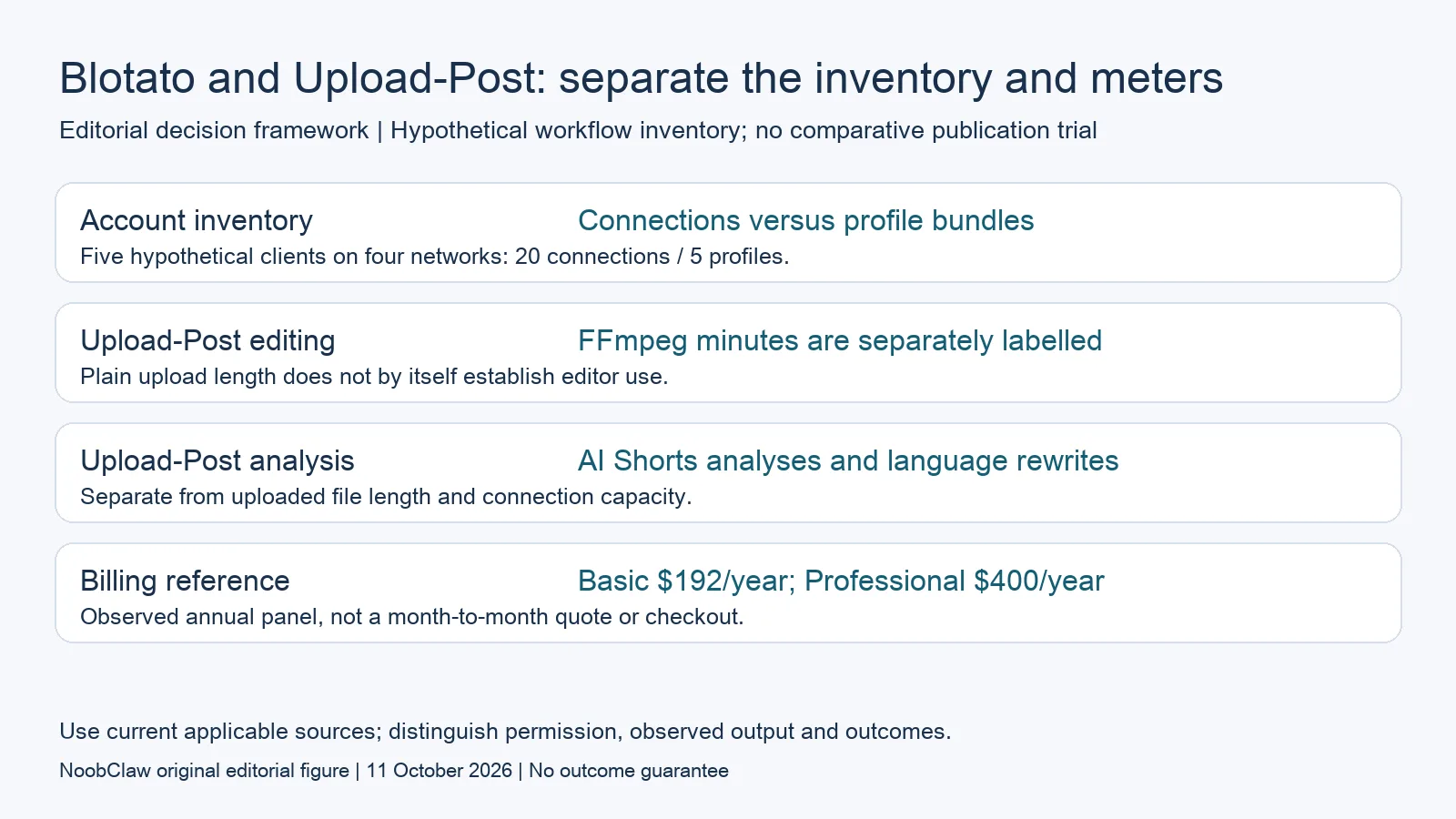
- Account inventory: Connections versus profile bundles. Five hypothetical clients on four networks: 20 connections / 5 profiles.
- Upload-Post editing: FFmpeg minutes are separately labelled. Plain upload length does not by itself establish editor use.
- Upload-Post analysis: AI Shorts analyses and language rewrites. Separate from uploaded file length and connection capacity.
- Billing reference: Basic $192/year; Professional $400/year. Observed annual panel, not a month-to-month quote or checkout.
Treat Upload-Post’s profiles as bundles rather than individual accounts
Upload-Post’s current pricing defines a profile as a person or client with one account per platform. Its displayed annual panel lists Basic at $192 per year with five profiles and Professional at $400 with twenty-five. The rounded monthly-equivalent labels are $16 and $33, respectively. This review uses the full annual charges when describing that panel; it does not infer monthly prices from a discount banner or call an annual equivalent a monthly invoice.
A hypothetical set of five clients with one account on each of four supported networks has twenty connections but needs five Upload-Post profiles under that definition. Twenty Instagram accounts require twenty profile slots, not five profiles with unused slots on other networks. Compare that inventory with Blotato’s total account count and narrower network conditions. Neither arrangement establishes permission to create repetitive identities or an entitlement to every format.
User access needs a separate check: the displayed Basic reference has one owner seat, while Professional has an owner and one member. A profile allowance does not add a teammate. The panel also lists extra-profile packages that do not stack and a separately monthly-billed X link-post add-on. Record the exact configuration and term before estimating a real purchase. We have not verified a checkout, tax, custom quote or the available configuration of your account.
Distinguish plain uploads, editor minutes and AI analyses
The current Free card separates ten monthly uploads, two profiles, thirty FFmpeg video-editor minutes and ten AI Shorts analyses. Basic separately lists unlimited uploads, 300 editor minutes and one hundred analyses; Professional lists unlimited uploads, 1,000 editor minutes and three hundred analyses. The minute label is explicitly an editor API allowance. A finished file’s playback length alone does not prove that this editor was used or determine its billable use.
For a hypothetical workload, forty-five finished two-minute videos contain ninety minutes of source footage. That arithmetic is not a statement that ninety editor minutes were consumed. Record whether the workflow requested the optional editing service, and use the actual counter and documented billing definition for that request. A standard upload and an editing job are different actions; do not declare that every uploader will hit the editor allowance before an upload limit.
The pricing explanation says an AI analysis and a caption rewrite into another language each count toward the analysis quota, with resets by billing cycle. Generation, analysis and upload observations therefore need separate columns. A paid unlimited-upload claim does not guarantee destination acceptance, remove account conditions or establish a growth schedule. We do not infer the exact free multi-destination counting rule from the headline allowance; check it on the actual documented route.
Evaluate the interface and authorization rather than inventing a universal review queue
Both products expose a publishing API, and Upload-Post also presents a scheduler, automation integrations and an AI Shorts Uploader. Calling one only a panel and the other a product with no creative layer hides documented options. Blotato advertises broader writing and media-generation features; Upload-Post’s analysis feature addresses a different task. Compare the actual input and output instead of declaring that the two interfaces cannot overlap.
A managed provider describes its own platform integration; a customer authorizes an account and meets the applicable destination conditions. Those roles should remain separate. The materials reviewed here do not establish that every hosted customer must register and wait three weeks for a personal developer-app review. We do not certify a vendor’s blanket account-safety marketing, privacy assurances or reliable-delivery claims as results of an independent credential or publication audit.
For a hypothetical integration test, preserve the accepted asset, intended account, permissions and subsequent final destination result. Upload-Post’s documentation illustrates an asynchronous upload-initiation response; that initial success label is distinct from a completed visible publication. Check the destination result and failures. This is a verification method, not a report that our account completed the route or that a provider’s app approval makes every proposed automated action acceptable.
Select according to the actual production and publishing bottleneck
Blotato can be a candidate where its supported AI creation and managed publishing tasks fit the brief. Upload-Post can be a candidate where the required profile inventory, publishing integration, optional editing or analysis features fit. Neither is universally the cheaper choice. Match the term, currency, accounts, people and optional actions before comparing totals. A maximum-capacity price divided by every available slot is not evidence of your actual utilization or saved operating cost.
For the documented inventories, list repeated accounts on one network separately from multi-network bundles. Also list the actions used: preparing a caption, generating media, analyzing a video, editing it and publishing to an eligible destination. These items can have different counters. Confirm the current supported network and format instead of asserting that all other networks lack a publishing API or that every unified provider excludes an entire region for the same reason.
NoobClaw’s public example below can help assess a separate script-to-video production step. It does not supply a verified unified-API replacement, an automatic handoff to either vendor or evidence of a commercial result. Review the exported asset, stated limitations and current offer. If the missing requirement is a managed publishing endpoint or client reporting, a local export is not proof that the complete workflow is ready.
Choose the output you need: post-caption drafts, opening-line drafts or spoken-script drafts. These text tools have a limited anonymous allowance; they do not transcribe or publish a video.
For the related content and workflow decisions, read Blotato vs n8n: Credits, Workflow Runs and Integration Costs and Blotato vs Buffer: Channels, Credits and Workflow Fit. Each review has its own evidence and scope.
A separate documented creative export, with its limitations
NoobClaw publishes this article. Its public October 10, 2026 execution record documents one local creative run: 441 English input characters became a 32.6-second video at 1080 × 1920 pixels and 30 frames per second. This establishes the input and exported file for that run. It does not establish a client approval, scheduler integration, external publication, copyright clearance, monetization acceptance or audience response. Generic or off-topic stock footage still requires scene-by-scene review, and voice quality and footage rights were not independently approved. Use the bounded example to assess the separate production step. A paid plan or a successful export cannot replace review of the actual asset, the rights available for its intended use and the destination’s requirements.
The script-to-video guide and public creative execution record document a local video result, not external-platform publication. Check the current product offer against the supported action you need.
Frequently asked questions
Does a long uploaded video automatically consume FFmpeg editor minutes?
The reviewed pricing labels the minutes as video-editor API use. Playback duration alone does not establish use of that optional service; check the actual request and billing counter.
Is an Upload-Post profile one connected account?
Its stated profile bundles one account per supported platform for a person or client. Repeated accounts on the same network need separate profile slots; teammate seats are another allowance.
Is Basic’s displayed $16 a month-to-month price?
The observed panel also states $192 billed annually. This review treats $16 as that annual equivalent and does not certify a monthly checkout or infer it from a discount banner.
Sources
Official material reviewed on October 11, 2026. Document conditions apply to their stated service and scope; the editorial examples are explicitly hypothetical.
- Blotato: current monthly plans and trial FAQ
- Blotato: October2026 API account limits, trial billing and status scope
- Upload-Post: current annual panel, profiles and separate usage meters
- Upload-Post: separate FFmpeg editor job and minute allowances
- Upload-Post: current asynchronous publishing overview