Later Pricing: Social Sets, Users and Monthly Post Limits
- Later standard Starter, Growth and Scale include one, two and six Social Sets, with one, two and four users respectively.
- Current annual USD equivalents are $18.75, $37.50 and $82.50 per month, billed yearly before taxes; monthly invoices are a separate term.
- Later counts scheduled posts and drafts in the month they are created; publishing does not refill a waiting queue. Deletion rules and reset dates matter.
- Official help describes a Free plan. Check subscription-specific terms and the Starter AI-credit add-on conflict rather than assuming all offers are identical.
Later pricing depends on more than the number of connected accounts. You need the Social Sets that can hold those profiles, access for the people doing the work, a monthly creation allowance and the eligible features. This guide uses current official material reviewed on October 11, 2026. It distinguishes the annual public panel, standard-plan documentation and account-specific subscriptions, so a headline price or an older search result does not become a universal invoice.
Count your real profiles and monthly creation activity, then verify the billing term and the people who need access.
Later Social Sets, users and actual connected inventory
Later’s current standard plans list one Social Set and one user on Starter, two sets and two users on Growth, and six sets with four users on Scale. Each set can hold one profile on each supported platform: Instagram, Facebook, Threads, Pinterest, TikTok, LinkedIn, YouTube and Snapchat. Eight possible slots are not eight profiles of any type you choose. Two profiles on the same network require capacity in two sets.
Inventory and utilization are separate. One brand with profiles on four supported networks can occupy four slots inside one set, while four Instagram profiles require four sets even if other slots are empty. These are hypothetical configurations, not customer observations. Count your real profiles by network and verify the supported account and post type before estimating the sets required. A social set is not a person or an unrestricted client workspace.
Growth and Scale support extra sets and users for desktop subscriptions. Standard Scale’s unlimited post allowance does not mean unlimited users: its base has four. Existing accounts can have legacy, promotional, custom or package-based subscriptions with different allowances. The official plan-selection guide advises checking the specific subscription. Do not use the current standard table to overwrite an account’s actual package terms.
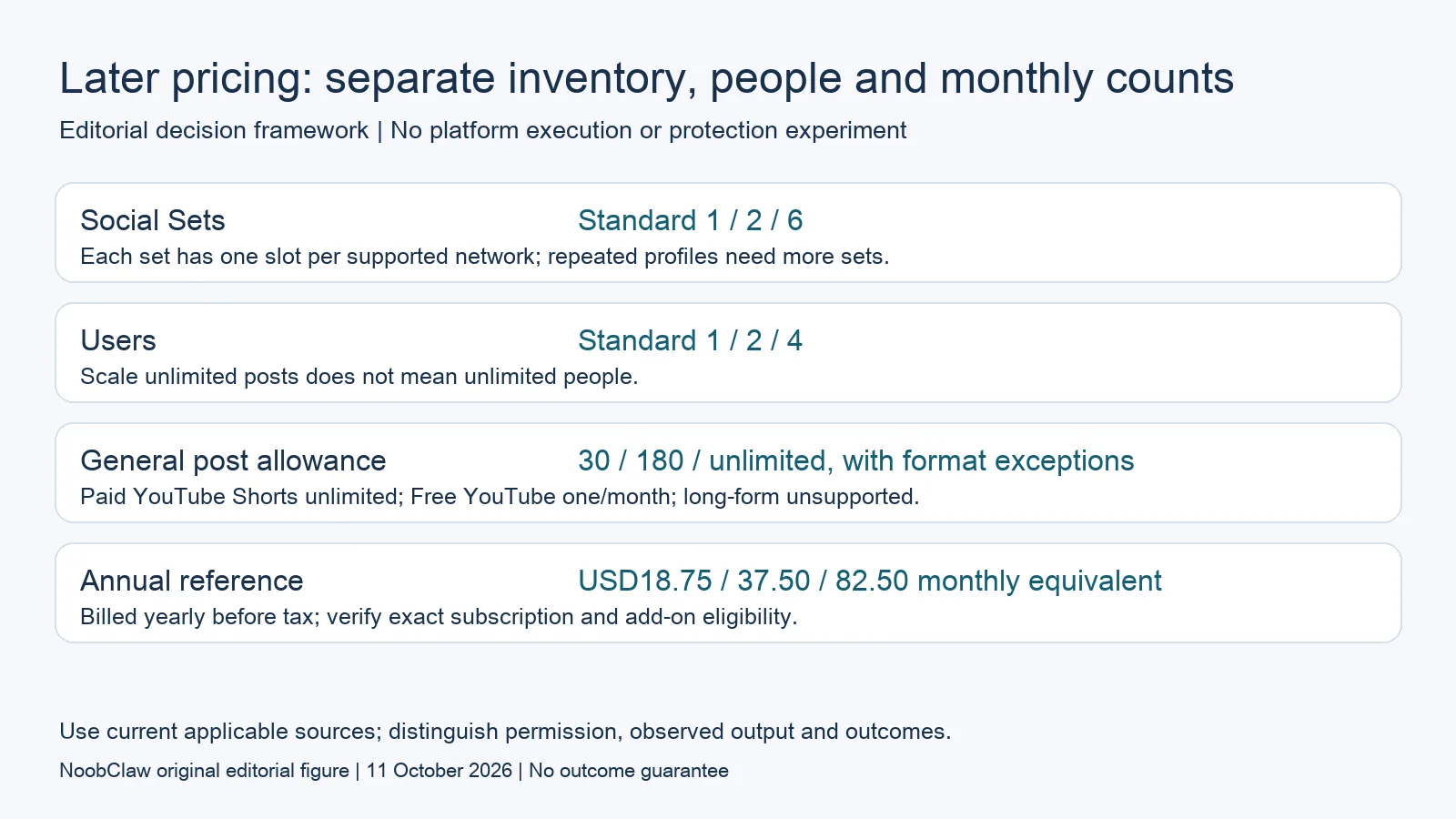
- Social Sets: Standard 1 / 2 / 6. Each set has one slot per supported network; repeated profiles need more sets.
- Users: Standard 1 / 2 / 4. Scale unlimited posts does not mean unlimited people.
- General post allowance: 30 / 180 / unlimited, with format exceptions. Paid YouTube Shorts unlimited; Free YouTube one/month; long-form unsupported.
- Annual reference: USD18.75 / 37.50 / 82.50 monthly equivalent. Billed yearly before tax; verify exact subscription and add-on eligibility.
The monthly counter is not a refilling queue
Later’s specific post-count documentation says posts consume the month’s allowance when scheduled rather than when published. A draft also consumes the month’s counter when created; scheduling that draft does not count it again. The general post row lists thirty per profile per month for Starter, one hundred eighty for Growth and unlimited for Scale, with twelve for Free. The same current availability reference has a specific YouTube Shorts exception: one per month on Free and unlimited on the current paid Starter, Growth and Scale plans. Long-form YouTube videos are not supported. Use the applicable format row rather than impose the general thirty or one-hundred-eighty cap on paid Shorts.
The counter resets on the first day of each month at midnight UTC, independently of the subscription renewal date. Deleting an unpublished scheduled post returns its count if that post was originally created in the same month. Deleting a draft also returns its count. A published post does not simply release a waiting slot. Therefore the size of the future queue alone does not tell you how much monthly capacity remains.
For a hypothetical Starter Instagram profile using the general monthly allowance, creating thirty scheduled items this month for future dates can use this month’s allowance even when none has published. Publishing one does not establish permission to create a thirty-first that month. The count applies separately to each profile and includes content such as Stories where supported. It is a planning allowance, not a platform safety limit, recommended posting frequency or audience-growth target.
Current Later billing and add-ons need matching terms
The current public annual pricing panel lists monthly equivalents of $18.75 Starter, $37.50 Growth and $82.50 Scale, billed yearly in USD before applicable taxes. Its displayed annual discount is twenty-five percent. These are annual equivalents, not cancel-any-month invoices. A historical search result with different plan names, set counts or an older promotion should not substitute for the current page and subscription-specific quote.
The annual panel lists extra Social Sets at $11.25 per month equivalent, extra users at $3.75, and one hundred additional AI credits at $3.75 on Growth and Scale. An annual reference does not establish the monthly add-on charge or an individual checkout total. Add-on eligibility also depends on desktop signup: the current help guide says iOS in-app subscriptions do not support those add-ons.
There is a source boundary for Starter AI credits. The marketing Starter card says extra sets, users and AI credits are unavailable, while the current help references allow AI-credit add-ons on current paid plans. Both agree that extra sets and users are unavailable on Starter. Confirm AI-credit availability in the actual subscription rather than making an absolute claim about every add-on. Removing a profile or user is also not the same as removing the paid add-on from billing.
Free plans, trials and supported tasks
Later’s official plan-selection guide and availability reference explicitly describe a Free plan. The public pricing page emphasizes paid plans and a fourteen-day trial, which does not prove that Free does not exist. The reference lists one user, one set, a limited monthly post count and restrictions such as one YouTube Short per month and no paid AI-caption generation on Free. Confirm the offer and feature path available to your account.
Free and trial access are different. Later says trials are not available on accounts that previously had a trial or paid subscription. A visible premium dashboard can also be an upgrade preview rather than working access. For the task you need, verify the actual profile type, post format, delivery method and plan eligibility. A network logo or an unlimited headline is not evidence that every action is automatically supported.
Creation evidence and scheduler capabilities are separate
Later advertises Caption Writer and Ideas, with plan-specific AI credits. Its public pricing page describes one credit as three ideas or one caption. These are feature and metering descriptions, not comparative output-quality evidence. A scheduler can include drafting, editing and customization; do not describe every scheduling product as requiring finished identical copy. Neither a calendar layout nor its billing unit determines whether it can create distinct content.
NoobClaw publishes this article and offers separate caption, opening-line, spoken-script and documented local video workflows. Those may complement a scheduler when asset creation is the missing step. They do not establish hosted approval, analytics, external publishing permissions or account protection. Match the supported output, review it completely, then verify the delivery workflow you actually need.
Choose the output you need: post-caption drafts, opening-line drafts or spoken-script drafts. These text tools have a limited anonymous allowance; they do not transcribe or publish a video.
For the related content and workflow decisions, read SocialBee vs Later: Profile Bundles, Sets and Team Access and Buffer vs Later: Channel Prices, Social Sets and Post Limits. Each review has its own evidence and scope.
A local creative result is a separate product task
A public NoobClaw record dated October 10, 2026 documents one local creative run: 441 English input characters, one 32.6-second video, 1080 × 1920 resolution and 30 frames per second. This is an observed asset, not a Later connection, scheduler delivery test or audience result. The stock footage includes generic or off-topic scenes requiring a full editorial check. Voice quality and footage rights were not independently approved. A supported local export therefore does not establish that the finished video is ready to publish or that it replaces hosted analytics and team approvals.
NoobClaw publishes this article. Its script-to-video guide and public creative execution record document a local video result, not external-platform publication. Check the current product offer against the supported action you need.
Frequently asked questions
Does Later have a Free plan?
The current official help guide and availability table describe Free with limited scheduling. The marketing pricing table emphasizes paid plans and a trial, so use the specific offer and feature requirements rather than claiming Free is absent.
Does publishing a post return a monthly slot?
The counter is monthly creation or scheduling activity, not waiting-queue depth. Current help gives specific rules for deleting unpublished posts created in the same month and deleting drafts. The count resets at midnight UTC on the first day of the month.
Can I reduce the bill by deleting a connected profile?
Removing a profile or user does not automatically remove the corresponding paid add-on from billing. The help guide describes removing it from the subscription, retaining access until the cycle ends and no refund for unused time. Check your actual plan and signup channel.
Sources
Official material reviewed on October 11, 2026. Document conditions apply to their stated service and scope; the editorial examples are explicitly hypothetical.