Buffer vs Later: Channel Prices, Social Sets and Post Limits
- Buffer counts connected profiles as channels. Later groups one profile per supported network in each Social Set; actual inventory can fit those units differently.
- Buffer’s current monthly Essentials rates use progressive bands, while Later’s public annual panel is a different billing commitment. Match terms before calling a winner.
- Buffer Free uses ten waiting posts per channel; Later’s limited plans count monthly creation or scheduling activity, including drafts.
- Both advertise AI creation. Compare the supported task, reviewer access and delivery format rather than assuming either only forwards finished copy.
Buffer versus Later is a comparison of the inventory and work you actually have. The full capacity of a Social Set is not the number of profiles you will necessarily connect, and an annual equivalent is not a monthly invoice. We checked current official pricing and Later’s detailed plan and post-count guidance on October 11, 2026. This comparison explains the different counters and units without predicting a universal price winner or audience result.
Match real channels, supported networks, monthly creation and reviewer access before comparing a subscription total.
Buffer channels and its current progressive monthly rates
Buffer’s current machine-readable pricing lists monthly Essentials rates of $6 per channel for the first ten, $4 for channels eleven through twenty-five, $3 for twenty-six through fifty, and $1 above fifty. Team starts at $12 for the first ten and then lists $4, $3 and $2 for the succeeding bands. These are progressive bands, not a single discounted rate applied to every channel once a threshold is reached.
For hypothetical Essentials inventories, five channels cost $30 monthly and ten cost $60. Twenty-five cost $120: ten at six dollars plus fifteen at four. These calculations use the published monthly bands before additional applicable charges; they are not customer invoices or evidence of equivalent features. Buffer’s annual pricing is a separate commitment and should be matched to an annual competitor quote.
Current Free lists three simultaneously connected channels, ten waiting scheduled posts per channel and one user. Published posts release waiting queue slots. An eight-unique-channel lifetime connection boundary is separate from the simultaneous three-channel count. Supported format and delivery conditions still need checking. A paid fair-use allowance should not be casually relabeled as a monthly publishing quota if its period is not established.
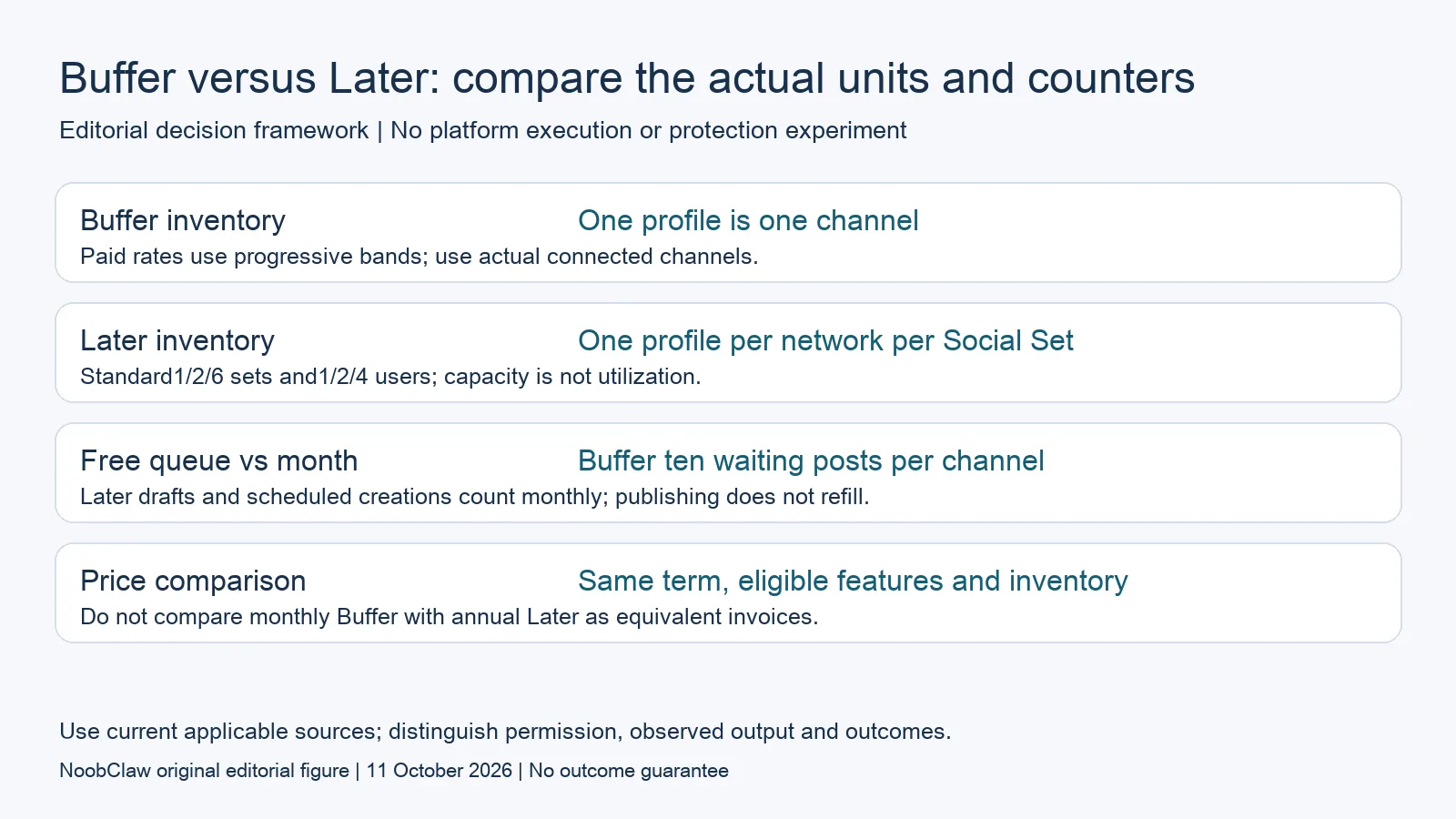
- Buffer inventory: One profile is one channel. Paid rates use progressive bands; use actual connected channels.
- Later inventory: One profile per network per Social Set. Standard1/2/6 sets and1/2/4 users; capacity is not utilization.
- Free queue vs month: Buffer ten waiting posts per channel. Later drafts and scheduled creations count monthly; publishing does not refill.
- Price comparison: Same term, eligible features and inventory. Do not compare monthly Buffer with annual Later as equivalent invoices.
Later Social Sets, users and actual connected inventory
Later’s current standard plans list one Social Set and one user on Starter, two sets and two users on Growth, and six sets with four users on Scale. Each set can hold one profile on each supported platform: Instagram, Facebook, Threads, Pinterest, TikTok, LinkedIn, YouTube and Snapchat. Eight possible slots are not eight profiles of any type you choose. Two profiles on the same network require capacity in two sets.
Inventory and utilization are separate. One brand with profiles on four supported networks can occupy four slots inside one set, while four Instagram profiles require four sets even if other slots are empty. These are hypothetical configurations, not customer observations. Count your real profiles by network and verify the supported account and post type before estimating the sets required. A social set is not a person or an unrestricted client workspace.
Growth and Scale support extra sets and users for desktop subscriptions. Standard Scale’s unlimited post allowance does not mean unlimited users: its base has four. Existing accounts can have legacy, promotional, custom or package-based subscriptions with different allowances. The official plan-selection guide advises checking the specific subscription. Do not use the current standard table to overwrite an account’s actual package terms.
The monthly counter is not a refilling queue
Later’s specific post-count documentation says posts consume the month’s allowance when scheduled rather than when published. A draft also consumes the month’s counter when created; scheduling that draft does not count it again. The general post row lists thirty per profile per month for Starter, one hundred eighty for Growth and unlimited for Scale, with twelve for Free. The same current availability reference has a specific YouTube Shorts exception: one per month on Free and unlimited on the current paid Starter, Growth and Scale plans. Long-form YouTube videos are not supported. Use the applicable format row rather than impose the general thirty or one-hundred-eighty cap on paid Shorts.
The counter resets on the first day of each month at midnight UTC, independently of the subscription renewal date. Deleting an unpublished scheduled post returns its count if that post was originally created in the same month. Deleting a draft also returns its count. A published post does not simply release a waiting slot. Therefore the size of the future queue alone does not tell you how much monthly capacity remains.
For a hypothetical Starter Instagram profile using the general monthly allowance, creating thirty scheduled items this month for future dates can use this month’s allowance even when none has published. Publishing one does not establish permission to create a thirty-first that month. The count applies separately to each profile and includes content such as Stories where supported. It is a planning allowance, not a platform safety limit, recommended posting frequency or audience-growth target.
Compare billing terms, approval needs and used capacity
Later’s current annual public panel lists $18.75, $37.50 and $82.50 per month equivalents for Starter, Growth and Scale, billed yearly before taxes. Those references must not be compared to Buffer’s monthly rates as if both were cancel-any-month invoices. Use the same term, network inventory, people and required features before comparing a configured total.
Do not divide a price by every possible profile slot and present the quotient as the cost of the profiles you actually use. A Later set cannot be filled with eight Instagram accounts, and a partially occupied set has unused capacity. Growth and Scale permit more sets and users through eligible desktop add-ons, so six sets is not a universal ceiling above which Buffer becomes the default winner.
Later’s current help reference lists collaboration and approvals on Growth and higher, with desktop and format conditions. Buffer Team has its own approval and collaboration offer. Inspect the actual review task rather than treating a solo plan’s queue as equivalent to a multi-person team. A visually richer planning workflow may matter, but this review does not establish which interface a particular customer will prefer.
Creation evidence and scheduler capabilities are separate
Later advertises Caption Writer and Ideas, with plan-specific AI credits. Its public pricing page describes one credit as three ideas or one caption. These are feature and metering descriptions, not comparative output-quality evidence. A scheduler can include drafting, editing and customization; do not describe every scheduling product as requiring finished identical copy. Neither a calendar layout nor its billing unit determines whether it can create distinct content.
NoobClaw publishes this article and offers separate caption, opening-line, spoken-script and documented local video workflows. Those may complement a scheduler when asset creation is the missing step. They do not establish hosted approval, analytics, external publishing permissions or account protection. Match the supported output, review it completely, then verify the delivery workflow you actually need.
Choose the output you need: post-caption drafts, opening-line drafts or spoken-script drafts. These text tools have a limited anonymous allowance; they do not transcribe or publish a video.
For the related content and workflow decisions, read Later Pricing: Social Sets, Users and Monthly Post Limits and Buffer Free Plan Limits: Queue Slots, Users and Upgrades. Each review has its own evidence and scope.
Creative output does not certify a publishing integration
A public NoobClaw record dated October 10, 2026 documents one local creative run: 441 English input characters, one 32.6-second video, 1080 × 1920 resolution and 30 frames per second. This is an observed asset, not a Later connection, scheduler delivery test or audience result. The stock footage includes generic or off-topic scenes requiring a full editorial check. Voice quality and footage rights were not independently approved. A supported local export therefore does not establish that the finished video is ready to publish or that it replaces hosted analytics and team approvals.
NoobClaw publishes this article. Its script-to-video guide and public creative execution record document a local video result, not external-platform publication. Check the current product offer against the supported action you need.
Frequently asked questions
Which is cheaper at nine channels?
A valid total depends on whether those channels fit Later’s network slots, the required plan and the billing term. Do not compare Buffer monthly prices with Later annual equivalents or assume all available slots are interchangeable.
Do both plans limit posts the same way?
No. Buffer Free has a refilling waiting queue. Later limited plans count monthly creation or scheduling, including drafts. A post publishing is a different event from the creation-counter reset.
Do both products help create content?
Both advertise AI assistance or content creation. Those public features are not a controlled comparison of quality, originality, delivery reliability or audience results. Match the output and review a representative asset.
Sources
Official material reviewed on October 11, 2026. Document conditions apply to their stated service and scope; the editorial examples are explicitly hypothetical.
- Later: current pricing and USD billing panels
- Later: monthly post counter and draft/deletion rules
- Later: standard plans and subscription variations
- Later: current plan availability reference
- Later: user and Social Set add-ons
- Buffer: original current pricing markdown and graduated rates
- Buffer: plans and feature conditions