
Mixpost Lite vs Pro (2026): The Free Tier Gets Updates Forever, the $299 One Gets a Year
- Mixpost Lite publishes to exactly three networks: Facebook Pages, X and Mastodon. Pro unlocks eleven. That single line disqualifies Lite for most people faster than any feature table does.
- The counterintuitive part: Lite lists "lifetime access to updates" while Pro and Enterprise list "1-year free updates". The free tier is the one with the longer update window.
- Pro is $299 once for one domain or subdomain. Against a $29-a-month subscription that is roughly ten months to break even — which lands inside the twelve-month update window, not outside it.
- Mixpost caps nothing: unlimited accounts, members and workspaces. The vendor says so and then says the platforms may rate-limit you anyway, and may charge you to lift it. The ceiling did not vanish, i
Most "one-time payment" pages are arguing with subscriptions. Mixpost's is doing that too, and it is doing it well — pay once, own forever, unlimited accounts, unlimited team members, no per-seat fee. Then you read the two bullet lists side by side and find something nobody writes about: the free package includes lifetime access to updates, and the $299 package includes one year.
Both statements are on the same page, in the plan cards and again in the FAQ. That is not a contradiction and it is not a trick; it is a deliberate structure that almost every roundup of this product leaves out, and it is the single fact that should decide whether you buy.
Lite is not a trial. It is a three-network product.
The cleanest way to settle Lite versus Pro takes about fifteen seconds, and it is not about features. Lite publishes to Facebook Pages, X and Mastodon. That is the list. Pro and Enterprise publish to those three plus Instagram (posts, reels, stories), LinkedIn profiles and company pages, YouTube videos and shorts, TikTok, Pinterest, Threads, Bluesky and Google Business Profile.
So if Instagram or TikTok is in your plan at all, the comparison is over before the analytics, the approval flow, the AI assistant, the queue, the API, the webhooks or the MCP server enter the conversation. Everything else in this article is for the minority for whom three networks is genuinely enough — and for the larger group who want to know what the $299 is actually purchasing.
What Lite does include is not token: calendar, media library, basic analytics, post versions, post labels, community support, the full source on GitHub. It is a real product with a narrow mouth.
The update window is the term nobody prices
Here is the structure exactly as the page states it. Lite: free, and "you will receive updates forever at no additional cost." Pro at $299 and Enterprise at $1,199: "you will receive free updates for 1 year. After 1 year, you can continue using the software, but you will not receive updates unless you renew the license."
A perpetual licence and a perpetual product are different purchases. You keep the software forever. You keep the version forever. Those are the same sentence only if nothing upstream ever changes.
Every purchase also carries a perpetual fallback licence, so the thing you paid for cannot be switched off. But self-hosted social tooling lives downstream of eleven platforms that rewrite their publishing endpoints on their own schedule, which means the clock that matters is not "how long may I run this" but "how long will it keep working without me". The card answers the first question loudly and the second one in a FAQ entry.
This is worth putting next to the payback arithmetic rather than after it. At $299 once, against a $29-a-month hosted scheduler you would otherwise pay, you break even at roughly ten months — two months before updates stop. Against a heavier subscription, say ten channels at $60 a month on a metered plan, you break even at around five months, leaving about seven months of covered updates on the other side of the line. Same $299, two very different purchases.
None of which says $299 is a bad deal. It says the honest way to write the comparison is: the break-even month and the update expiry are two separate dates, and you should know which one comes first before you pay.
What $299 buys, what $1,199 buys, and the licence sentence people miss
| Lite | Pro | Enterprise | |
|---|---|---|---|
| Price | Free, open source | $299 one-time | $1,199 one-time |
| Networks | 3 (FB Pages, X, Mastodon) | 11 | 11 |
| Free updates | Forever | 1 year | 1 year |
| Install scope | Self-host, no licence key | 1 domain or subdomain | 1 domain or subdomain |
| Accounts / members / workspaces | Unlimited | Unlimited | Unlimited |
| API, MCP, webhooks | Not listed | Included | Included |
| Multi-tenant workspaces | Not listed | Included | Included |
| Billing / subscriptions / coupons | — | — | Included |
| Support | Community | Standard | Standard |
| Price per account | No account gate on any tier — this column does not exist here, which is the point | ||
| Price per post | No output cap on any tier; see the rate-limit clause below | ||
The two columns that normally decide a scheduler comparison — money per account and money per permitted post — are genuinely empty here, and that is a finding rather than a gap. Mixpost does not meter either unit. Both of the usual denominators are absent, so the comparison has to move to a different axis entirely: the domain, the update year, and the licence terms.
The licence terms are where the two paid tiers really separate, and it is one sentence: "a Mixpost Pro license cannot be used to build a SaaS platform. For this purpose, we offer the Mixpost Enterprise license." Enterprise is not a bigger Pro — it is the version you may resell, which is why it ships subscription management, a customer dashboard, automated billing and coupons. If you are running your own accounts or your own clients' accounts, Pro is the right tier and Enterprise is a different business.
Two smaller clauses are worth knowing before you buy. Pro upgrades to Enterprise by paying only the difference, but only within the first three months — after that it is a separate purchase. And non-profits and NGOs get 30 percent off, on Pro only, after verifying with support.
One thing the page does not document is any upgrade path from Lite to Pro. It documents the Pro-to-Enterprise one carefully and says of Lite only that "for more features, you have to buy a license." Read it as two packages rather than two rungs, and check with support before you assume a key will be issued against your existing install.
"Unlimited accounts" is true, and it is not the ceiling
Mixpost answers the limits question more honestly than most of the hosted competition, and the answer contains its own asterisk:
"Mixpost allows you to connect unlimited social accounts and manage as many clients as you need - without restrictions. However, social networks like Facebook, LinkedIn, and TikTok may impose rate limits. If you reach a platform's limit, you can request a higher limit directly from them, though some may charge a fee for this."
Compare that with a hosted scheduler that publishes a per-platform daily table: there, one ceiling is the vendor's and another is the platform's, and the vendor's sits lower. Self-hosting removes the first ceiling entirely. It does not remove the second, and the vendor is telling you the second one may come with an invoice of its own.
That is the correct way to think about the whole self-hosted trade. You are not buying the absence of limits. You are buying the removal of one intermediary's limits, in exchange for taking on the deployment, the platform app approvals and the upgrade path yourself. The subscription you stop paying becomes time; if you would rather not spend the time, it becomes money again.
FAQ
Can I start on Lite and upgrade to Pro later?
You can certainly start on Lite — it is free, open source and installs with Docker or Composer. What the pricing page does not describe is an upgrade mechanism from Lite to Pro; the only upgrade path it spells out is Pro to Enterprise, within three months, for the price difference. Plan for buying a Pro licence as a fresh purchase and ask support directly if you want confirmation for your specific install.
What happens after the one year of updates runs out?
You keep using the software indefinitely — that is what the perpetual fallback licence guarantees — but you stop receiving new versions unless you renew. The practical risk is not the missing features; it is that publishing integrations break when platforms change, and from month thirteen onward a fix released upstream does not reach you automatically. If you are budgeting for more than a year, budget the renewal alongside the licence rather than treating $299 as the total.
Is one domain per licence a real limit or a formality?
It is the only hard gate in the entire product. Accounts, workspaces and team members are unlimited on every paid tier; the licence is scoped to one domain or subdomain and there is no add-on list to buy a second one from. If you were planning separate installs for separate clients, that is separate licences — and it is the one place where Mixpost's "unlimited everything" framing needs reading carefully.
How to decide this in one sitting
Four questions, in this order, and you will not need a feature table:
- Do you need any network outside Facebook Pages, X and Mastodon? Yes means Pro; there is nothing further to weigh.
- What subscription would you actually cancel? Divide $299 by its monthly price. That number is your break-even month.
- Is that month before or after month twelve? Before means the update window covers your payback and then some. After means you are paying for a build that stops receiving fixes before it has paid for itself.
- Will you resell access? Yes means Enterprise, and the three-month difference-payment window is the cheapest moment to decide it.
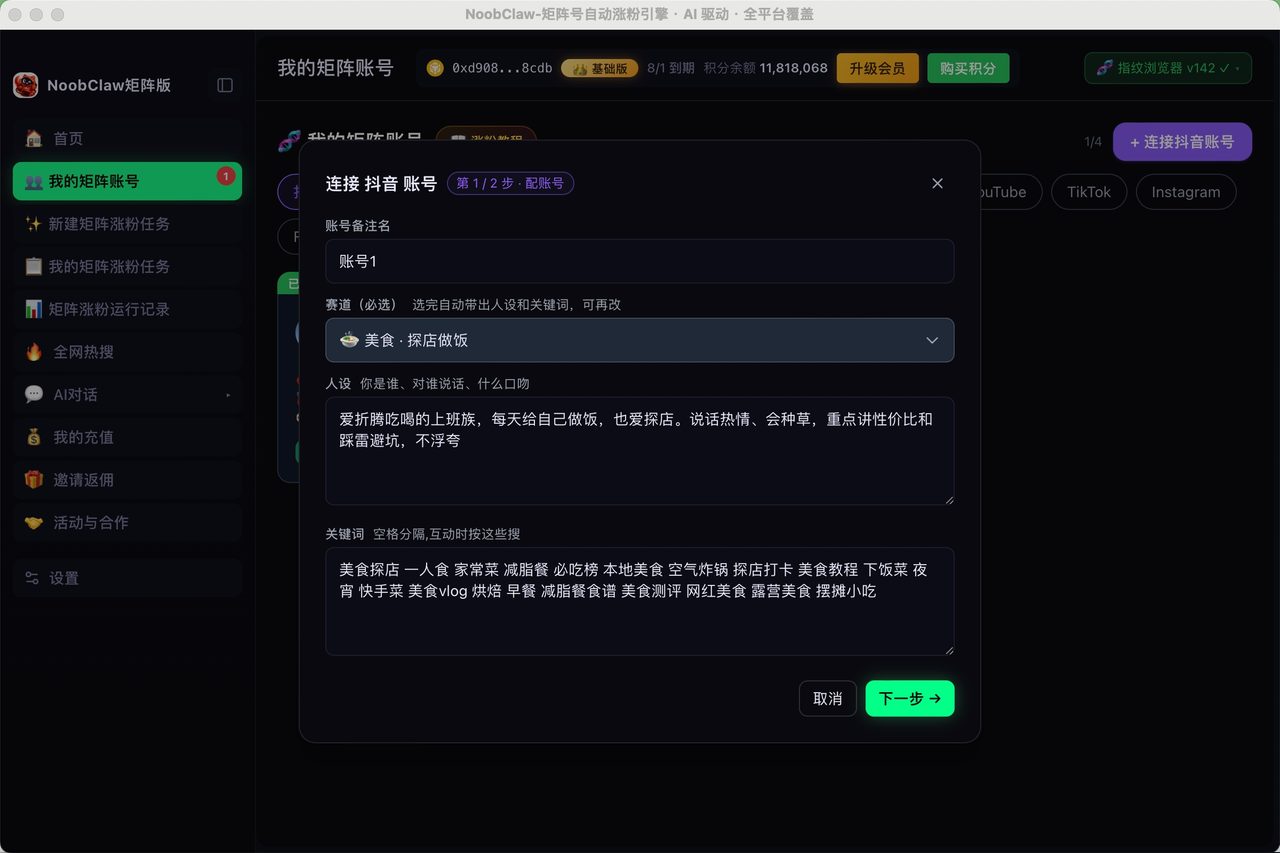
And if the reason you are looking at self-hosting is that you have more accounts than a per-account plan can affordably hold, note that hosted schedulers are not the only other shape. Tools that publish from a local browser already signed in to your own accounts — one fingerprint and one proxy per account, each account writing from its own niche and persona, randomised timing with daily caps and rest days — remove the vendor pipe rather than relocating it to your server. NoobClaw is one of those; it is a desktop application, it does not ask for your account passwords, and it is explicitly not a hands-off content factory. The platforms' limits still apply and human review is still yours to keep.
For the surrounding arithmetic: the one-time-payment case is worked in Mixpost pricing, one-time, the head-to-head with the other open-source option is Postiz vs Mixpost, the hidden bill of running it yourself is in the three-layer self-hosting bill, and the subscription-versus-source question is in what the subscription is actually buying.