RecurPost vs Buffer: Current Prices, Daily Limits and Teams
- RecurPost’s monthly Starter, Personal and Agency are $9, $25 and $79, with different account and daily allowances.
- Buffer monthly Essentials starts at $6 per channel; later channels use graduated rates, not a straight flat-price line.
- RecurPost extra accounts cost $4 monthly, but add-ons do not always beat an upgrade.
- Both list AI content assistance. Compare actual output and team requirements rather than declaring both distribution-only.
RecurPost and Buffer both support scheduling and creative assistance, but their current connection prices and capacity conditions differ. RecurPost combines an account bundle with a per-account daily post maximum; Buffer uses graduated channel pricing, with queue conditions on Free and fair use on paid plans. Comparing RecurPost’s monthly price with Buffer’s annual equivalent gives the wrong budget. This review uses current official terms checked October 11, 2026 and clearly hypothetical workloads to compare eligible account counts, daily requirements and collaboration.
Find the eligible workflow first. A cheaper way to buy twelve connections is not the right purchase when its daily allowance or approval process does not cover the work.
Match monthly prices and the actual connection unit
RecurPost’s current monthly Starter, Personal and Agency include two, five and twenty social accounts at $9, $25 and $79. Their per-account daily maxima are ten, twenty and eighty posts. An extra connected account is $4 monthly. One Facebook Page and its Instagram account are two connections under the stated account definition. Keep the required network and account type beside the unit rather than treating a brand name as one connection.
Buffer’s official monthly Essentials rates are $6 for channels one through ten, $4 for eleven through twenty-five, $3 for twenty-six through fifty and $1 thereafter. Each band applies to its own channels. Ten channels cost $60; twelve cost $68 and twenty-five cost $120 before applicable taxes or other services. Annual equivalents describe a different commitment. These are connection-budget calculations, not a matched trial or proof that either tool supports every desired task.
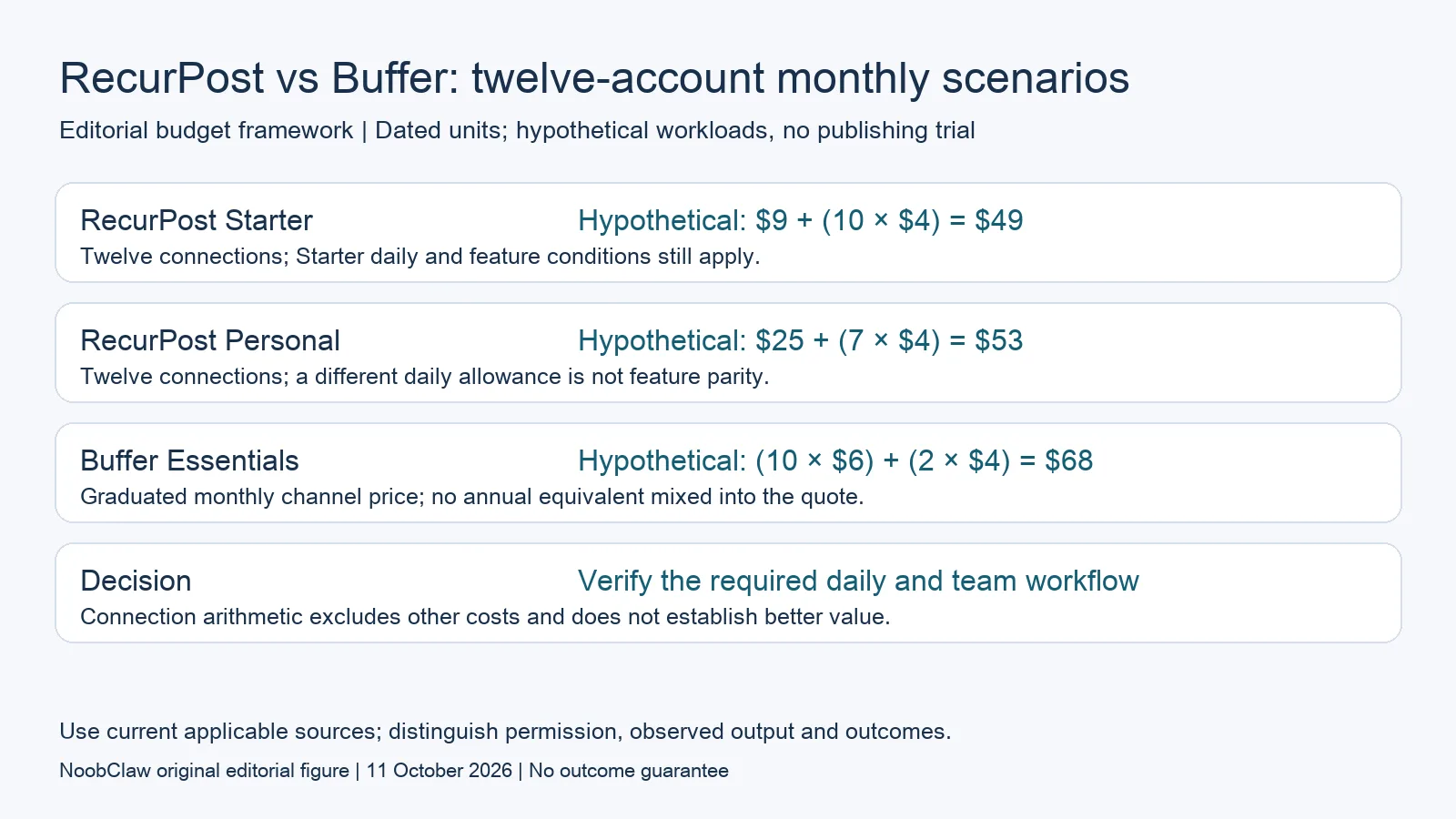
- RecurPost Starter: Hypothetical: $9 + (10 × $4) = $49. Twelve connections; Starter daily and feature conditions still apply.
- RecurPost Personal: Hypothetical: $25 + (7 × $4) = $53. Twelve connections; a different daily allowance is not feature parity.
- Buffer Essentials: Hypothetical: (10 × $6) + (2 × $4) = $68. Graduated monthly channel price; no annual equivalent mixed into the quote.
- Decision: Verify the required daily and team workflow. Connection arithmetic excludes other costs and does not establish better value.
Evaluate add-ons on the lowest eligible RecurPost plan
For a hypothetical twelve-account month, Starter plus ten extra accounts is $49; Personal plus seven is $53; Agency is $79. Those are three eligible capacity totals with different daily and workflow conditions. Starter’s ten-post daily maximum cannot be silently substituted for Personal’s twenty or Agency’s eighty. If the work requires a capability only present in a higher plan, the lower connection total does not make that plan an eligible replacement.
At twenty required accounts, the same connection arithmetic becomes $81 for Starter plus eighteen, $85 for Personal plus fifteen and $79 for Agency. Thus the claim that add-ons always beat upgrading is false for this published capacity example. Also distinguish a marginal extra account from an average included account: Agency’s $79 divided by twenty is $3.95, which is slightly below the $4 extra-account rate. None of these quotients establishes comparative quality, support value or the plan you should purchase without checking the required features.
Daily maxima and queue slots measure different resources
RecurPost states its maximum per social account per day. Treat that as a daily condition for each required account. An editorial planning example can put expected work beside each account rather than pooling everything into one total. If one intended account needs twenty-five daily posts and the others need only two, Personal’s twenty-post condition does not become satisfied because the average is lower. Confirm the exact formats and counting behavior for your intended work before treating a workload calculation as a complete capacity quote.
Buffer Free offers three channels and ten scheduled posts per channel at a time, with slots available again after publication. Its paid scheduling is subject to a five-thousand-post-per-channel fair-use condition. The quoted fair-use text does not establish an annual output window, so this review does not turn it into five thousand posts per year. A daily maximum, current queue capacity and a fair-use condition cannot be compared through one invented posts-per-month ratio. Keep each definition on its own line and check the operation that matters.
Compare approvals, creative help and unresolved permissions
Buffer Team includes unlimited team members and approvals; Essentials includes one user. RecurPost Agency includes three users, approval workflow and white-label reports, with additional teammates priced at $20 monthly. These are relevant shortlist conditions for client work, rather than proof that one provider handles all clients better. RecurPost’s current matrix and FAQ disagree about which plans include roles and permissions. Treat that exact role question as unresolved and ask for confirmation for the intended plan instead of certifying either conflicting statement.
Both providers document AI content assistance, and RecurPost’s matrix also lists an inbox and AI replies. Those named features do not prove that a finished asset is accurate or that every interaction is permitted on every network. Prepare a representative brief, inspect the returned draft and check the account-specific supported action. For a hypothetical nonprofit event announcement, the date, venue and registration destination need review even when a tool produces fluent copy. Keep the record of a creative draft separate from an approval and the actual publishing status.
Choose by the constraint you can demonstrate
Consider RecurPost when its recurring-content workflow, eligible daily capacity and required client controls fit. Consider Buffer when its supported channels, graduated pricing and relevant team workflow fit. These are decision criteria, not a tested recommendation that either provider produces more traffic. Use the exact account count and busiest-account workload, then add required services and any unresolved conditions. A price advantage for one hypothetical inventory does not become a universal best-value ranking.
If your missing deliverable is a narrated video rather than a scheduling entry, evaluate that production step independently. Define the input, needed format, review owner and intended destination. NoobClaw’s local record below documents one export with known limitations; it does not certify an integration, platform permissions or a client approval process. Buying more connections does not prove that you have more suitable content, and using different prompts does not guarantee unique outputs. Measure actual clicks or paid sales separately after an observed publication under the appropriate destination and time window.
Choose the output you need: post-caption drafts, opening-line drafts or spoken-script drafts. These text tools have a limited anonymous allowance; they do not transcribe or publish a video.
For the related content and workflow decisions, read RecurPost Pricing: Accounts, Daily Posts, Add-ons and X Fees and Social Media Tool Pricing Models: Compare Workflow Costs. Each review has its own evidence and scope.
A bounded example of a separate production output
NoobClaw publishes this article. Its public October 10, 2026 execution record documents one local creative run: 441 English input characters became a 32.6-second video at 1080 × 1920 pixels and 30 frames per second. This establishes one input and exported file. It does not establish scheduler integration, client approval, platform publication, rights clearance or audience response. Generic or off-topic footage needs scene-by-scene review; voice quality and footage rights were not independently approved. Use the record to evaluate a separate production output before assuming it replaces a publishing or coordination service.
The script-to-video guide and public creative execution record document a local video result, not external-platform publication. Check the current product offer against the supported action you need.
Frequently asked questions
Should I always add RecurPost accounts instead of upgrading?
No. At twenty connections, the published account-only examples make Agency $79 versus Starter-plus-add-ons $81 and Personal-plus-add-ons $85. Check the required daily and workflow conditions before comparing those prices.
Is Buffer’s paid rate flat at every account count?
No. Its current official monthly document publishes graduated bands. Apply each rate only to the channels in that band and keep annual billing separate. Do not multiply the starting rate by every channel indefinitely.
Do both providers require me to bring all content already written?
Both list creative assistance. Evaluate the actual output and supported workflow. This review does not establish that either covers every video-production requirement or that an AI draft is approved for publication.
Sources
Official material reviewed on October 11, 2026. Document conditions apply to their stated service and scope; the editorial examples are explicitly hypothetical.