RecurPost vs Later: Plans, Post Limits and Add-ons
- RecurPost monthly $9/$25/$79 includes 2/5/20 connected accounts.
- Later Social Sets contain one profile per supported platform, rather than any eight profiles.
- Later add-on availability and the paid Shorts exception require the current plan conditions.
RecurPost vs Later depends on the shape of your account inventory and the publishing work you need. RecurPost sells connected-account bundles with per-account daily maxima. Later uses Social Sets, plan-specific monthly counters and a distinct current paid YouTube Shorts allowance. This October 11, 2026 comparison corrects the units before comparing prices. It does not treat either product as a substitute for every creative production or approval task.
A lower starting price matters only when the plan includes your actual profiles, people and publishing allowance.
Count accounts and Social Sets using the actual network mix
RecurPost lists two connected accounts on Starter, five on Personal and twenty on Agency. Later’s current Starter, Growth and Scale configurations contain one, two and six Social Sets. A Social Set contains one profile for each supported platform; it does not let you replace unused networks with several Instagram profiles. The same total profile count can therefore require a different Later configuration.
For a hypothetical business with one Instagram, one Facebook and one YouTube account, RecurPost counts three accounts. A supported Later configuration can place those distinct platforms in one Social Set. For three Instagram profiles, Later instead needs three sets. These are inventory examples rather than a statement that every account type, publishing format or existing subscription has been connected successfully.
Inventory the destinations first, then verify the supported account types and connection route. Later currently lists eight supported Social Set platforms; X is not one of those listed platforms. A purchaser whose required destination is missing should investigate that requirement directly. Do not use the nominal eight-profile capacity as evidence that a required unsupported destination is available.
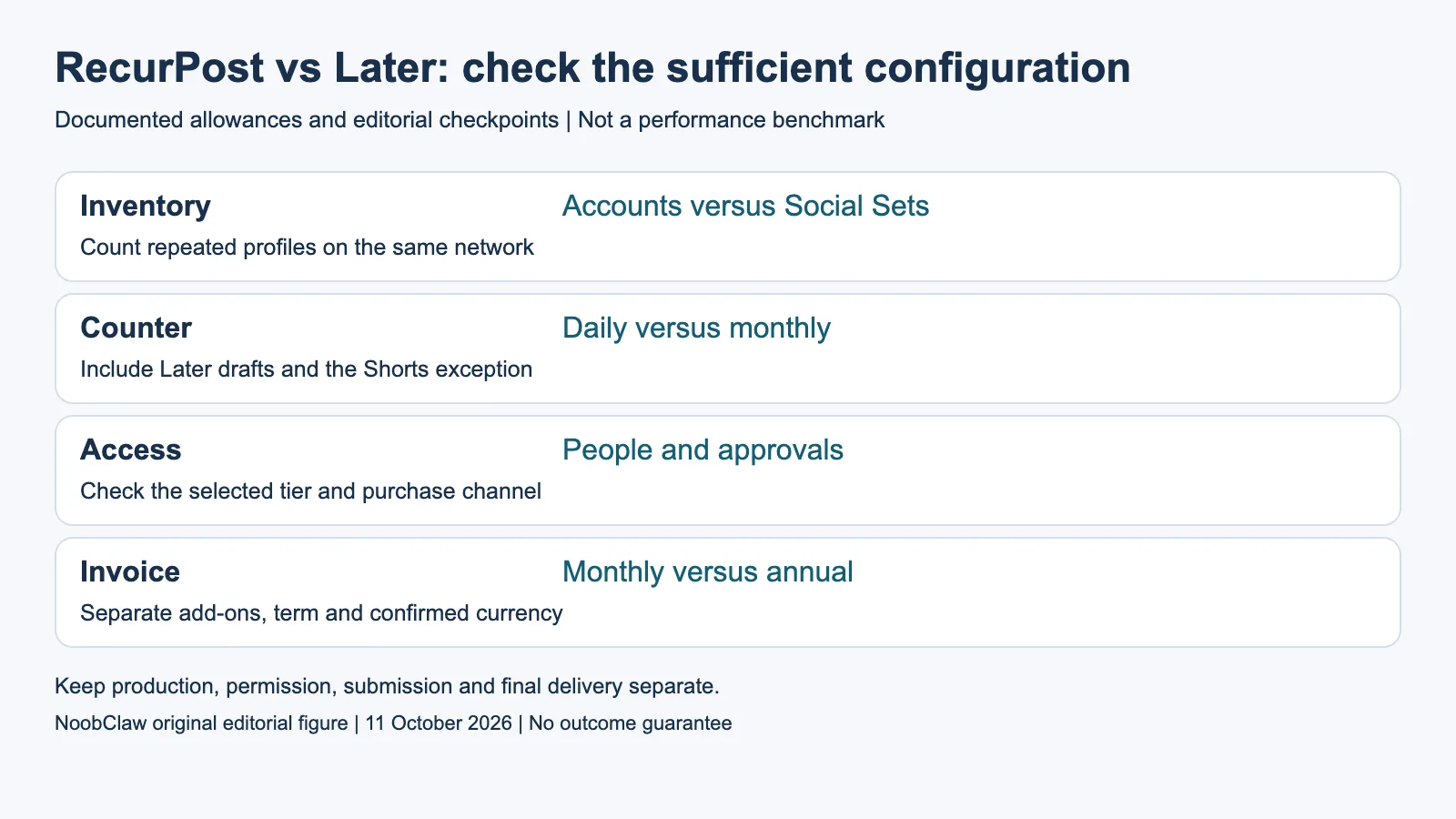
- Inventory: Accounts versus Social Sets. Count repeated profiles on the same network
- Counter: Daily versus monthly. Include Later drafts and the Shorts exception
- Access: People and approvals. Check the selected tier and purchase channel
- Invoice: Monthly versus annual. Separate add-ons, term and confirmed currency
The publishing counters require different workload checks
RecurPost’s current daily maximum is ten posts per social account on Starter, twenty on Personal and eighty on Agency. Those are per-account limits, separate from its unlimited stored library. A library containing thousands of items does not raise a daily maximum or establish that a destination will accept a particular post. The limit is a planning constraint rather than a recommended cadence.
Later’s current reference guide lists general monthly post allowances per profile of twelve on Free, thirty on Starter, 180 on Growth and unlimited on Scale. Drafts also occupy this counter. Its YouTube Shorts help article provides a specific exception: current paid plans have no Later posting limit for Shorts, while other plans have one Short per month. State that exception alongside the general row.
For a hypothetical ten-day plan with two items daily on each of three Instagram profiles, each profile requires twenty items, plus any drafts that occupy the Later counter. A monthly total and a daily maximum answer different questions. Check both the planned busiest day and the relevant monthly inventory. Neither advertised allowance guarantees platform acceptance, audience reach or successful automatic delivery.
Use actual billing terms and eligible add-ons
RecurPost monthly Starter, Personal and Agency are $9, $25 and $79. Its listed extra connected account costs $4 monthly and an extra user $20 monthly. A hypothetical solo three-account Starter configuration is therefore $13 before other required features or taxes. This arithmetic establishes a catalogue subscription amount, not equivalence to a Later team or client-review tier.
Later’s displayed annual monthly equivalents of $18.75, $37.50 and $82.50 are not evidence of a monthly invoice at those amounts. Keep the annual commitment, selected currency and account configuration beside the comparison. A visible starting price can change with additional Social Sets or users. Request the sufficient configuration rather than presenting an annual equivalent as the amount charged each month.
The current Later guide allows additional users and Social Sets only on current Growth and Scale subscriptions purchased through desktop. Starter and iOS subscriptions are excluded from that add-on route. Three Instagram profiles cannot be priced as Starter plus three purchased profiles. Use an eligible larger configuration and its actual quotation; do not assume that an add-on shown for one tier can be bought on another.
Approvals and preparation change the minimum sufficient tier
RecurPost Agency consistently lists client workspaces, approvals and white-label reports. Its current feature table and FAQ disagree about lower-tier role access: the table excludes Starter and Personal, whereas the FAQ describes availability from Starter. Confirm lower-tier permissions instead of treating the favorable sentence as tested entitlement. If formal client review is required, price the consistently supported configuration.
Later’s current guide includes approvals on Growth and Scale, with a stated exception for Instagram Stories. It also identifies separate user limits and plan gates. A plan that fits the account count may still miss a required reviewer or approval route. Describe the required destination and format when asking about approvals; a generic collaboration tick does not answer every workflow question.
Both products include preparation features, and RecurPost lists AI writing, image generation and an inbox. Later also includes content preparation features. The available sources do not establish equal finished-video production, equal editing quality or an accepted publishing benchmark. Evaluate the missing preparation task separately and verify its actual output before equating a scheduling subscription with a complete content operation.
Choose from a representative task and preserve unresolved facts
Later’s marketing trial is separate from the Free plan documented in its current help guide. The guide also distinguishes current and legacy subscriptions, so check availability for the actual account. RecurPost’s current FAQ says its fourteen-day trial does not become a permanent Free plan. These offer types should remain explicit; do not classify a temporary trial as an ongoing free scheduler.
Run one proposed acceptance task through the required draft, review and delivery route, checking the destination result and the actual subscribed tier. This article did not conduct that comparative test. NoobClaw’s public production record covers one local vertical export with audio and subtitles, including unsuitable visuals and unapproved voice and assets. That case supports reviewing creative output, not a claim that these schedulers were benchmarked.
RecurPost is a candidate when the account bundle, per-account daily maximum and confirmed features fit. Later is a candidate when the Social Set inventory, current allowance, format support and eligible review tier fit. Preserve the lower-tier RecurPost role mismatch and any unquoted Later configuration. A useful comparison ends with a sufficient configuration and evidence to check, rather than a universal cheaper-or-better winner.
For the related content and workflow decisions, read RecurPost vs Metricool: Accounts, Brands and Costs and Social Media Scheduler Prices: Compare the Actual Total. Each review has its own evidence and scope.
NoobClaw publishes this article. Its script-to-video guide and public creative execution record document a local video result, not external-platform publication. Check the current product offer against the supported action you need.
Frequently asked questions
Can three Instagram accounts share one Later Social Set?
No. A Social Set contains one profile per supported platform. Three Instagram profiles require three sets, with a configuration eligible for that capacity.
Do Later drafts count toward the monthly limit?
The current general plan reference says drafts count. Current paid YouTube Shorts has its own no-Later-posting-limit exception; other plans have one Short per month.
Does the advertised annual price equal a monthly bill?
No. An annual monthly equivalent describes the annual commitment. Compare it with another annual basis or obtain the current monthly invoice for the sufficient configuration.
Sources
Official material read on October 11, 2026. Prices identify their billing term; vendor allowances are not measured publishing results. Hypothetical inventory and cost examples are labeled; the public local-production record has its own limitations.