Social Media Schedulers for Agencies: Clients, Seats and Costs
- Count client accounts and required roles separately from the vendor’s maximum capacity.
- Buffer Team prices channels; SocialBee Pro counts workspaces and users per workspace.
- Later Social Sets and Hootsuite quote conditions require their own configuration checks.
A social media scheduler for agencies needs to match client access, review responsibility and the accounts actually managed. A low starting price is insufficient if the required permission or delivery method is missing. This October 11, 2026 comparison uses current official plan information from Buffer, SocialBee, Later and Hootsuite. It defines a buying and acceptance procedure without claiming a universal cheapest agency plan or a tested migration saving.
The useful agency configuration is the one that supports the required people, client boundaries and accepted deliverables.
Describe the client workflow before comparing subscriptions
List the clients, their destinations, required formats and the people who prepare, approve and publish each item. Record whether a client needs direct product access or can review through a separate agreed process. Those conditions affect role and workspace needs. Do not assume that an unlimited user count guarantees every approval permission or that a white-label report appears on every plan.
A hypothetical agency with four clients, twelve occupied profiles and three internal operators needs a different access design from a solo operator managing twelve profiles. If clients log in, check which drafts, accounts and reports each role can see. If they do not, define who records approval. These are proposed review questions, not claims that the products here all implement an identical client portal.
Include offboarding in the requirement: who can revoke a reviewer, transfer account ownership and retain a record of accepted work? Confirm the supported product behavior before committing the client workflow. A lower subscription component can be useful, but manual steps and an unusable approval configuration should be identified before calling the option sufficient. This review does not estimate those steps in billable hours.
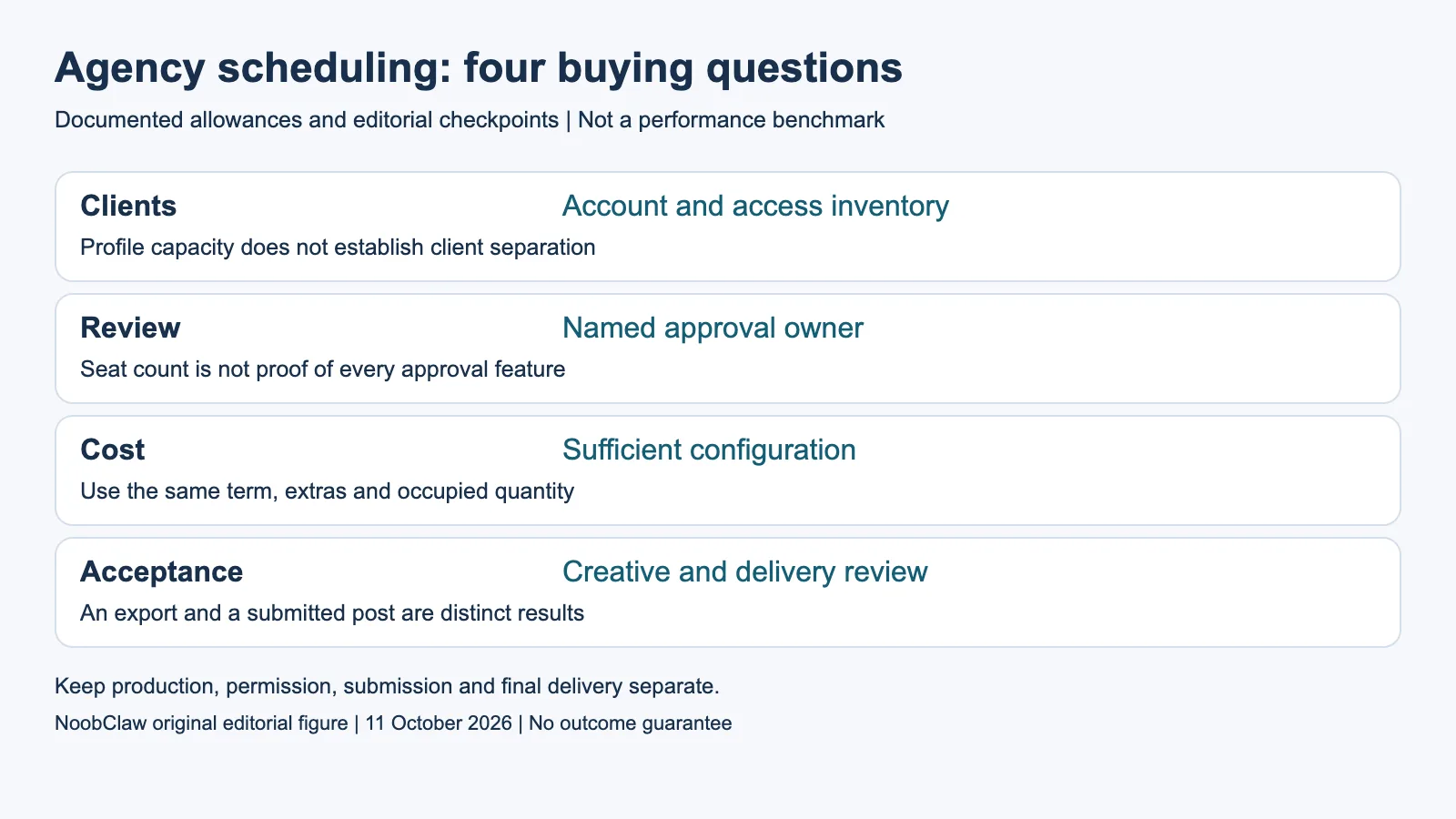
- Clients: Account and access inventory. Profile capacity does not establish client separation
- Review: Named approval owner. Seat count is not proof of every approval feature
- Cost: Sufficient configuration. Use the same term, extras and occupied quantity
- Acceptance: Creative and delivery review. An export and a submitted post are distinct results
Buffer Team and SocialBee Pro package different units
Buffer Team starts at $12 monthly per channel for the first ten channels, followed by $4 for the next fifteen, $3 for the next twenty-five and $2 above fifty. It advertises unlimited users. A hypothetical twelve-channel Team subscription therefore has a $128 monthly subscription component before tax. Confirm the role and approval features actually required rather than treating the unlimited seat headline as a complete access specification.
SocialBee Pro is $99 monthly for twenty-five profiles, five workspaces and three users per workspace. Bootstrap and Accelerate provide one workspace and one user per workspace, with five and ten profiles respectively. The per-workspace user unit matters: it is not simply three people across any number of client arrangements. Check the permission behavior needed inside those workspaces.
SocialBee lists monthly add-ons of $10 for a user, $10 for a workspace and $15 for a pack of five profiles. The captured current page does not establish a $5 individual-profile purchase. These amounts describe the listed add-ons and need a configured plan check. They do not demonstrate that buying extras is always cheaper than upgrading or that two vendors’ features are equivalent. Compare the actual required inventory and sufficient functionality before using the arithmetic.
Later sets and Hootsuite quotes need a configured comparison
Later Starter, Growth and Scale include one, two and six Social Sets, with one profile per supported platform in each set. The displayed total capacities are eight, sixteen and forty-eight, and included users are one, two and four. Several profiles from one network can require several sets. The captured annual monthly equivalents are $18.75, $37.50 and $82.50; those figures are for annual billing rather than month-to-month invoices.
Later’s annual extra Social Set amount is $11.25 per month equivalent. The current help guide restricts set and user add-ons to Growth and Scale desktop sign-ups; Starter and iOS purchases cannot add them. The extra-user card and FAQ also differ, requiring a configured quote. The general thirty and one-hundred-eighty monthly rows include drafts; current paid YouTube Shorts instead have no Later posting limit, with one Short per month on other plans. These are not ten-place reusable queues.
Hootsuite’s current FAQ gives Standard and Professional starting references of $99 and $199 per user per month under annual billing, with Advanced references extending to $399. The main selected plan amounts were not populated in the captured view. Confirm the actual product tier, currency, contract and user quote. The high end of a reference range should not be presented as the starting price of every Advanced purchase.
Check creation, review and reporting as separate requirements
The listed schedulers can include content-preparation or AI-assisted features; they should not be described as tools that only transfer finished files. The useful question is whether the selected plan produces the needed draft, permits the required review and supports the destination format. Identify each feature gate with its actual plan rather than attributing a whole vendor feature list to a low-cost entry tier.
For an agency needing reports, verify the reporting history, export behavior and access that clients require. For approval, check what happens after an edit, who can bypass the review and what is retained when work is rejected. These are proposed acceptance conditions. This article did not conduct a hands-on feature comparison, so a listed user or workspace count is not a certification that every agency workflow is available.
Test one representative post using the intended account and format. Preserve whether delivery was automatic, notification-assisted or rejected, then confirm the destination result. A queued item or successful API submission does not independently prove that the post is public. Neither profile capacity nor a paid plan overrides the destination’s eligibility and publication rules, and no scheduler outcome or reach advantage is inferred here.
Use a creative acceptance record before scaling client output
NoobClaw’s public execution record describes a single locally exported 32.6-second vertical video with audio and subtitles. It also records unsuitable visuals and unapproved voice and assets. For an agency, this case illustrates why the client’s factual and creative approval should precede publication. It is not a completed client campaign, a measured agency efficiency gain or a test of the scheduler products in this comparison.
If production is missing, evaluate the actual brief, source assets and exported creative. If distribution is missing, evaluate the supported account and delivery route. Those tasks can involve several products or product features, but they need their own evidence. NoobClaw’s local result does not establish credential isolation, account protection or universal destination permission, and no recurring posting frequency is justified by the case.
Shortlist the sufficient plans after the client inventory and required roles are known. Obtain quotes for unresolved billing or feature conditions, run the representative acceptance procedure and preserve the decision. Recheck when a new client, operator, format or reporting obligation changes the configuration. Price alone does not name a universal agency winner, and unused profile places are not evidence of extra audience or client value.
For the related content and workflow decisions, read Social Media Scheduler Prices: Compare the Actual Total and Social Media Scheduler for Multiple Accounts: Plans and Costs. Each review has its own evidence and scope.
NoobClaw publishes this article. Its script-to-video guide and public creative execution record document a local video result, not external-platform publication. Check the current product offer against the supported action you need.
Frequently asked questions
Is an unlimited user plan enough for client approvals?
Not by itself. Confirm the needed roles, account visibility, approval behavior and records on the selected tier. A seat allowance is a different fact from a complete client review workflow.
Can Later’s sixteen profiles be any sixteen accounts?
Its two Social Sets each contain one profile per supported platform. Several accounts on the same network may require additional sets; confirm the configured quote.
Which plan is cheapest for an agency?
That depends on occupied profiles, required users, client boundaries, features and the billing term. The worked subscription examples exclude tax and are not measured migration savings or feature-equivalent rankings.
Sources
Official material read on October 11, 2026. Prices identify their billing term; vendor allowances are not measured publishing results. Hypothetical inventory and cost examples are labeled; the public local-production record has its own limitations.