Kuaishou Automation: Tasks, Access and Platform Rules
- Content preparation, authorization, upload and publication have different results.
- Kuaishou documents separate app-capability, scope and file-readiness conditions.
- A local NoobClaw export does not establish Kuaishou publishing access or audience performance.
Kuaishou automation is best evaluated as a set of separate tasks: preparing content, obtaining the access required for a particular action, transferring the asset and confirming the resulting publication. A generated video or a successful sign-in does not demonstrate that all those steps have completed. Choose the workflow by the stage you need, rather than by a promise of account growth.
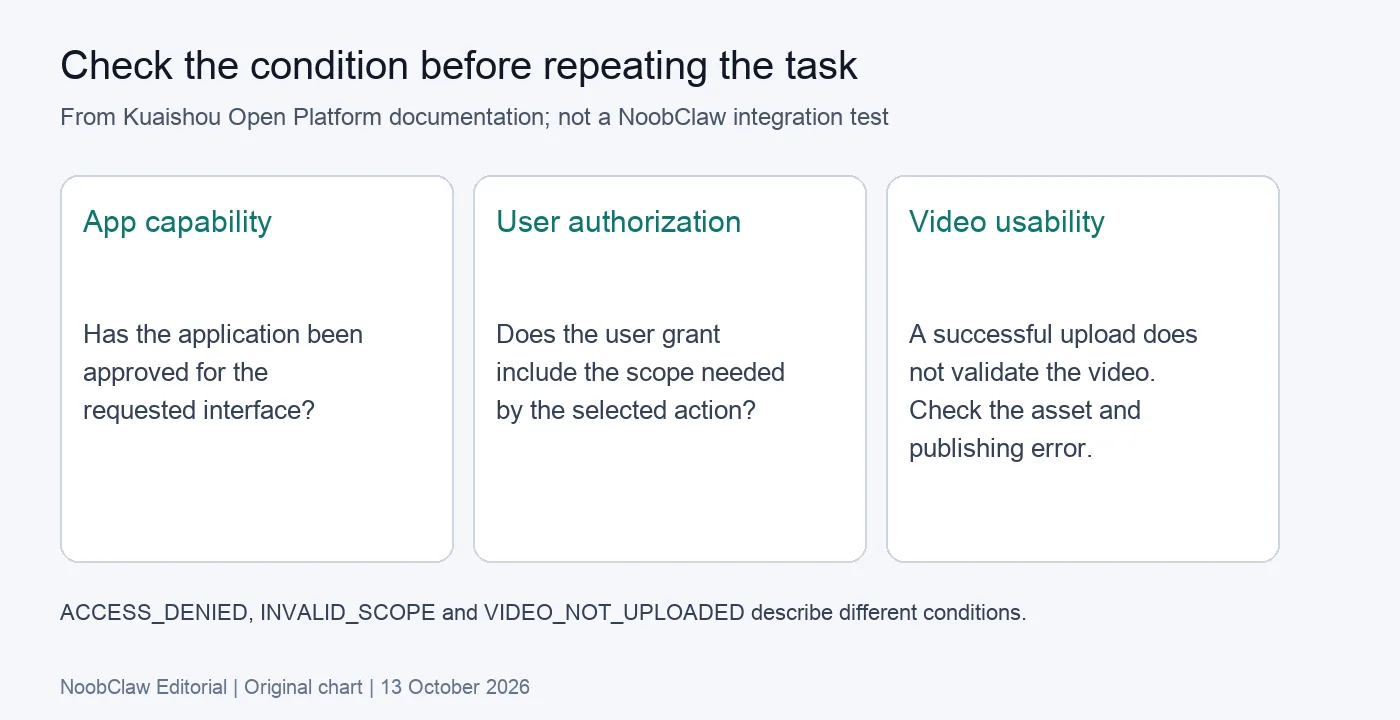
This matters for an operator preparing content across accounts. A task can fail because the application lacks an approved capability, because the user did not grant the required permission, or because the upload was not completed as expected. Those are different problems. Changing a caption or adding more accounts does not answer an authorization error.
Keep the asset result, access result and publication result as separate entries in your run record.
What do Kuaishou's audience figures tell an operator?
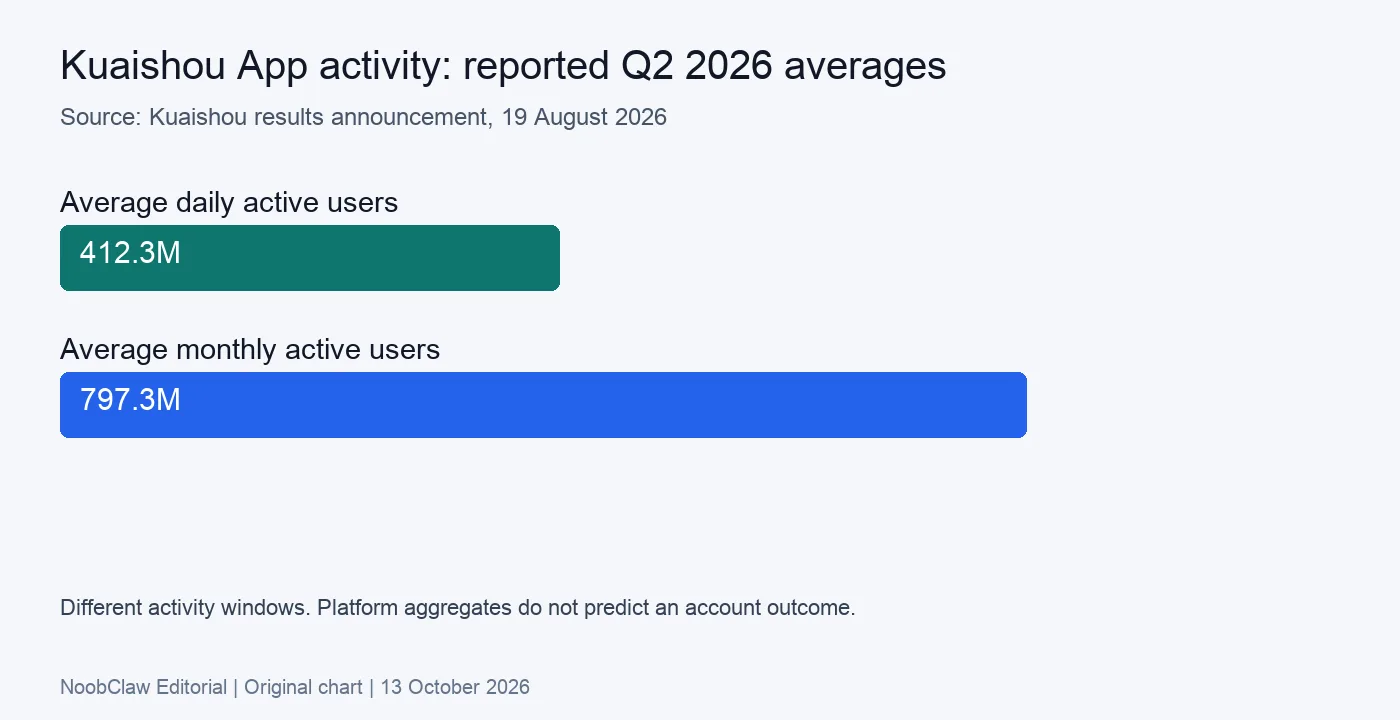
In its 19 August 2026 results announcement, Kuaishou reported average App daily active users of 412.3 million and average monthly active users of 797.3 million for the second quarter of 2026. These are platform-level audience measures for that reporting period, not forecasts for a creator's reach or a particular tool.
The useful planning question is narrower: does your intended audience use the platform in a way that fits the content you can produce? A large aggregate audience does not answer whether a particular product demonstration, language or topic will be useful. Review relevant public content and your own authorized reporting before treating platform scale as a reason to expand production.
Also identify the reporting population. The announcement discusses the Kuaishou App. It is not a count of the followers reachable through your account, nor proof that every user is available to a particular publishing workflow. Keep platform context separate from the evidence you need to approve a content or software decision.
What does the official video workflow actually separate?
Kuaishou's official video-creation documentation describes three stages: initiate the upload, upload the video and publish the video. The documentation makes file transfer and publication separate parts of the workflow. Depending on the transfer method, the stages can involve additional requests; “three stages” does not mean every implementation uses exactly three HTTP calls.
That separation gives an operator a useful test. Ask which stage a status message describes. A local file is an asset. An uploaded file is a transfer result. A publication response is evidence about the publishing request. Check the relevant identifier and the destination account instead of treating a general completion message as proof that the post is visible.
For software selection, ask whether the vendor shows these distinctions in its reporting. Can you tell whether an item was prepared, uploaded, published or skipped? Can you review the content before the publication decision? A workflow may still be useful if it deliberately stops at a local draft, provided that boundary is clear.
This article explains the official documentation's decision points. It does not report a NoobClaw-to-Kuaishou API integration test. An implementation should be assessed against its actual access route, capabilities and current platform conditions, rather than inferred from a similar-looking wizard or a successful export on another task.
Why can a token exist while the requested action is unavailable?
Kuaishou's website-application authorization documentation describes an OAuth 2.0 flow with user authorization and access tokens. The application requests scopes corresponding to capabilities. The existence of a token therefore needs to be read alongside the permissions available to the application and those the user actually granted.
The official FAQ gives concrete examples. For ACCESS_DENIED, it directs developers to check the scope needed by the API. For INVALID_SCOPE, it explains that the application must first have the corresponding interface capability approved before requesting the user's authorization. It also discusses VIDEO_NOT_UPLOADED: the upload API can return success without validating the video. Incorrect uploading can leave a damaged video that fails transcoding at the publishing stage. A completed transfer therefore does not, by itself, establish a usable uploaded asset.
These examples explain why repeating the same task can be the wrong response. If an application cannot request a capability, another user consent screen does not establish that the capability was approved. If the uploaded video is damaged and fails transcoding, editing the account's persona does not repair the asset. Diagnose the stated condition before changing unrelated content settings.
Our recommendation is to record the stage, the returned error and the action you intended. Keep sensitive credentials out of screenshots and support messages. Ask the provider to explain the required capability and the current result, using information you can share without exposing a token or an account secret.
Where can a content-generation workflow fit?
Content preparation can be valuable even when publication remains a separate task. A team may need a clearer script, an opening line or an assembled draft to review before choosing a destination. Keep that production job distinct from account access so that the asset can be evaluated on its own merits.
The NoobClaw script-to-video feature page describes an installed workflow for assembling a narrated local draft. Its supporting 10 October test record documents one English-script export with explicit limitations. The record does not establish Kuaishou publication, platform permission or audience performance.
That boundary helps with a purchase decision. If the missing step is preparing an asset, review the input, output and required credits. If the missing step is Kuaishou publishing, request evidence for that specific access route and format. A provider's list of platform names does not substitute for checking the task you intend to perform.
For additional context, the account-role planning article separates ownership, briefs and publication decisions. The content-generation analysis distinguishes text tools from video assembly. Use the corresponding Guide for the documented NoobClaw setup, rather than assuming it supplies a Kuaishou authorization procedure.
What should your review record contain?
Record the account owner, intended audience, source material and publication destination. Attach the draft you reviewed and the result of the stage you actually ran. If the workflow stops at a local file, label it that way. If it attempts publication, inspect the returned result and the destination using the controls available to you.
Review rights and platform requirements alongside the technical result. The Kuaishou Community Management Guidelines address user content and behavior. A technical success is not a substitute for assessing the material and the action under current requirements. This does not justify inventing a daily interaction quota or claiming that a particular timing pattern makes an account approved.
For a recurring workflow, preserve a clear stopping point when a prerequisite is missing. An unanswered access question should remain an access question in the record; an unavailable file should remain a transfer issue. This prevents later reporting from turning retries into successful posts or generated drafts into published work.
Evaluate audience and business results separately if you later publish. Describe the reporting period, account and available measures. A usable draft, a confirmed post and a relevant customer response are different observations, and the official audience figures do not supply the missing evidence between them.
FAQ
Does an access token prove that an app can publish videos?
Not by itself. Check the capability approved for the application, the scope required by the selected API and the user's actual grant. Kuaishou's FAQ distinguishes these conditions. A token should be evaluated within the task and permissions it represents.
Is a successful upload the same as a published post?
No. The official workflow separates transfer and publication. Its FAQ explains that upload success does not validate the video: incorrect uploading can damage the file, which then fails transcoding when publication is requested. Inspect the asset and the publishing error as well as the destination.
Does the documented NoobClaw video export prove Kuaishou support?
It proves one local export under specified settings, with review limitations. It does not prove Kuaishou publishing access, every platform-specific format or account growth. Ask for evidence about the exact task you need, while evaluating content preparation separately.
Sources
- Q2 and Interim 2026 Results — Kuaishou, 19 August 2026; checked 13 October 2026.
- Create a video — Kuaishou Open Platform, live documentation; checked 13 October 2026.
- Website application authorization — Kuaishou Open Platform; checked 13 October 2026.
- Common problems — Kuaishou Open Platform; checked 13 October 2026.
- Community Management Guidelines — Kuaishou, live rules; checked 13 October 2026.
Correction, 13 October 2026: this English page replaces a Chinese-language body. Unverified account-loss anecdotes, daily interaction prescriptions and claims about evading detection have been removed. The original URL is retained.