Postiz vs Blotato: Compare Account and AI Limits
- Account capacity and media allowances are separate limits.
- Monthly price examples depend on the number of used accounts.
- Self-hosting adds operating work and does not remove platform rules.
Postiz vs Blotato is a choice between two bundles whose account capacities and media allowances do not rise in the same way. Start with Postiz if you want to evaluate a scheduling workflow and its integration or hosting model. Start with Blotato if your comparison centers on its writing and media-generation bundle. Test the exact output and network you need before calling either product the cheaper complete solution.
The useful price question is not how many accounts you could theoretically connect. It is which allowance your actual work would exhaust first. This revision checks official pages on 10 October 2026, calculates a few bounded base-fee examples and separates account capacity from AI video production. We did not execute a competitive publishing or quality benchmark.
Price the actual account inventory first
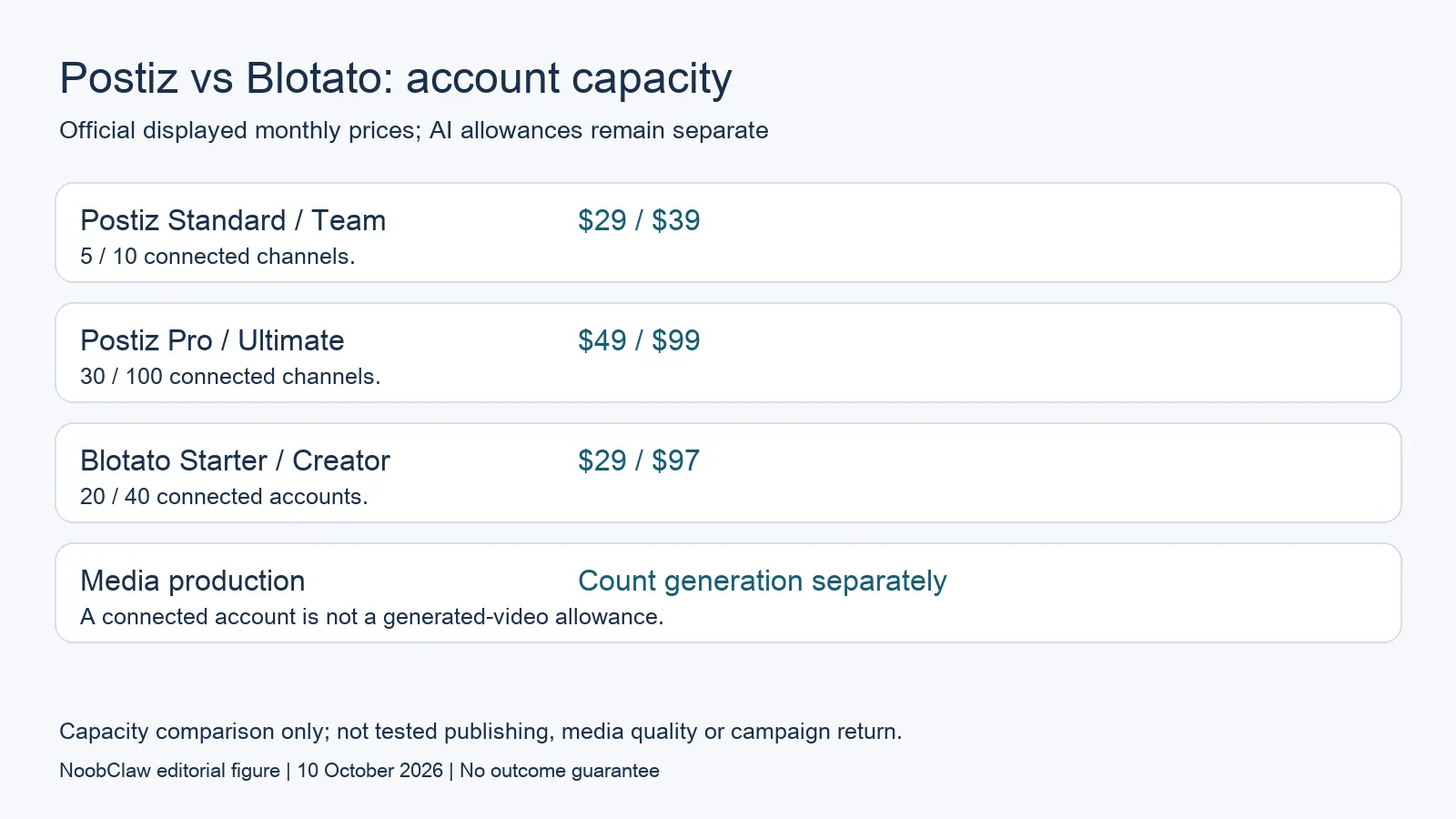
The current Postiz monthly cards list Standard $29 for five channels, Team $39 for ten, Pro $49 for thirty and Ultimate $99 for one hundred. The Blotato monthly cards list Starter $29 for twenty accounts and Creator $97 for forty. Both sources have additional production conditions, so the account figures alone do not describe an equivalent finished-content service.
| Illustrative connected accounts | Postiz listed account-capacity tier | Blotato listed account-capacity tier |
|---|---|---|
| 5 | Standard, $29/month | Starter, $29/month |
| 20 | Pro, $49/month | Starter, $29/month |
| 30 | Pro, $49/month | Creator, $97/month |
| 40 | Ultimate, $99/month | Creator, $97/month |
This table selects the displayed tier whose account capacity accommodates each hypothetical inventory. It excludes tax, media requirements and other feature gates. It is not an observed customer bill or a recommendation to buy solely on account count. Blotato's Agency card does not provide a separately stated account limit in the snapshot, so we do not assign it an invented capacity or extend the curve beyond the documented figures.
At twenty used accounts, the two base fees above imply $49 ÷ 20 = $2.45 and $29 ÷ 20 = $1.45 per used account. At thirty they imply roughly $1.63 and $3.23. Those are our arithmetic, rounded to cents. The direction changes because the next account-capacity tier differs, not because one vendor suddenly becomes a better creator or delivers a higher campaign return.
A tier change explains a bill. It does not explain content quality or account outcomes.
Keep an inventory with the actual network, profile type, owner and required post format for each connection. A nominal capacity of thirty does not establish that thirty of your chosen account types support the same publication method. Verify the connection and format in the current product before migrating. Account authorization also remains a separate task from transferring an editorial calendar.
Account limits and AI production have different meters
Postiz's current pricing page lists three AI videos and sixty minutes of AI video clipping on Standard, with different allowances on larger plans. That makes an older blanket description of Postiz as a scheduler with no media-generation offering unreliable. A listed allowance is still a vendor specification; this comparison does not establish the clip quality, source matching or output suitability of either product.
Blotato lists media credits alongside its account caps and distinguishes writing from those credits. Do not compare a video count, clipping minutes and credits as though they were the same unit. Ask what the intended job consumes, what settings affect consumption and what happens when the output needs another attempt. A quota can look generous while covering a different operation from the one you need.
Define “finished” before you estimate monthly output. A generated script, an exported file and a publishable edit have different acceptance criteria. If a scene is unrelated to the narration, the job is not complete for an editor merely because the export succeeded. Include the human correction work in your trial notes rather than assuming that a credit or video allowance represents approved deliverables.
For a real purchasing test, retain the original script, input assets and chosen settings. Check the output at the level that matters to your work: narration accuracy, readable subtitles, source rights and the intended aspect ratio. Do not claim one vendor is faster or cheaper per approved video unless you have measured comparable settings, attempts and review requirements. We have no such cross-vendor measurements here.
Integrations and self-hosting change who maintains the workflow
Postiz also offers a self-hosted route, documented in its official documentation. That is a separate deployment and operating decision from paying for a hosted tier. Software access does not make hosting, upgrades, secrets management, backups or platform app configuration costless. Decide who will maintain those responsibilities before treating self-hosting as a zero-cost equivalent of the hosted subscription.
For either hosted product, test your intended integration with a non-sensitive draft before depending on an unattended production run. Specify the input fields, destination account, approval point and expected result. Ask how a failed action is reported and whether a retry can create a duplicate. These are evaluation questions; the presence of an API or an integration badge does not independently settle them.
Permissions deserve their own review. A writer, a reviewer and the person authorized to publish may be different people. Verify who can reconnect an account or change a destination, then check what record remains after an edit. Do not conclude that a broad team-members allowance necessarily supplies the exact approval sequence your client requires.
A migration rehearsal should include one representative post and one future scheduled item. Keep the original assets and timezone, and record what does not transfer. Historical analytics, draft structure and existing account authorizations can have different export paths. Ask the vendor to identify those paths; a successful new connection is not evidence that your existing history has moved with it.
The third option belongs only to the missing creation step
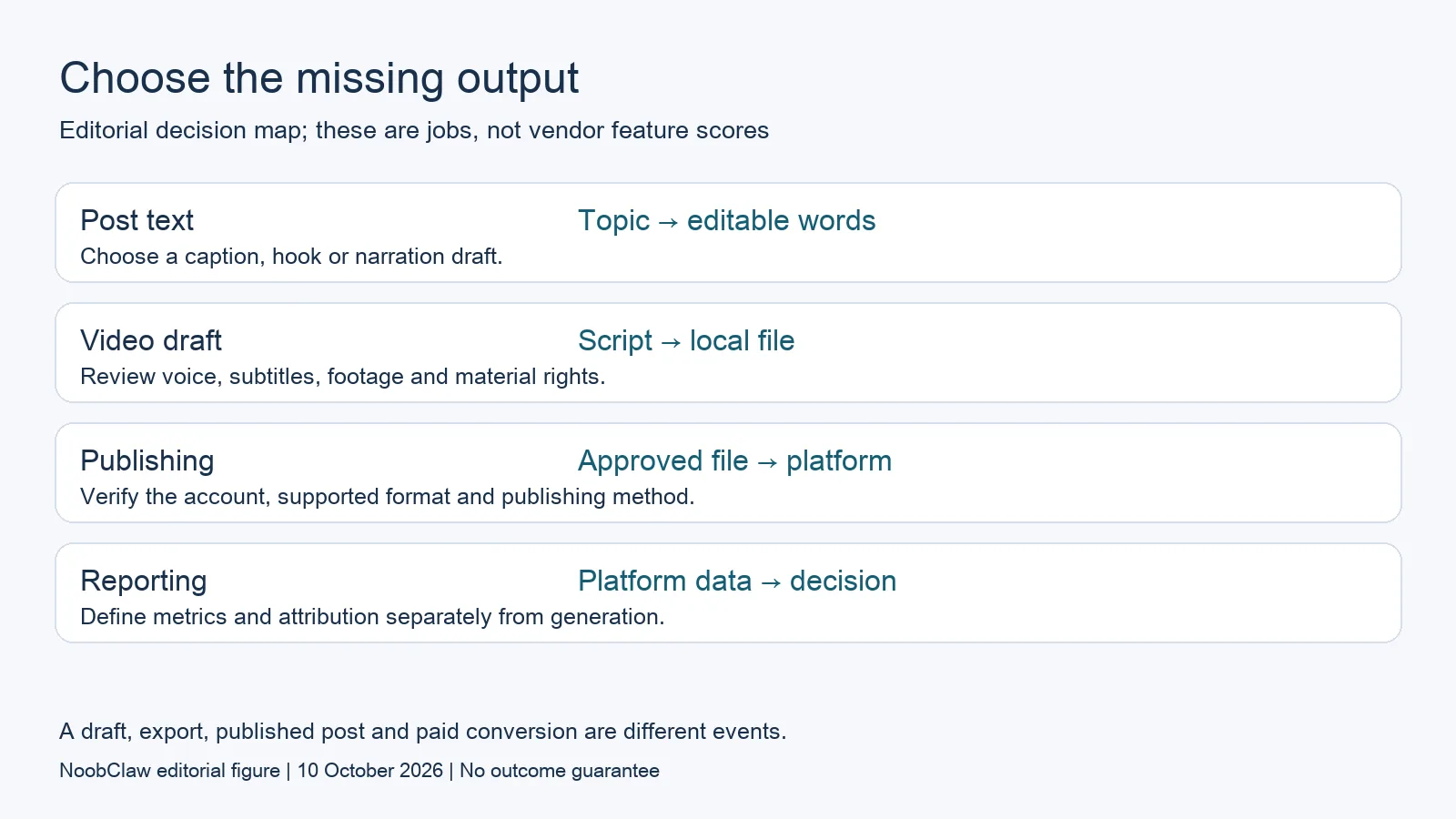
NoobClaw publishes this comparison and is a commercial desktop product. In our single recorded test, a supplied 441-character script became one local 32.6-second video at 1080×1920. Some stock footage was generic or off-topic. That record establishes a particular export, not automatic publication, audience growth or a benchmark against Postiz and Blotato.
Consider the desktop script-to-video workflow if assembling a narrated draft is your missing job. Read its Guide for installation, profile, network, credit and review conditions. Keep your scheduling or reporting requirement separate: the case does not justify presenting NoobClaw as a complete substitute for a hosted collaboration suite.
If grouping accounts by client is the unresolved price question, the Postiz vs Metricool analysis addresses channels and brands. For a channel-priced alternative, read Blotato vs Buffer. The purpose is to choose a fitting path, not to manufacture a reason to replace a tool that already performs your needed work.
A sensible final decision records the accepted output, the complete quoted bill and the remaining manual responsibilities. If a trial cannot answer one of those questions, keep it unresolved. A month of low-volume production may favor a different bundle from a month of heavy video work, even when the account inventory has not changed.
FAQ
Is Postiz always cheaper once I have many accounts?
No. The base-fee direction depends on the documented account tiers, and production or feature requirements can change the required plan. The table is a capacity calculation for stated inventories, not a universal threshold.
Can I compare Blotato credits directly with Postiz videos?
No fixed conversion is established here. Quote the same output, settings and expected attempts in each product, and include the review needed before treating an export as usable.
Does self-hosting remove all ongoing costs?
No. It changes who operates the system. Account configuration, infrastructure, backups and maintenance still need an owner; hosted-plan prices do not establish the total cost of a self-hosted deployment.
Sources
- Postiz pricing — vendor, checked 10 October 2026.
- Postiz documentation — vendor, checked 10 October 2026.
- Blotato pricing — vendor, checked 10 October 2026.
- NoobClaw local export record — first-party case, 10 October 2026.
Editorial correction, 10 October 2026: the article now includes Postiz's current media allowances, removes unsupported universal price and feature conclusions, and separates observed NoobClaw export from publishing and campaign outcomes.