
X Auto Poster: What X Allows, What the API Charges Per Post, and When Native Scheduling Is Enough
- Autocomplete for "x auto poster" returns a full family today. So does "twitter auto poster". The phrase that returns nothing is "auto post tool", under either brand name.
- X developer policy says services that post must follow the Automation Rules, and must never post identical or substantially similar content across multiple accounts.
- The X API is pay-per-usage with no free tier: $0.015 to create a post, $0.200 for a post with a URL, and 100 post creations per 15 minutes per user (docs.x.com, 2026-09-17).
- One account, a few posts a day: native scheduling covers it. Needing a posting API only makes sense once you are publishing from another system.
You want your X account to keep posting on the days you cannot. So you search for an x auto poster, and you get a GitHub bot, a WordPress plugin, a scraping marketplace listing and a scheduling blog, all on page one, all describing a different thing.
They are different things, and they carry different costs and different rules. This guide sorts them using what X itself publishes: the developer policy, the API pricing and rate-limit pages, and the changelog, all fetched on 17 September 2026.
The search word changed, and it was not the brand
A day earlier, a check of twitter auto post tool returned an empty autocomplete, which we wrote up in a piece on that empty search. The obvious theory was the rename: people stopped saying Twitter.
Today's check does not support that theory. Here is what Google autocomplete returned on 2026-09-17:
- x auto poster: x auto post, x auto post github, x auto post bot, automatic x poster, x automatic post.
- twitter auto poster: twitter auto poster bot ai, twitter auto post free, bot, github, discord, ai, api, extension.
- twitter auto post tool and x auto post tool: both empty.
So the brand is not what matters. The noun is. People do not search for a "tool" that posts; they search for a poster or a bot, and the words github, api, discord and extension sit next to it. That describes someone who wants a thing that runs by itself, and who is open to building it. The older Twitter family is still larger and more specific (it includes free, ai and extension), which suggests the habit has not fully moved to the new name, but both names work.
The rename did not break the search. The word "tool" did. People searching for an auto poster want something that runs, not something they operate.
What X's own documents say about automated posting
X's help-centre page on automation returned HTTP 403 to our fetcher today, so we do not quote the Automation Rules page itself. The X Developer Policy did load, and it is explicit:
- "Services that perform write actions, including posting Posts, following accounts, or sending Direct Messages, must follow the Automation Rules."
- "Never post identical or substantially similar content across multiple accounts."
- "Never perform bulk, aggressive, or spammy actions, including bulk following."
- "Always get explicit consent before sending people automated replies or Direct Messages."
- "If you're operating an API-based bot account you must clearly indicate what the account is and who is responsible for it."
Read those carefully and a pattern appears. None of them forbids scheduling your own posts. What they forbid is repetition across accounts, bulk social actions, unsolicited automated contact and undisclosed bots. That matches what we found when we looked at X's automation rules and AI agents: the line is drawn around machines doing the social part, not around software pressing publish.
The cross-account rule is the one that ends most multi-account setups. An auto poster that pushes the same post to five accounts is doing, word for word, the thing the policy names.
What an X auto poster costs through the API in September 2026
If your auto poster uses the official API, it is on the meter. The X API pricing page describes "pay-per-usage pricing with no subscriptions", with credits bought upfront in the Developer Console. There is no free tier on the page. The write prices as listed on 2026-09-17:
| Action | Price | 30 days at 3 posts a day |
|---|---|---|
| Create a post | $0.015 per request | 90 requests = $1.35 |
| Create a post with a URL | $0.200 per request | 90 requests = $18.00 |
| Read posts | $0.005 per resource | depends on what the tool reads |
The link surcharge is the number that surprises people. A link post costs about thirteen times a plain post, so an auto poster that shares blog links is a very different bill from one that posts text.
Rate limits sit on top, and the rate-limit page lists post creation at 100 per 15 minutes per user and 10,000 per 24 hours per app. The same page adds: "You can be within rate limits but still incur usage costs, or hit rate limits without additional cost." For the history of how the free tier disappeared, see X API free tier limits.
One change from this month is worth knowing if your poster handles video. The X API changelog for 1 September 2026 lists video posting at "up to 20 minutes and 8 GB" for default accounts and "up to 125 minutes and 16 GB" for Premium or verified accounts, enforced on the authenticated user's status rather than the developer's tier.
Three kinds of X auto poster, and which one you actually need
1. X's own scheduler. The compose box on X has a built-in scheduling option, and it costs nothing. Its help page was not retrievable today, so we will not quote limits for it. For one account posting a few times a day, it is usually enough, and it cannot trip a cross-account rule because it only ever knows about one account.
2. API-based posters. The GitHub bots, the WordPress plugins and most schedulers. You either bring your own developer credentials and pay the meter above, or a vendor passes the cost through in its plan. This is the right choice when posts are generated elsewhere (a CMS, a spreadsheet, a pipeline) and need to reach X without a person in the loop. Which schedulers still support X after the pricing change is covered in this comparison.
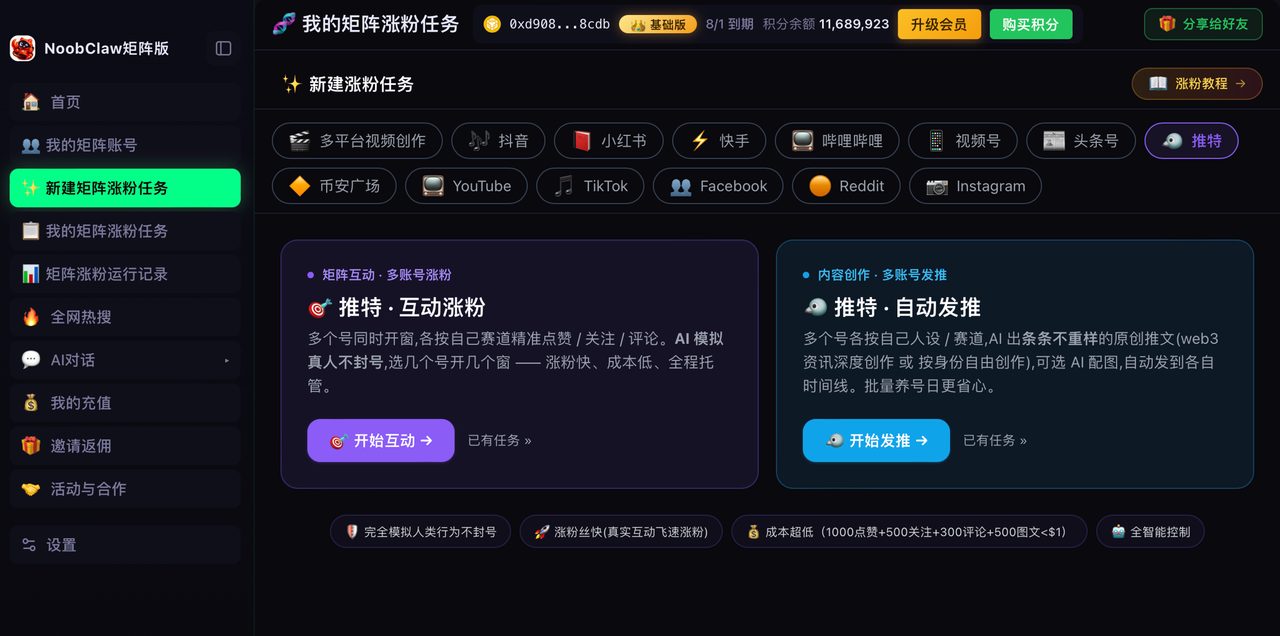
3. Browser-session posters. These publish through a logged-in browser rather than the API, so there is no per-post meter. NoobClaw's X auto posting is in this group: it runs in a local browser logged into your own account, gives each account its own profile and persona, writes each post separately, and keeps a human pace. Posting through a browser does not put you outside X's rules. The platform judges what the account does, not which door the request came through, so the cross-account and bulk-action lines apply exactly the same way.
A checklist before you switch any auto poster on
- Count your accounts. One account: try native scheduling first. More than one: confirm every account gets its own content, not a copy.
- Price your link ratio. If most posts carry a URL and you use the API, budget at the $0.200 rate, not the $0.015 one.
- Check who pays the meter. Your own credits, or bundled in a vendor plan? Find the answer on the pricing page, not in a sales chat.
- Turn off automated replies and DMs unless people have explicitly asked for them. That is a named policy line.
- If the account is a bot, label it and name who is responsible, as the developer policy requires for API bots.
- Watch the first week by hand. Read what went out. An auto poster that nobody reads is how duplicate or broken posts survive for a month.
FAQ
Is there a free X auto poster?
X's native scheduler is free. API-based posters are not free to run, because the X API is pay-per-usage with no free tier listed on its pricing page as of 17 September 2026. A "free" poster either uses your paid credentials, absorbs the cost in another plan, or does not use the API.
Can I use one auto poster for several X accounts?
You can, but the developer policy says to "never post identical or substantially similar content across multiple accounts." The safe setup is one voice and one content stream per account. How many accounts X tolerates is a separate question, covered in how many X accounts you can have.
Will an auto poster get my X account suspended?
Scheduling your own posts is not what the policy targets. The named risks are duplicate content across accounts, bulk follows or likes, unsolicited automated replies and undisclosed bots. Stay away from those and the tool is not what decides your account's fate. Your content is.