Loomly vs Hootsuite: Annual Prices, Accounts and Team Costs
- Loomly Beyond’s annual monthly equivalent is $249; Hootsuite Professional’s published annual-billing reference starts at $199 per user before tax.
- A one-user sixty-connection illustration has a $50 monthly-equivalent difference, not the $133 difference obtained by mixing Loomly monthly with Hootsuite annual billing.
- Hootsuite’s account allowance does not make additional people free, and Professional is not the right approval-plan substitute when Advanced is required.
- Loomly documents Beyond additions in ten-account increments. Public card limits and missing add-on prices do not establish an automatic upgrade rule for every configuration.
Loomly vs Hootsuite depends on accounts, people and the billing commitment. Comparing Loomly’s $332 month-to-month Beyond price with Hootsuite’s $199 annual-billing Professional reference makes the difference look larger than a matched-term comparison. This review corrects that comparison and gives a buyer a concrete inventory and workflow check. Official sources were reviewed on October 11, 2026. We have not purchased either plan, completed a checkout or tested their account-specific permissions.
Match the billing term, then count connections and required people. A cheaper illustrative total does not certify the workflow.
Count actual connections and people before using the plan card
Loomly lists Starter at $65 monthly or a $49 annual monthly equivalent, with twelve connected social accounts and three users. Beyond lists $332 monthly or a $249 annual equivalent, with sixty accounts and unlimited users. The annual totals are $588 and $2,988 before tax. A monthly equivalent requires the stated annual commitment; it is not the same purchase as a monthly subscription.
Its account-definition help counts each connection to a calendar. Connecting the same social account to another calendar counts again, while a person participating in several calendars still counts as one user. Client approvers can count toward the user allowance. An agency should preserve the actual connection list and invited people rather than assuming that the number of different account names is its entire billable inventory.
Loomly’s customization help documents Beyond account additions in increments of ten through subscription management. The absence of an add-on amount in the public pricing cards does not prove additions are impossible or that every larger portfolio must use Enterprise. The exact configured price remains a purchase check. The published Starter boundary is twelve accounts; do not turn that card into an unsupported claim about every possible custom arrangement.
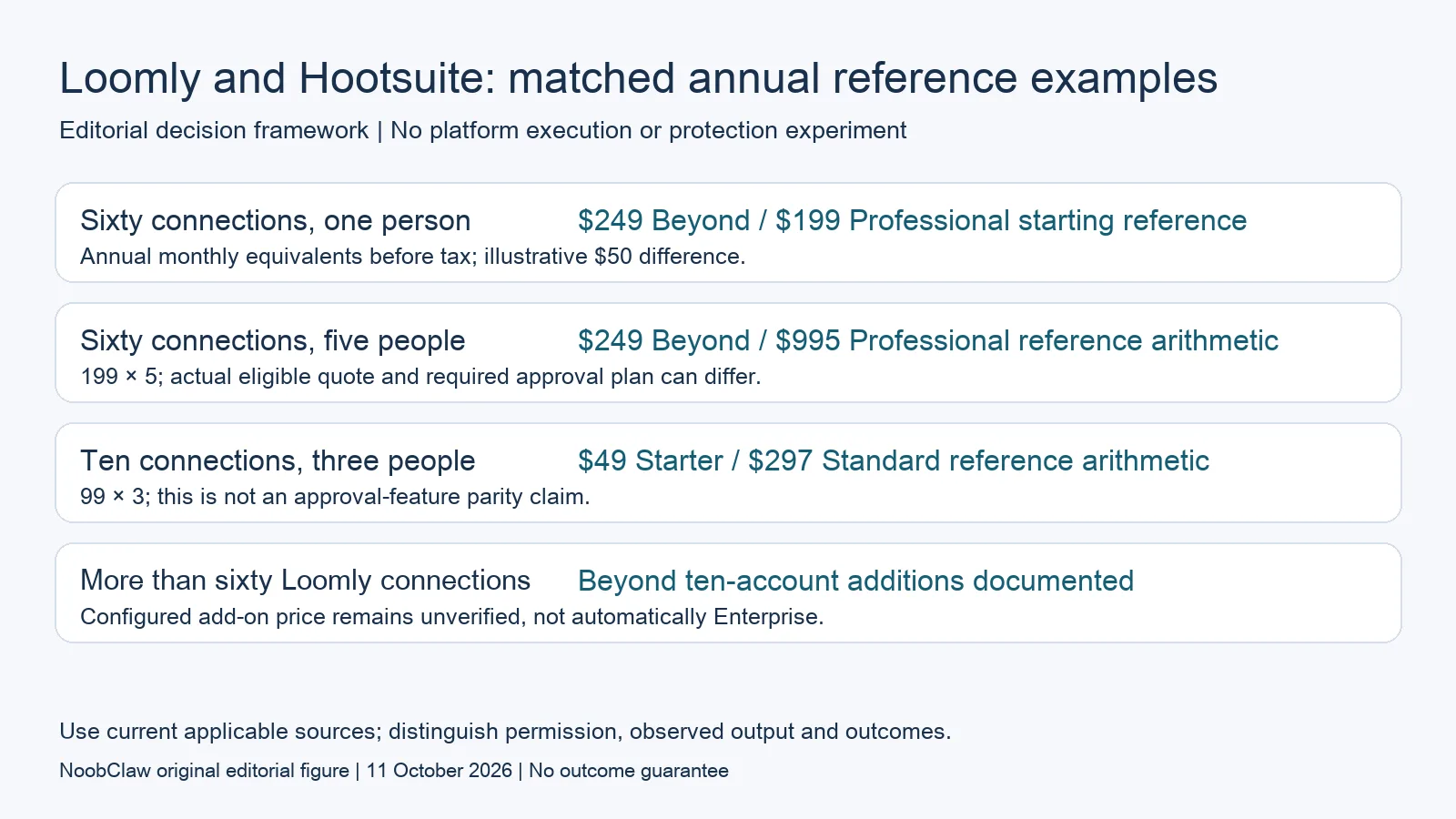
- Sixty connections, one person: $249 Beyond / $199 Professional starting reference. Annual monthly equivalents before tax; illustrative $50 difference.
- Sixty connections, five people: $249 Beyond / $995 Professional reference arithmetic. 199 × 5; actual eligible quote and required approval plan can differ.
- Ten connections, three people: $49 Starter / $297 Standard reference arithmetic. 99 × 3; this is not an approval-feature parity claim.
- More than sixty Loomly connections: Beyond ten-account additions documented. Configured add-on price remains unverified, not automatically Enterprise.
Use the same annual commitment and state the price boundary
Hootsuite’s plans page labels the public card references per user with annual billing before tax. Its FAQ says Standard starts at $99, Professional starts at $199 and Advanced ranges up to $399. The last figure is an upper reference, not a verified minimum or an authenticated team quote. Standard lists ten accounts; Professional and Advanced list unlimited accounts. Required people still need seats.
For an illustrative sixty-connection portfolio with one person and no Advanced-only requirement, compare $249 annual monthly equivalent on Loomly Beyond with the $199 Professional starting reference. The arithmetic difference is $50. Their annual reference totals are $2,988 and $2,388. A configured checkout, tax or different required features can alter the actual purchase; this is not a claim of a customer saving.
For five people, multiplying the same Professional starting reference by five produces $995 monthly equivalent or $11,940 annually. Beyond’s listed unlimited-user bundle remains $249 or $2,988 in this illustration. For ten connections and three people, Starter’s $49 annual equivalent can be compared with three $99 Standard references, totaling $297. These examples expose the seat denominator; they do not certify identical capabilities or that either tier satisfies required approvals.
Separate an account allowance from the approval requirement
Hootsuite’s current lineup places content approvals on Advanced; Professional’s larger account allowance is not evidence of the same approval access. Some features also require multiple seats. Obtain the selected plan and seat configuration for the required review step before calculating a decision. Buying unlimited account capacity alone does not establish who can block or release a post.
If the requirement is simply one operator preparing posts for many connections, a lower illustrative starting reference can matter. If the requirement is a client’s mandatory sign-off, repeat the comparison with the eligible approval configuration. Do not carry a Professional-only price into that second decision without verifying eligibility. We have no controlled trial showing which vendor is faster, safer or better at that work.
An annual commitment can narrow a displayed difference without reversing a particular illustrative ordering. In the sixty-account one-user case, the mixed-term difference is $133, while the annual-reference difference is $50. That arithmetic does not support saying the annual discount widens the gap. Record the exact term on each side so another reviewer can reproduce the comparison rather than trusting a headline price.
Evaluate the actual approval and production requirement
A buying brief should name the people who can edit a draft, approve its exact version, schedule it and release it. For an illustrative team with one required client approver, ask whether another user can publish before approval and what happens after an approved asset is edited. Preserve the account, format and observed permission result. This is an evaluation method, not a report that either vendor passed our authenticated test.
Do not assume that managing many accounts makes content variation the dominant workload. A team may instead spend its time on client review, inbox replies, reporting or producing assets. Record a small sample of the actual work before assigning the bottleneck. A cost-per-connection calculation describes the subscription under its assumptions; it does not measure editorial quality, time saved, publication reliability or commercial return.
Both products in this comparison advertise help with content preparation. An assistant’s presence does not establish equal output quality or guarantee that generated material is accurate or cleared for its intended use. Keep the input, draft, reviewed asset and delivered status separate. Compare the feature that supports the named job rather than describing all schedulers as accepting finished content with no creation or adaptation capabilities.
Test the requirement, then keep the content-production result separate
Use one representative asset in a buyer’s evaluation: the intended account type, required format, accepted draft, named approver and actual returned delivery status. Record whether the asset was only prepared, scheduled or successfully published. A trial allowance is not proof of paid throughput, and an account allowance does not describe every supported format. A missing or failed check remains unverified rather than being counted as a success.
Check the renewal term, the people still needing access and any configured additions before committing. An operator who needs only a text draft or a local creative file may have a different task from a team buying inbox, approval and reporting features. Avoid substituting a smaller production tool for a complete social-management requirement unless the omitted work has an identified solution.
NoobClaw’s public execution record below documents one local video export. It does not establish a Loomly or Hootsuite connection, an approved client workflow, external publication, browser protection or an audience response. The relevant question is whether that separate preparation step helps the intended operator. No per-account revenue, reach increase or account-survival result is inferred from the file.
Choose the output you need: post-caption drafts, opening-line drafts or spoken-script drafts. These text tools have a limited anonymous allowance; they do not transcribe or publish a video.
For the related content and workflow decisions, read Loomly vs Sendible: Workspace Prices, Users and Posting Limits and Loomly vs Buffer: Account Bundles, Channel Rates and Teams. Each review has its own evidence and scope.
The separate local production record and its limits
NoobClaw publishes this article. Its public October 10, 2026 execution record documents one local creative run: 441 English input characters became a 32.6-second video at 1080 × 1920 pixels and 30 frames per second. This establishes the input and exported file for that run. It does not establish a client approval, scheduler integration, external publication, copyright clearance, monetization acceptance or audience response. Generic or off-topic stock footage still requires scene-by-scene review, and voice quality and footage rights were not independently approved. Use the bounded example to assess the separate production step. A paid plan or a successful export cannot replace review of the actual asset, the rights available for its intended use and the destination’s requirements.
NoobClaw publishes this article. Its script-to-video guide and public creative execution record document a local video result, not external-platform publication. Check the current product offer against the supported action you need.
Frequently asked questions
Does annual billing widen the sixty-account one-user gap?
The cited annual references give $249 minus $199, or $50 monthly equivalent. The $133 figure mixes Loomly monthly with Hootsuite annual billing and is not a matched-term comparison.
Is $399 a verified Advanced minimum?
No. The current FAQ describes a range up to that figure. Verify the selected plan, seats and actual quote for the required approval workflow.
Does more than sixty Loomly accounts automatically require Enterprise?
Its customization help documents Beyond additions in ten-account increments. The actual configured amount remains a purchase check; a public card alone does not establish every possible arrangement.
Sources
Official material reviewed on October 11, 2026. Document conditions apply to their stated service and scope; the editorial examples are explicitly hypothetical.