Loomly vs Sendible: Workspace Prices, Users and Posting Limits
- Sendible’s USD monthly Core, Plus and Premium references are $35, $99 and $199, with one, three and seven workspaces and six profiles per workspace.
- Loomly’s monthly Starter and Beyond references are $65 and $332, with twelve and sixty connections and three or unlimited users.
- Sendible’s public Premium calculator changes seven workspaces to eight and $199 to $224 monthly, with forty-eight profiles; this is a panel observation, not a checkout result.
- Sendible’s feature table uses daily sends per workspace, while its FAQ uses per-user wording and an older plan name. Neither a universal five-hundred-send ceiling nor a multiplied throughput guarantee
Loomly vs Sendible can now include actual public USD monthly prices: Sendible’s interactive panel supplies prices after currency and term are selected. Workspace counts are not dollar amounts. The comparison also needs the people, account connections and required approval features, with a separate check of a conflict in Sendible’s daily-send wording. Official sources and the public calculator were reviewed on October 11, 2026. No authenticated trial, checkout or comparative publishing experiment is claimed.
Count the purchased bundle and the inventory actually used. A daily-send unit must be resolved before it becomes a throughput forecast.
Count actual connections and people before using the plan card
Loomly lists Starter at $65 monthly or a $49 annual monthly equivalent, with twelve connected social accounts and three users. Beyond lists $332 monthly or a $249 annual equivalent, with sixty accounts and unlimited users. The annual totals are $588 and $2,988 before tax. A monthly equivalent requires the stated annual commitment; it is not the same purchase as a monthly subscription.
Its account-definition help counts each connection to a calendar. Connecting the same social account to another calendar counts again, while a person participating in several calendars still counts as one user. Client approvers can count toward the user allowance. An agency should preserve the actual connection list and invited people rather than assuming that the number of different account names is its entire billable inventory.
Loomly’s customization help documents Beyond account additions in increments of ten through subscription management. The absence of an add-on amount in the public pricing cards does not prove additions are impossible or that every larger portfolio must use Enterprise. The exact configured price remains a purchase check. The published Starter boundary is twelve accounts; do not turn that card into an unsupported claim about every possible custom arrangement.
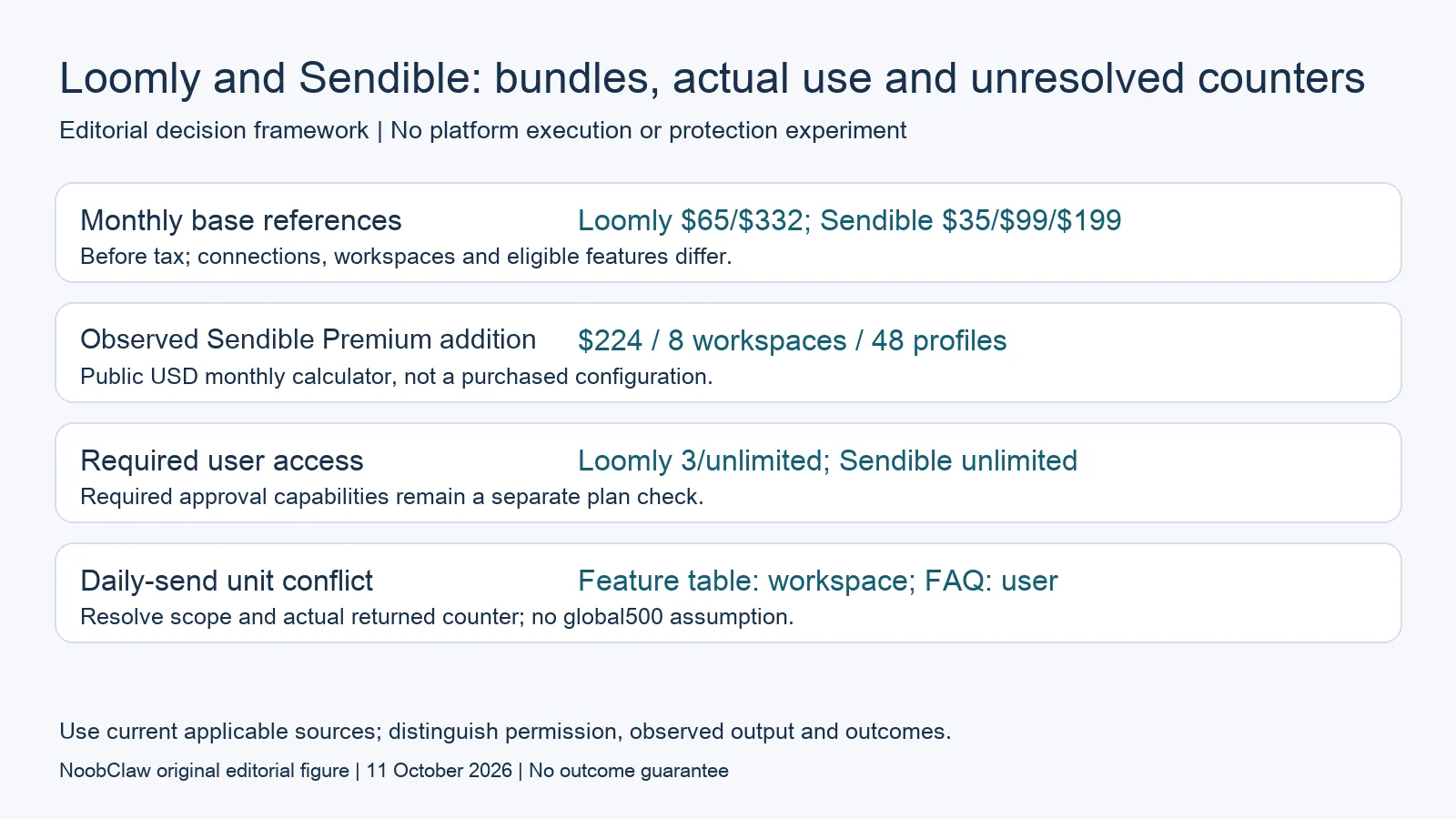
- Monthly base references: Loomly $65/$332; Sendible $35/$99/$199. Before tax; connections, workspaces and eligible features differ.
- Observed Sendible Premium addition: $224 / 8 workspaces / 48 profiles. Public USD monthly calculator, not a purchased configuration.
- Required user access: Loomly 3/unlimited; Sendible unlimited. Required approval capabilities remain a separate plan check.
- Daily-send unit conflict: Feature table: workspace; FAQ: user. Resolve scope and actual returned counter; no global500 assumption.
Select the term and observe the configured workspace price
In the public USD monthly panel, Sendible Core, Plus and Premium list $35, $99 and $199 for one, three and seven workspaces. The current structure contains six profiles per workspace and unlimited users. Its Plus card adds assignment and approvals. We selected the public currency control rather than treating one, three and seven as prices from the neighboring workspace column.
Increasing Premium from seven to eight workspaces changed the displayed price from $199 to $224 monthly and the capacity from forty-two to forty-eight profiles. This is a directly observed public-panel result. It is not an authenticated invoice, a guarantee of future renewal terms or proof that every required feature is eligible. Additional workspaces can increase capacity without automatically changing the base tier; a feature requirement can still make a different tier necessary.
For a hypothetical portfolio needing forty-eight actual connections, the observed Premium-plus-one-workspace configuration can be compared with Loomly Beyond’s monthly reference. But first specify how the portfolio should be divided into client workspaces, which people need access and whether each format is supported. Extra slots are purchased capacity, not a result delivered to a client. We do not report a customer migration or a savings outcome from this example.
A normalized connection cost can help if the denominator is explicit
A bundle’s purchase unit and its utilization are different useful measurements. A buyer can report both the workspace bill and the effective bill per connection actually used. That normalized figure is meaningful when the selected tier, term, actual use and spare capacity are stated. It becomes misleading if maximum profile slots are presented as accounts already used, or if incompatible billing commitments are divided as though they were identical.
For an illustrative six-profile one-workspace operator, Sendible Core’s $35 monthly reference divided by six is about $5.83 per used profile. Loomly Starter’s $65 divided by the same six actual connections is about $10.83, with six listed connection slots remaining. This arithmetic does not establish that Core supplies an approval requirement or that either service fits every account format. State the requirement before treating a lower normalized number as the decision.
For an illustrative forty-eight-connection inventory, $224 divided by forty-eight is about $4.67, while $332 divided by forty-eight is about $6.92. These are matched monthly reference calculations before tax and under the stated inventory. Different client boundaries, repeated calendar connections, required permissions or configured quotes can change the relevant comparison. A per-connection column supplements the purchased bundle; it does not make workspace organization irrelevant.
Resolve the daily-send unit instead of dividing one global ceiling
Sendible’s current feature table names its daily-send limit per workspace. Its FAQ instead uses per-user language and mentions the older Traction plan name. The table’s tier references are 100, 200, 300, 500 and 500. Those internally different units do not establish that all Enterprise profiles share one global five-hundred-send ceiling. They also do not certify an aggregate volume obtained by multiplying the table’s number by every workspace.
Before buying for a high-volume requirement, obtain the applicable current subscription, counting unit, reset time and meaning of a send. Ask how a post targeting several profiles is counted and whether failed attempts consume the allowance. Preserve the actual returned counter or written current explanation. We have not resolved that vendor wording through an authenticated publishing test; this article does not assign a verified total daily capacity to a portfolio.
A platform restriction, a vendor counter, a waiting queue and a successfully published item should be recorded separately. A larger bundle does not itself prove that each destination will accept all planned work. Conversely, a vendor-side quantity limit can differ between configurations. Start from the exact error or counter and the applicable source instead of predicting delivery solely from the number of connected profiles.
Evaluate the actual approval and production requirement
A buying brief should name the people who can edit a draft, approve its exact version, schedule it and release it. For an illustrative team with one required client approver, ask whether another user can publish before approval and what happens after an approved asset is edited. Preserve the account, format and observed permission result. This is an evaluation method, not a report that either vendor passed our authenticated test.
Do not assume that managing many accounts makes content variation the dominant workload. A team may instead spend its time on client review, inbox replies, reporting or producing assets. Record a small sample of the actual work before assigning the bottleneck. A cost-per-connection calculation describes the subscription under its assumptions; it does not measure editorial quality, time saved, publication reliability or commercial return.
Both products in this comparison advertise help with content preparation. An assistant’s presence does not establish equal output quality or guarantee that generated material is accurate or cleared for its intended use. Keep the input, draft, reviewed asset and delivered status separate. Compare the feature that supports the named job rather than describing all schedulers as accepting finished content with no creation or adaptation capabilities.
Choose the output you need: post-caption drafts, opening-line drafts or spoken-script drafts. These text tools have a limited anonymous allowance; they do not transcribe or publish a video.
For the related content and workflow decisions, read Loomly vs Hootsuite: Annual Prices, Accounts and Team Costs and Planable vs Buffer: Workspace Prices, Channels and Approvals. Each review has its own evidence and scope.
The separate local production record and its limits
NoobClaw publishes this article. Its public October 10, 2026 execution record documents one local creative run: 441 English input characters became a 32.6-second video at 1080 × 1920 pixels and 30 frames per second. This establishes the input and exported file for that run. It does not establish a client approval, scheduler integration, external publication, copyright clearance, monetization acceptance or audience response. Generic or off-topic stock footage still requires scene-by-scene review, and voice quality and footage rights were not independently approved. Use the bounded example to assess the separate production step. A paid plan or a successful export cannot replace review of the actual asset, the rights available for its intended use and the destination’s requirements.
NoobClaw publishes this article. Its script-to-video guide and public creative execution record document a local video result, not external-platform publication. Check the current product offer against the supported action you need.
Frequently asked questions
Are one, three and seven Sendible prices?
They are base workspace counts. The current public USD monthly panel shows $35, $99 and $199 for Core, Plus and Premium; record currency, term and selected configuration.
Does Enterprise have one global five-hundred-send daily ceiling?
The current table and FAQ use different units. That wording does not establish one global total or a verified multiplied allowance. Resolve the actual subscription counter before forecasting throughput.
Is cost per used connection meaningless for a workspace product?
No. It can describe utilization if the purchased bundle, actual inventory, spare capacity and required features are explicit. It cannot substitute for the actual workflow requirement.
Sources
Official material reviewed on October 11, 2026. Document conditions apply to their stated service and scope; the editorial examples are explicitly hypothetical.