Planable vs Planoly: Workspace Prices, Sets and Approvals
- Planable monthly references are $39 Basic and $59 Pro per workspace before tax. Basic has four pages, Pro ten; created-entry limits are separate.
- Planoly’s public USD switch shows Starter, Growth and Pro at $16, $28 and $55 monthly, versus $14, $24 and $47 annual monthly equivalents.
- Planoly includes one, two or six social sets and one, two or six users respectively. A set can cover one account on each of eight listed networks.
- Planable Basic’s optional approval differs from Pro’s required approval. Planoly advertises AI assistance and direct posting where supported, with reminder delivery for other cases.
Planable vs Planoly is most useful when you identify the accounts, people and approval rules that the subscription must cover. A Planable workspace and a Planoly social set count different things. Comparing their headline prices without an inventory can hide a destination or reviewer requirement. This review uses current public pricing and help material, includes a direct observation of Planoly’s USD billing switch and separates documented features from an authenticated workflow test. Sources were reviewed on October 11, 2026. The examples are hypothetical, and displayed USD references are before any applicable checkout tax.
A social set is a bundle of destinations; it is not evidence that all eight destinations are active or publish every format automatically.
Read the monthly switch and the inventory together
The public Planoly page was observed with annual billing selected at $14, $24 and $47 per month equivalent for Starter, Growth and Pro. Switching to monthly billing displayed $16, $28 and $55. These are current public USD displays, not an authenticated checkout or a tax-inclusive quote. Annual equivalents should remain labelled as annual billing. Planable’s pricing help separately gives $39 and $59 monthly per workspace, with yearly invoices of $390 and $590.
Planoly’s three paid cards include one, two and six social sets and one, two and six users respectively. Its FAQ defines a set as one account each on Instagram, Facebook, X, Pinterest, LinkedIn, YouTube, Threads and TikTok. A set can therefore describe eight possible connections without establishing that a particular customer has connected all eight. It also does not establish identical format support or automatic delivery to each network.
For a hypothetical client with Instagram, Facebook and TikTok, one set may describe the intended account bundle, subject to actual eligibility and format support. A second Instagram account is a different inventory question because a set allows one account per listed network. Count destinations at that level before assuming the cheapest card covers the client. Keep the people who need access alongside the account inventory.
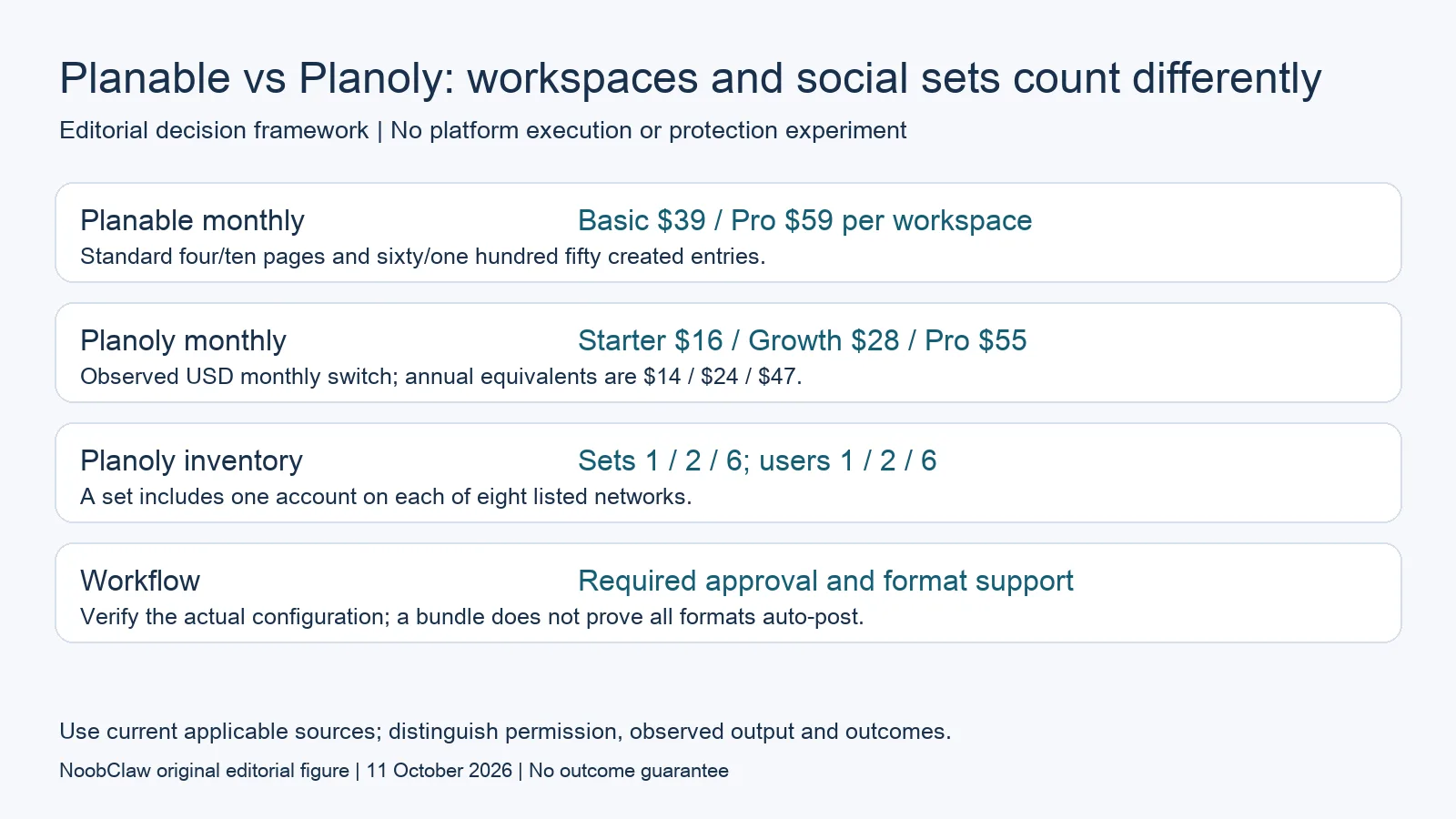
- Planable monthly: Basic $39 / Pro $59 per workspace. Standard four/ten pages and sixty/one hundred fifty created entries.
- Planoly monthly: Starter $16 / Growth $28 / Pro $55. Observed USD monthly switch; annual equivalents are $14 / $24 / $47.
- Planoly inventory: Sets 1 / 2 / 6; users 1 / 2 / 6. A set includes one account on each of eight listed networks.
- Workflow: Required approval and format support. Verify the actual configuration; a bundle does not prove all formats auto-post.
Compare the documented approval requirement
Planable’s approval help identifies optional approval and required approval on Pro, with multi-level review in Enterprise. Basic’s optional approval allows scheduling and publication without a recorded approval. Its paid plans list unlimited users, but an invitation count does not establish enforcement. If the client agreement requires release only after approval, evaluate that requirement explicitly rather than equating comments or calendar access with an enforced decision.
The Planoly pricing page does not by itself demonstrate that the intended configuration enforces the same required-approval rule. That is an unresolved evaluation question here, not evidence that Planoly has no collaboration or approval feature. Check its current help and permitted trial for the actual roles, decision record and publishing restriction the relationship needs. A pricing comparison should not turn missing detail on one public page into a universal absence claim.
Use a harmless sample involving an editor, client contact and revised asset. Ask what the client can see, who can schedule and whether a rejection prevents the next step under the selected settings. Preserve what the test establishes and what it leaves open. A colleague’s comment on version two does not automatically approve a changed version three, regardless of which calendar the team prefers.
Account for add-ons, AI and delivery conditions
Planoly’s FAQ says Starter cannot add sets or users and requires a move to Growth or Pro for that expansion. Its listed monthly add-ons are $10 per set and $5 per user on Growth, versus $8 and $3 on Pro. For an illustrative Growth subscription with one extra set and one extra user, $28 plus $10 plus $5 is $43 monthly before tax. That illustration does not establish identical permissions or an annual add-on invoice.
Planoly lists keyword-based caption suggestions and other AI assistance across its paid plans. It also distinguishes direct posting where platform support permits it from reminder-based completion for other cases. Do not describe it as a product without AI writing or promise automatic posting of every supported account and format. Its FAQ mentions a mobile free option with ten uploads per month and a fourteen-day trial, which are separate from the paid cards’ unlimited uploads.
Unlimited uploads are not proof of unlimited accepted publications, unlimited client approval or a universal production allowance. A team evaluating a video should check the file, format, account type and available delivery route. Record any manual completion that the workflow requires. Differences in that requirement may matter more than a small subscription saving when the client needs a specific destination or release procedure.
Check the creation counter and the actual upgrade route
Planable’s post-count help article says paid limits depend on creation date in the current calendar month. Reaching that limit prevents new creation until reset, while editing, reviewing, approving, scheduling and publishing existing entries remain available. Free has fifty created entries in total, not fifty renewed each month. Removing an entry does not restore that lifetime free allowance. A publication date therefore does not identify when a creation cap will be reached.
The newer pricing help article lists an extra-post add-on for Pro at $49 monthly or $490 annually and describes five hundred created posts a month across all workspaces. This company-wide description differs from the standard per-workspace limits. Ask the vendor to confirm how that option applies to your configuration and how it interacts with standard quotas before buying it. Additional capacity is not necessarily a requirement to buy another workspace, and the older post-count article does not describe this newer add-on.
For a hypothetical workspace using four pages with thirty newly created entries for each, the inventory is four connections and one hundred twenty entries. All four Basic page slots are used and its sixty-entry monthly creation limit is exceeded. It is not half the page allowance. The date the cap is reached depends on entry creation. If the same proposed publications are entered in advance, a publication calendar alone cannot establish the creation month or the reset available to that workflow.
Evaluate a representative workflow before committing
Use harmless draft material representing the account, format, asset version and reviewer roles you intend to use. Inspect what each collaborator can see and change, what happens after rejection, and whether a changed approved asset needs a renewed decision. Check the required destination and its actual format support. These are suggested evaluation questions, not a report of an authenticated trial or a guarantee that every account in a market is supported.
Keep the public reference, billing interval, currency, connected-account inventory and any required add-ons together. A displayed monthly equivalent on an annual plan carries an annual payment commitment. A public USD amount also does not establish the final tax or a completed US checkout. Request confirmation when documentation differs, when a limit’s scope is unclear or when the requested workflow is not demonstrated. Mark an unresolved question as unverified rather than treating missing documentation as a missing feature.
Record the accepted version and the live destination separately after a permitted evaluation. A planned row, an approval and a successful publication are different observations. The vendor’s general feature list cannot establish your configuration, and a short sample cannot establish reliable savings or higher reach. Select the product that meets the actual requirements you observed, then review those requirements when the team, destinations or creation inventory changes.
Choose the output you need: post-caption drafts, opening-line drafts or spoken-script drafts. These text tools have a limited anonymous allowance; they do not transcribe or publish a video.
For the related content and workflow decisions, read Planable vs Buffer: Workspace Prices, Channels and Approvals and Client Content Calendars: Approvals, Templates and Plan Limits. Each review has its own evidence and scope.
What the local production record establishes
NoobClaw publishes this article. Its public October 10, 2026 execution record documents one local creative run: 441 English input characters became a 32.6-second video at 1080 × 1920 pixels and 30 frames per second. This establishes the input and exported file for that run. It does not establish a client approval, scheduler integration, external publication, copyright clearance, monetization acceptance or audience response. Generic or off-topic stock footage still requires scene-by-scene review, and voice quality and footage rights were not independently approved. Use the bounded example to assess the separate production step. A paid plan or a successful export cannot replace review of the actual asset, the rights available for its intended use and the destination’s requirements.
NoobClaw publishes this article. Its script-to-video guide and public creative execution record document a local video result, not external-platform publication. Check the current product offer against the supported action you need.
Frequently asked questions
Are the Planoly annual card numbers monthly charges?
They are monthly equivalents with annual billing selected. The public USD monthly switch showed $16, $28 and $55 on October 11, 2026. Checkout tax and the selected configuration still need checking.
Does one Planoly set mean eight active accounts?
It describes room for one account per listed network. It does not demonstrate that all eight are connected, support the needed format or complete publication automatically.
Does a missing approval detail prove Planoly lacks approvals?
No. This pricing page does not establish equivalence to the required rule being evaluated. Check current help and a permitted workflow test before deciding.
Sources
Official material reviewed on October 11, 2026. Document conditions apply to their stated service and scope; the editorial examples are explicitly hypothetical.